
What if the right sound system starts with the room, not the equipment schedule? Professional sound system design is a performance-led engineering process. Intended use, room acoustics, listener positions, and project constraints shape the system before equipment selection begins.
It’s understandable to focus first on speakers, microphones, and control equipment. But selecting components before defining performance goals can leave important questions unanswered: Will coverage reach the intended listening areas? Can users operate the system in the ways the room requires? Have acoustic, architectural, construction, and network needs been coordinated?
This guide provides a practical framework for answering those questions. Learn how to define requirements, compare design approaches against room conditions and use cases, and evaluate performance criteria. It follows the work from project brief through acoustic analysis, engineering, technical documentation, multidisciplinary coordination, and commissioning. The result is a clearer way to judge whether a proposed system fits the project and how each design decision relates to operation.
Key Takeaways
- Define performance goals around users, room conditions, and operating requirements before selecting equipment.
- Use acoustic conditions and loudspeaker coverage needs to assess how a system may serve its intended listening areas.
- Compare system approaches by use case, room conditions, operating modes, integration needs, and project constraints.
- Professional sound system design connects requirements, engineering, documentation, coordination, and commissioning across the project lifecycle.
- Align technical drawings and design decisions with architecture and construction coordination to support project delivery.
What Professional Sound System Design Delivers to a Project
Professional sound system design is the engineering process of defining and coordinating an audio system around its users, spaces, and operational requirements. It establishes what the system must do, where and how it will be used, and which constraints shape the design before equipment is selected.
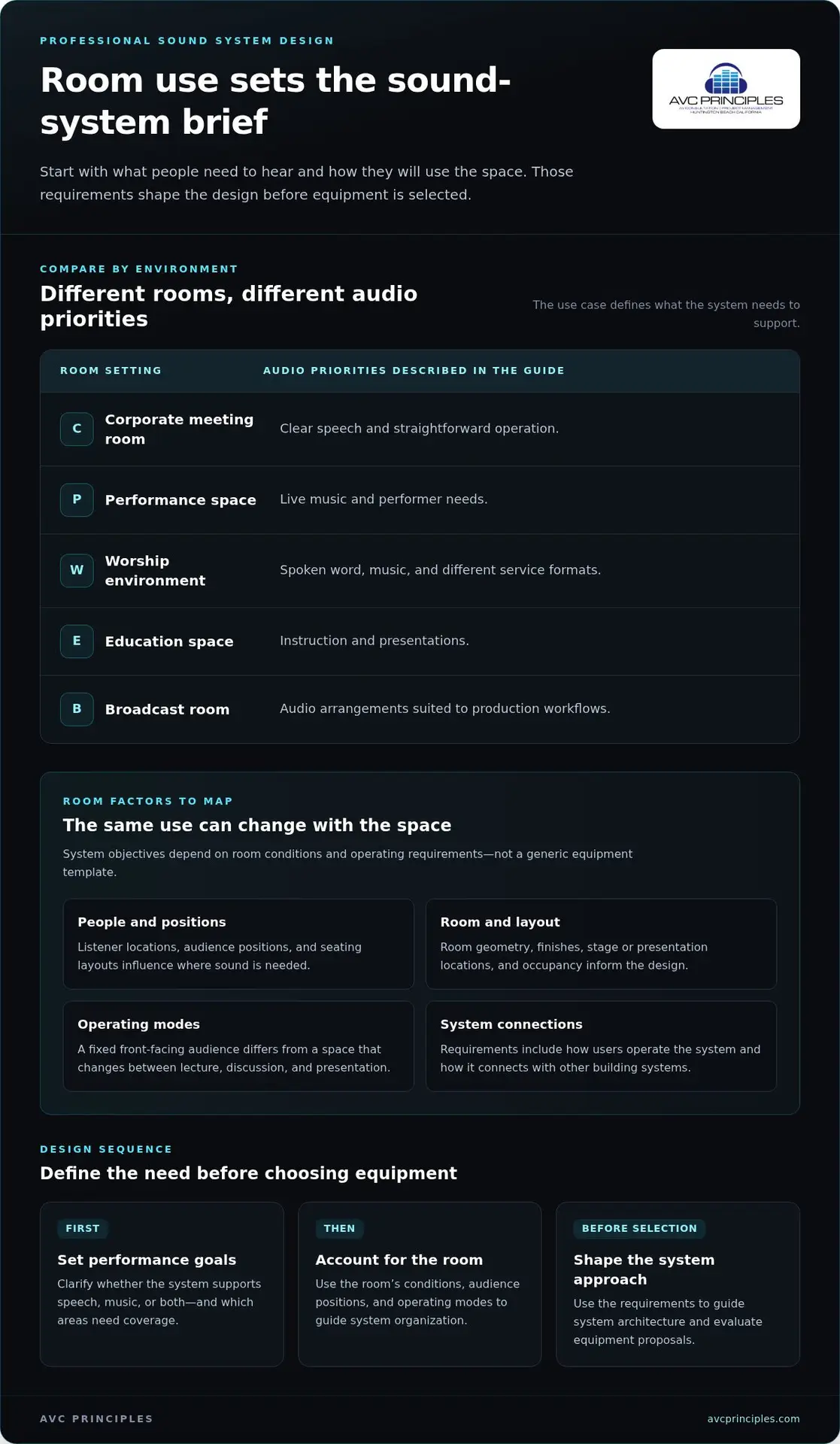
That sequence matters. A list of speakers and amplifiers is not a performance brief. Requirements should clarify whether the system supports speech, music, or both; which areas need coverage; how users will operate it; and how it connects with other building systems. These decisions guide the system architecture and give the project team a basis for evaluating equipment proposals.
Design engineering is distinct from procurement, installation, and ongoing managed services. Engineering translates project requirements into system concepts, technical documentation, and coordination information. Procurement obtains equipment, installation puts it in place, and managed services address continuing operational support. These activities may connect within a project, but they are different scopes of work. A useful overview of a sound reinforcement system can help clarify the components and applications the engineering process must account for.
How room use shapes sound-system objectives
Use defines priorities. A corporate meeting room may need clear speech and straightforward operation, while a performance space must account for live music and performer needs. Worship environments can combine spoken word, music, and different service formats. Education spaces may serve instruction and presentations, while broadcast rooms need audio arrangements suited to production workflows.
Room conditions refine those objectives. Audience positions, seating layouts, stage or presentation locations, and operating modes all influence where sound is needed and how the system is organized. A fixed, front-facing audience differs from a space that changes between lecture, discussion, and presentation. Define the actual uses and layouts first, rather than relying on a generic equipment template.
Who contributes to a professional sound-system project
Owners and end users define operational needs. Architects and interior designers shape room geometry, finishes, and visual integration. Contractors coordinate construction and installation requirements. AV integrators contribute implementation knowledge, while consultants connect user needs with system engineering and project documentation.
Early alignment helps surface decisions that affect multiple disciplines. Equipment locations need space and access; loudspeaker positions may intersect with lighting, structure, or interior elements; and networked systems need coordination with information technology infrastructure. Resolving these interfaces in design documents gives project participants a shared reference as the building develops.
AVC Principles connects acoustics, system integration, technical documentation, and project coordination through design and commissioning. For a broader view of how these responsibilities fit within project delivery, the AV design and engineering consulting guide explains the consulting role and its relationship to the wider AV system.
How Acoustics and System Architecture Shape Sound Performance
Acoustic analysis informs system architecture by showing how room geometry, surface behavior, occupancy, and intended use affect sound propagation and component placement. A design must account for the room as well as the equipment. Hard, reflective surfaces can contribute to reverberation, while room shape and obstructions can affect how sound reaches listeners. Occupancy matters too, since people and furnishings change the acoustic conditions.
Room acoustics and loudspeaker performance are related but distinct. A loudspeaker has defined coverage characteristics, while the room affects how its output is heard. Design engineering considers both: which listening areas need coverage, where loudspeakers can be positioned, and how the system can support the required speech or music use. Coverage planning helps assess consistency across intended listening positions, but it does not by itself establish intelligibility or a particular listening experience.
Acoustic analysis and coverage planning
Analysis starts with the space and its intended operating conditions. The design team considers room dimensions, surfaces, audience locations, and how the room will be occupied. EASE audio prediction software supports evaluation of proposed sound-system designs by modeling loudspeaker coverage in the project context. It informs design decisions, but does not replace the need to distinguish room-acoustic conditions from the characteristics of the proposed system.
For example, a presentation room with listeners facing one direction raises different coverage questions from a space where seating or audience positions vary. Listening-area analysis can help determine whether proposed loudspeaker locations and coverage patterns correspond to those positions. Speech intelligibility is a design objective shaped by several factors, including room acoustics, system configuration, and operating conditions.
Signal flow, control, and network integration
Acoustics guide where and how sound is delivered. System architecture defines how audio moves through the equipment. A typical signal path can be mapped from sources, such as microphones or playback devices, through processing and control, to amplification and loudspeaker endpoints. Documenting this path makes interfaces visible and clarifies what each component needs to support.
Processing manages the audio signal for the intended operation, while control gives users a way to select or adjust functions. Amplification drives the loudspeakers. The arrangement depends on project requirements, equipment architecture, and how users need to operate the space. If digital audio transport is appropriate, Audinate Dante may carry audio between compatible system components over a network. Its use calls for coordination with low-voltage and IT design so network interfaces and system responsibilities appear in project documentation, without assuming a particular network specification.
Acoustics, signal flow, and infrastructure are connected design decisions. AVC Principles brings these disciplines together through AV systems design and engineering, including acoustics, integration, and technical coordination. Projects that need an engineering partner can explore AV systems design engineering as part of a coordinated approach.
How to Compare Sound-System Approaches for Different Environments
Compare system approaches against the work a room must support, not against a universal equipment ranking. System architecture should follow the use case. A practical comparison considers audience arrangement, room conditions, operating modes, integration needs, and project constraints together. This keeps decisions tied to the brief rather than to a component list.
| Environment | Use and operating modes | Design considerations |
|---|---|---|
| Speech-focused rooms | Meetings, presentations, or instruction | Listener positions, presenter locations, speech coverage, and room configuration |
| Performance spaces | Live music, performances, or varied productions | Audience layout, source locations, stage requirements, and event changes |
| Worship facilities | Spoken word and music across service formats | Seating, platform arrangement, operating modes, and integration with other AV functions |
| Sports venues | Events with distributed audiences and changing activity areas | Audience zones, event operation, room scale, and coordination with venue systems |
| Broadcast environments | Audio for production and broadcast workflows | Source routing, operational control, production needs, and system interfaces |
The table frames the questions, not the equipment choice. A fixed-use room may prioritize a consistent arrangement, while a multipurpose venue may need to accommodate different audience layouts and source locations. Those changes can affect loudspeaker strategy, signal routing, and control requirements. In professional sound system design, the trade-off is between the project’s needs and the constraints of the specific space.
Matching system configuration to the operating brief
Start by documenting how the space will operate: who uses it, where listeners and audio sources are located, and which event modes must be supported. A lecture room with a stable, front-facing audience presents a different planning problem from a hall that shifts between presentations and performances. Defining the modes helps compare configurations against real use, without assuming one approach suits every venue.
Evaluating retrofit and new-construction conditions
New construction allows system coordination alongside architectural and construction decisions. The design can address equipment locations, pathways, and interfaces as the wider project develops. Retrofit work begins with existing conditions: available infrastructure, room constraints, and the sequence of construction activities can all shape feasible options. For event spaces where staging and AV requirements intersect, the staged environment engineering guide covers related coordination considerations.
Compare alternatives by recording what each approach supports, which constraints it must accommodate, and which project interfaces it depends on. This makes trade-offs visible to owners, designers, and construction teams. To develop a project-specific approach, discuss your sound-system design requirements with AVC Principles.
A Practical Workflow for Sound-System Design and Project Coordination
Professional sound system design moves through defined project phases. Each phase turns user needs into decisions the design and construction teams can coordinate, then provides a basis for checking the installed system against its design intent. Drawings and technical documentation are not administrative outputs alone. They communicate system requirements, interfaces, and design decisions to the people delivering the project.
From project brief to coordinated design documents
The workflow begins with discovery. The team documents room uses, user requirements, operating modes, existing conditions, and project constraints. Those inputs inform the system architecture and the design criteria used to develop coordinated documents.
- Define requirements. Record how the space will be used, who will operate it, and what the system needs to support.
- Develop the design. Translate the agreed requirements into system architecture, drawings, and technical documentation.
- Coordinate interfaces. Align AV information with architects, contractors, consultants, and integrators as the building design and construction plans progress.
- Commission the system. Verify the installed system against the project’s documented design intent.
Tools such as Revit BIM, AutoCAD, Bluebeam Revu, and BIM 360 can support project documentation and drawing coordination. They help teams communicate design information, coordinate interfaces, and review documents within the project workflow. The value lies in clear, consistent information, not the software name itself.
Commissioning and verification at project completion
Commissioning takes place after installation. It checks whether system components are configured and functioning in line with the project design. Functional checks and documented results help establish what was tested and identify items that require attention. This differs from equipment selection: a specification describes the intended system, while commissioning evaluates the installed system against that intent. It provides a project-level verification record, not a substitute for a separately defined performance-calibration process.
Engineering experience across complex environments
AVC Principles provides audio visual consulting, design engineering, programming, project management, and commissioning for integrated AV systems. Documented work includes performing arts centers, universities, sports arenas, casinos, broadcast studios, and corporate campuses. The principal consultant has led multimillion-dollar projects and holds CTS-I, CTS-D, and BICSI RCDD credentials. Listed training in Audinate Dante, Biamp Tesira, and QSC Q-Sys supports relevant knowledge of networked audio and AV systems.
For a project discussion, outline the venue, its users, operating requirements, and current project phase. AVC Principles can relate those requirements to design engineering and project-management needs. Discuss your project requirements with AVC Principles.
Set a Clear Direction for Your Next Project
Turn project needs into a brief that can guide decisions as the space develops. Define what users need the system to support, identify project constraints, and keep those priorities visible through design and delivery. A clear brief gives stakeholders a common reference when requirements, room plans, or construction details change. It also keeps professional sound system design focused on the intended operation of the space.
AVCPrinciples brings sound-system engineering experience across performing arts, education, sports, broadcast, corporate, and worship environments. The principal consultant’s listed credentials include CTS-I, CTS-D, and BICSI RCDD. This background supports a project-specific approach grounded in technical coordination, rather than a one-size-fits-all equipment template.
Bring your venue, user needs, project phase, and key constraints into the first conversation. Discuss your sound-system design requirements with AVCPrinciples and establish an engineering direction for the work ahead.
Frequently Asked Questions
Is a sound system design consultant different from an AV integrator?
Yes. A consultant typically develops the engineering basis for a system, including requirements, architecture, and technical documents. An AV integrator generally uses that design information to coordinate and implement the system. Roles can overlap depending on project structure, so the owner should establish responsibilities, deliverables, and approval points early. For professional sound system design, clearly assigned roles help keep design intent visible as the project moves from planning into delivery.
Can existing sound equipment be reused in a retrofit project?
Possibly, if the equipment’s condition, capabilities, and compatibility fit the project requirements. Begin with an inventory that records equipment identification, location, connections, and known operational issues. Then assess whether it can support the required operating modes and integrate with the proposed system. Reuse decisions also depend on the existing room and infrastructure. Documenting what stays, changes, or is removed helps coordinate design decisions and construction work.
How can a sound system support people who use hearing assistance?
A sound system can include an assistive listening system that provides audio to listeners through personal receivers or compatible hearing devices. Planning should consider how users access the system, where receivers are stored and returned, and how staff explain its use. The design team can coordinate the assistive listening approach with room use and accessibility requirements. Testing and clear operating procedures help ensure the system is ready for users.
What does a digital signal processor do in a sound system?
A digital signal processor, or DSP, manages audio signals between sources and system outputs. Depending on the design, it can support functions such as routing, equalization, level adjustment, and signal processing for different room modes. For example, a meeting room may need separate signal paths for local presentation audio and remote conferencing. DSP configuration should follow documented operating requirements, with control functions arranged so users can select the intended mode.
Can one sound system support both speech and live performance?
Yes, a system can be designed for both, provided the project brief accounts for the needs of each use. Speech may prioritize consistent listener coverage and clear vocal reproduction, while live performance can involve different sources, stage arrangements, and operating workflows. A multipurpose design may require selectable modes and carefully planned routing. The appropriate balance depends on the room, event types, and operational priorities, rather than a universal system configuration.
What information should a project owner prepare before a sound-system design meeting?
Bring the room plans, known construction milestones, intended uses, expected audience arrangements, and a list of current systems or equipment. Identify who will operate the system and describe routine activities as well as special event modes. Note constraints such as existing infrastructure, room changes, or coordination with other building systems. Even an initial outline of these details helps the design team identify open questions and organize the next stage of requirements development.
How does EASE audio prediction software support sound-system design?
EASE helps engineers evaluate modeled loudspeaker arrangements within a project’s room geometry. For example, the design team can compare proposed positions and examine how coverage may vary across defined listening areas. This supports design analysis before installation, but it does not replace understanding actual room conditions or verifying the completed system. Its predictions are most useful when the model reflects the project’s intended layout, audience areas, and system assumptions.