
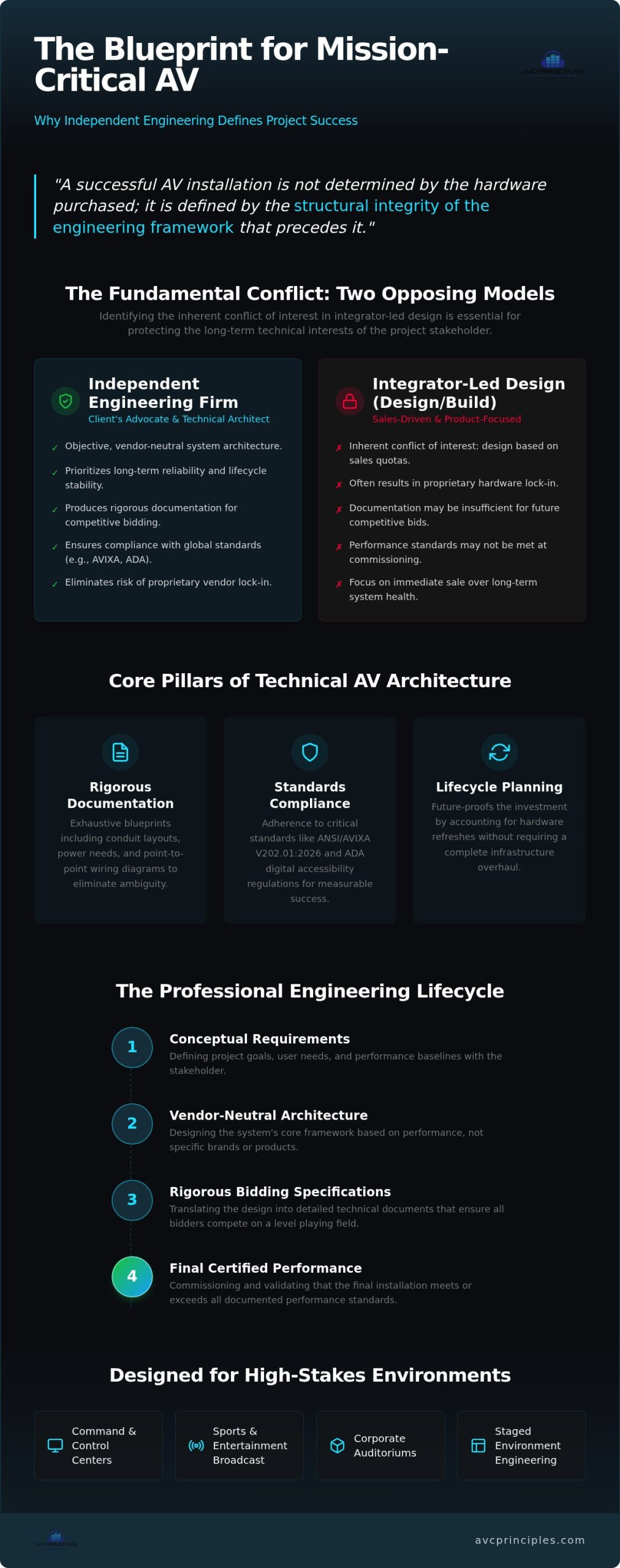
A successful AV installation is not determined by the hardware purchased; it is defined by the structural integrity of the engineering framework that precedes it. Many stakeholders mistake equipment procurement for comprehensive system design. This error often results in proprietary vendor lock-in and technical documentation that fails to survive a competitive bid. Professional AV system design and engineering firms serve as independent advocates. They ensure that mission-critical environments operate on foundations of technical precision rather than sales quotas.
You likely recognize the risk of systems that fail to meet performance standards during the final commissioning phase. It is a recurring failure in high-stakes infrastructure projects. This guide explains how independent oversight protects project integrity and ensures compliance with current standards like ANSI/AVIXA V202.01:2026 and upcoming ADA Title II digital accessibility regulations. We will examine the transition from vendor-neutral architecture to rigorous bidding specifications and final certified performance. This is a methodical approach to engineering that prioritizes long-term reliability and lifecycle stability over immediate convenience.
Key Takeaways
- Independent AV system design and engineering firms provide the objective oversight necessary to eliminate proprietary vendor lock-in and facilitate competitive bidding.
- Modern systems require the seamless integration of ICT infrastructure and AV signal distribution to maintain structural integrity across enterprise networks.
- Identifying the inherent conflict of interest in integrator-led design is essential for protecting the long-term technical interests of the project stakeholder.
- A structured engineering lifecycle, moving from conceptual requirements to rigorous technical documentation, ensures that systems meet performance standards during commissioning.
- Professional consulting secures compliance with evolving global standards and digital accessibility regulations for mission-critical and high-stakes environments.
The Evolution of AV System Design and Engineering Firms
The landscape of technical infrastructure has shifted. The traditional model of hardware-centric installation has reached obsolescence. Modern AV system design and engineering firms have transitioned into specialized technical consultancies. This shift reflects the increasing complexity of Audiovisual (AV) technology as it merges with enterprise IT networks. Systems are no longer isolated loops of analog signals. They’re sophisticated nodes within a broader ICT infrastructure.
Audiovisual technology is now a sub-discipline of systems architecture. This evolution requires a higher degree of engineering gravity. Projects now demand a holistic understanding of how signal distribution affects network bandwidth and security protocols. Designing these systems isn’t a retail exercise. It’s a rigorous application of physics and data science. Stakeholders now prioritize independent oversight to ensure that their technical foundations are built on standards rather than sales quotas.
Defining Professional AV Engineering
Professional engineering focuses on structural integrity and technical reliability. It’s a discipline rooted in precision. The shift from basic installation to engineered solutions marks a fundamental change in project methodology. Engineering consultancies don’t sell boxes. They provide the architectural blueprints that ensure those boxes function as a unified, resilient system. This approach prioritizes lifecycle stability and technical compliance over proprietary features.
AV engineering is the intersection of acoustics, broadcast, and network science. It demands a senior strategy that accounts for multi-disciplinary challenges. Engineers must calculate thermal loads, power requirements, and network latency with clinical precision. This level of detail ensures that the final system architecture is robust enough to survive the rigors of mission-critical use. By focusing on the “how” of engineering, firms protect the project from the common pitfalls of incomplete documentation.
The Scope of Mission-Critical Systems
High-stakes environments demand independent oversight. These spaces require a level of reliability that standard office setups don’t need. Identifying these environments early is critical for project success. Specialized environments include:
- Command and Control Centers: Real-time data visualization for emergency response or utility management.
- Sports and Entertainment Broadcast: High-bandwidth signal routing for live global audiences.
- Corporate Auditoriums: Large-scale communication hubs for executive leadership and stakeholder engagement.
- Staged Environment Engineering: Complex setups for performance and presentation that require precise timing and synchronization.
Failure in these environments isn’t a mere inconvenience. It’s a disruption of organizational continuity. If a command center’s signal distribution fails during an emergency, the consequences are severe. Professional AV system design and engineering firms mitigate these risks through precise technical documentation. They provide the rigorous oversight needed to prevent systems from failing during the final commissioning phase.
Core Pillars of Technical AV Architecture and ICT Design
Technical documentation is the architectural foundation of any high-stakes project. It bridges the gap between conceptual theory and physical execution. Leading AV system design and engineering firms produce exhaustive specifications that include conduit layouts, power requirements, and point-to-point wiring diagrams. This level of detail eliminates ambiguity during the bidding process. It ensures that every contractor understands the performance expectations before the first cable is pulled. Without these rigorous blueprints, projects often suffer from costly field changes and integration delays.
Engineering compliance isn’t optional in mission-critical environments. Adhering to metrics established by AVIXA, the Audiovisual and Integrated Experience Association provides a framework for measurable success. For instance, the ANSI/AVIXA V202.01:2026 standard for display size and viewing positions ensures visual clarity for all participants. Lifecycle planning further protects the investment. It accounts for future hardware refreshes without requiring a complete overhaul of the underlying infrastructure. This forward-thinking approach maintains system relevance as technology evolves.
ICT Infrastructure and Network Reliability
Modern signal distribution relies on robust network architecture. Data center connectivity design must support the high bandwidth required for real-time AV streaming. Professional low voltage system design for smart buildings integrates lighting, climate, and communications into a single manageable fabric. In multi-use venues, achieving broadcast-grade stability requires rigorous network segmentation. This prevents AV traffic from compromising essential enterprise data. Organizations requiring this level of precision often partner with experts for ICT infrastructure design to secure their digital foundations.
Command and Control Center Visualization
Visualization in high-pressure environments requires more than high-resolution screens. It demands engineering ergonomics. Human-centric design in Network Operations Centers (NOCs) accounts for sightlines, fatigue, and ambient lighting. For real-time crime centers and Emergency Operations Centers (EOCs), the system must remain operational under intense conditions. Redundancy protocols are built into the system architecture at every level. This includes dual power supplies, failover signal paths, and secondary control processors. These safeguards ensure that mission-critical operations aren’t interrupted by a single point of failure.
Independent Engineering Firms vs. AV Integrators
The distinction between an integrator and a professional consultancy is foundational to project success. Many organizations inadvertently delegate design authority to the same entity responsible for equipment sales. This creates an inherent conflict of interest. Integrator-led designs frequently prioritize hardware inventory and manufacturer relationships over the specific technical requirements of the environment. In contrast, independent AV system design and engineering firms operate without equipment sales quotas. Their primary obligation remains with the client and the structural integrity of the system architecture. This separation of duties ensures that the design serves the mission, not the vendor.
Protecting the client budget requires a methodical approach to procurement. Professional engineering firms produce rigorous bidding documents that standardize the scope of work. These specifications allow multiple integrators to bid on an identical technical requirement. This transparency forces contractors to compete on the quality of their labor and execution rather than proprietary hardware markups. By establishing a level playing field, independent firms secure the best market value while maintaining the project’s technical goals. This disciplined oversight is a critical compliance factor in high-stakes infrastructure.
The Value of Vendor-Neutral Consulting
Vendor-neutrality is a critical component of large-scale procurement. It prevents proprietary lock-in, where a client becomes dependent on a single manufacturer’s ecosystem for the life of the system. By selecting best-in-class technology from diverse sources, engineers ensure the system remains flexible and scalable. This approach drives down the total cost of ownership. Engineering-led specifications allow for seamless integration across different hardware platforms. This flexibility is essential for enterprise environments that must adapt to evolving standards without requiring a total infrastructure overhaul.
Independent Project Oversight
Independent oversight serves as a vital quality control mechanism. Once the design phase concludes, the engineering firm transitions into a supervisory role. They manage the integrator to ensure strict adherence to the technical documentation. This oversight mitigates risk during the construction and installation phases, preventing unauthorized substitutions or substandard workmanship. A senior strategist navigates multi-disciplinary challenges, coordinating with architects, electrical engineers, and IT departments. This disciplined management ensures that the final system achieves certified performance during the commissioning phase. It provides the steady hand needed to manage complex, high-stakes infrastructure from theory to final execution.
The Lifecycle of a Professional Engineering Engagement
A professional engineering engagement is a phased progression. It moves methodically from high-level conceptualization toward granular technical detail. This structured approach prevents the technical drift often associated with loosely defined projects. Experienced AV system design and engineering firms utilize this lifecycle to maintain structural integrity from the initial theory to the final execution. Each phase serves as a critical checkpoint, ensuring that the system architecture remains aligned with the client’s operational goals and compliance requirements.
- Phase 1: Conceptual Development. We gather technical requirements and define the project scope. This establishes the mission-critical parameters for the entire system.
- Phase 2: Detailed Engineering Design. This stage produces the comprehensive technical documentation. It includes precise signal flow diagrams and infrastructure specifications.
- Phase 3: Bid Management. We provide oversight during vendor selection. This ensures that only qualified integrators who can meet the rigorous engineering specs are considered.
- Phase 4: Construction Administration. Continuous installation monitoring prevents unauthorized substitutions. We ensure the build matches the architectural blueprints exactly.
- Phase 5: Technical Commissioning. The final phase involves rigorous performance testing. We validate that every component operates at the certified standard.
Organizations seeking to protect their infrastructure through this rigorous lifecycle should engage a senior strategist for professional AV design and engineering services. This disciplined management ensures that the final system achieves certified performance during the commissioning phase.
Technical Commissioning and Testing
Technical commissioning is the final safeguard of project integrity. It is a clinical process of verification and calibration. We calibrate acoustics and broadcast controls to ensure peak performance in high-stakes environments. Testing protocols focus on network reliability and signal latency to prevent failures in real-time streaming. Final validation is measured against established engineering standards, such as ANSI/AVIXA V202.01:2026. This phase confirms that the system is not just functional, but optimized for mission-critical reliability.
Staged Environment Engineering
Staged environments require specialized engineering workflows. These spaces, including concert halls and corporate auditoriums, demand a higher degree of multi-disciplinary coordination. We utilize acoustic modeling to ensure speech intelligibility and sound reinforcement precision. Integrating digital signage networks with venue architecture requires a sophisticated understanding of both aesthetics and ICT infrastructure. This integrated AV design ensures that the technology enhances the environment without compromising the structural or visual intent of the space.
AVC Principles: Senior Strategy for Complex Technical Systems
AVC Principles operates as an authoritative strategist for high-stakes infrastructure. We manage the transition from initial theory to final execution with clinical precision. Our firm prioritizes clarity and technical reliability over marketing flair. We don’t engage in equipment retail. This independence allows us to focus entirely on the architectural integrity of the system. We provide the steady hand needed for multi-disciplinary challenges. Our national scope ensures that corporate and government entities receive consistent engineering standards across all locations. As one of the nation’s premier AV system design and engineering firms, we serve as a senior partner to organizations that cannot afford system failure. We ensure structural integrity is maintained through every phase of the project lifecycle.
Core service pillars:
- Systems integration.
- Standards compliance.
- Lifecycle management.
- Technical oversight.
Engineering for Diverse Sectors
Technical requirements vary by sector, yet the need for precision remains constant. In the public safety and government sectors, we specialize in command and control center design. These environments require redundant signal paths and ergonomic visualization to support real-time decision-making. For the sports and entertainment industry, we engineer broadcast infrastructure that handles massive data throughput. This includes stadiums and arenas where signal latency must be minimized for live global feeds. In healthcare and education, our enterprise-grade ICT and AV designs support high-density wireless networks and remote collaboration. As a leader among AV system design and engineering firms, we deliver solutions built on technical standards rather than manufacturer preferences.
Contact AVC Principles for Technical Consulting
Transitioning from a conceptual vision to a functional reality requires a trusted strategist. We navigate the complexities of multi-disciplinary projects with discipline. Our team coordinates with architects, electrical engineers, and IT departments to ensure a unified approach. This coordination is essential for maintaining the project’s technical goals through the final commissioning phase. We provide the rigorous oversight required to manage the lifecycle of complex technical systems. Organizations that prioritize results choose us for our focus on technical reliability and methodical veteran expertise. We move from high-level conceptualization toward granular technical detail with unwavering focus. Consult with AVC Principles on your system architecture to establish a foundation of engineering excellence and secure your next infrastructure project.
Securing Technical Integrity in High-Stakes Environments
The transition from conceptual theory to physical execution requires a methodical approach. Independent AV system design and engineering firms provide the essential oversight needed to protect project budgets and technical goals. By separating design from equipment sales, stakeholders ensure that their infrastructure remains vendor-neutral and scalable. This disciplined framework is the only way to guarantee that mission-critical systems meet rigorous performance standards during final commissioning. It’s about building for the long-term stability of your enterprise.
AVC Principles operates as a national engineering consultancy. Clinical precision in technical documentation. Expertise in mission-critical command and control centers. We bring a methodical veteran perspective to sports arenas and corporate auditoriums. Our work provides the architectural clarity required for complex ICT and AV integration. It ensures that every component functions as part of a unified, resilient system. Partner with AVC Principles for Independent AV Engineering Oversight to ensure your next project is built on a foundation of structural reliability. We’re ready to manage your most demanding multi-disciplinary challenges and deliver the results your organization demands.
Frequently Asked Questions
What is the difference between an AV consultant and an AV integrator?
An AV consultant focuses on independent design and technical oversight, whereas an integrator manages equipment sales and physical installation. Leading AV system design and engineering firms don’t sell hardware. This separation prevents conflicts of interest and ensures the system architecture remains vendor-neutral. Consultants provide the architectural blueprints and bidding specifications that allow multiple integrators to compete fairly on a project’s labor and execution costs.
Why is technical commissioning important for AV systems?
Technical commissioning is the final validation process that ensures an installed system meets its intended performance standards. It involves the clinical calibration of acoustics, broadcast controls, and network reliability. This phase is critical for mission-critical environments where failure isn’t an option. Without professional commissioning, stakeholders risk inheriting systems that appear functional but fail to meet rigorous technical specifications or compliance metrics during high-stakes operations.
How do engineering firms ensure vendor neutrality in AV design?
Engineering firms ensure vendor neutrality by operating without manufacturer sales quotas or equipment retail divisions. They select best-in-class technology based solely on the project’s technical requirements and lifecycle stability. This approach avoids proprietary lock-in and allows for a more flexible system architecture. By producing hardware-agnostic specifications, firms ensure that the final design serves the client’s operational needs rather than a specific vendor’s profit margins.
What documentation should I expect from a professional AV engineering firm?
You should expect a comprehensive package of technical documentation that serves as the project’s architectural foundation. This includes point-to-point wiring diagrams, conduit layouts, power requirements, and thermal load calculations. Professional firms also provide rigorous bidding specifications and functional narratives. This level of detail eliminates ambiguity during the construction phase and provides a clear roadmap for the integrator to follow, ensuring the final build matches the initial engineering theory.
Can an AV design firm help with ICT infrastructure and data centers?
Professional AV engineering consultancies often specialize in ICT infrastructure design and data center connectivity. Modern audiovisual systems reside on the enterprise network, requiring a deep understanding of low voltage system design and high-bandwidth signal distribution. Expertise in this area ensures that AV traffic doesn’t compromise network security or stability. This integrated approach is essential for smart buildings and mission-critical facilities that require broadcast-grade network reliability.
What industries benefit most from independent AV engineering oversight?
Independent oversight is most beneficial for sectors managing high-stakes, mission-critical infrastructure. This includes government agencies operating command and control centers, as well as sports and entertainment venues requiring complex broadcast design. Corporate auditoriums, healthcare facilities, and higher education institutions also require professional engineering to manage multi-disciplinary challenges. Any environment where system downtime results in significant operational disruption needs the steady hand of a methodical veteran strategist.
When should an AV engineering firm be brought into a project?
An AV engineering firm should be engaged during the conceptual development phase of a project. Bringing in a senior strategist early allows for the proper integration of technology with the architectural and electrical plans. This prevents costly field changes and ensures that infrastructure like conduit and power is correctly specified from the start. Early involvement secures the structural integrity of the system and aligns technical requirements with the broader project goals.
What standards do professional AV engineering firms follow?
Professional firms adhere to globally recognized engineering standards established by organizations like AVIXA. Key metrics include the ANSI/AVIXA V202.01:2026 standard for display size and viewing positions. Compliance with ADA Title II digital accessibility regulations is also mandatory for public-facing technology. These standards ensure that systems are reliable, accessible, and high-performing. Following these rigorous benchmarks provides a measurable framework for project success and long-term technical compliance.