
A display wall is not the starting point for a dependable monitoring environment. Mission critical monitoring environment design starts with the operational loop: how people detect, assess, communicate, and act. AV and ICT systems must support that workflow while fitting the room, facility infrastructure, and project requirements.
It is understandable to worry that a critical requirement could fall between operational teams, technology disciplines, and construction planning. A technically capable system can still miss the mark if its design does not reflect how operators work, or if coordination and commissioning are left until late in the project.
This guide offers a framework for defining the environment and its design requirements, comparing system and delivery choices, and aligning stakeholders around a coordinated plan. It covers operational workflows, AV and ICT integration, facility coordination, BIM, project delivery, and commissioning, showing how each decision contributes to an environment designed around operational needs.
Key Takeaways
- Define the monitoring environment across its physical, technical, and operational boundaries before selecting systems.
- Map how operators receive, interpret, share, and act on information to establish AV and control system requirements.
- Use mission critical monitoring environment design to compare centralized and distributed operations, and assess the distinct coordination demands of new builds and retrofits.
- Document stakeholder requirements, system relationships, and design decisions so they can be reviewed across the project team.
- Plan commissioning as a defined project phase, with verification tied to documented requirements.
What Is Mission-Critical Monitoring Environment Design?
Mission-critical monitoring environment design is the coordinated planning of the physical space, technical systems, and operational workflows people need to monitor conditions and respond to information. It considers how the room, AV and ICT infrastructure, control systems, and user responsibilities fit together. The goal is not to specify a display or select equipment in isolation, but to define an environment around the work it must support.
Continuity matters because monitoring tasks often connect to broader operational processes. A system relationship, room constraint, or unclear handoff can affect how information reaches the people responsible for interpreting it and deciding what happens next. Design coordination makes these dependencies visible during planning, so requirements can be considered across disciplines rather than handled as separate equipment decisions.
This scope differs from software reliability engineering, which focuses on the reliability of software services, including factors such as availability, latency, performance, and capacity. Mission critical monitoring environment design addresses the physical and technical setting where monitoring takes place, along with the workflows that connect people and systems. Software reliability may be one relevant consideration, but it does not define the whole environment.
Which operational environments does the term describe?
The term can describe network operations, security monitoring, facilities operations, or command operations. These are illustrative contexts, not interchangeable room types. A network team may monitor infrastructure status, while a facilities team may coordinate information about building systems. Security operations may involve different roles and escalation paths. The operating model determines what users need to see, share, and act on.
A Control room is one familiar form of monitoring workspace, but its design requirements depend on the functions performed there. Define responsibilities, information flows, and system relationships before drawing conclusions about the room or its technology. Ergonomics and visualization choices should follow from those requirements, not stand in for understanding the work.
What makes the environment mission-critical?
Mission-critical describes the importance of the operation the environment supports, not a guaranteed level of availability or a specific failure rate. Start with operational questions: What decisions depend on timely information? Which users are responsible for responding? How do systems support defined workflows? The answers establish a project design basis without assuming a universal configuration.
Identify the tasks the environment must support, the people and teams involved, and the information they use to carry out their responsibilities. Then consider how the physical setting and connected technologies support those tasks. This distinguishes environment design from equipment selection alone: a device may meet a technical specification and still be poorly matched to how people use the information.
A clear definition gives project stakeholders a shared reference point. It clarifies where operational requirements end and where AV, ICT, and facility coordination must connect. That shared basis makes design decisions easier to review and provides a practical foundation for comparing approaches in the sections that follow.
How Workflow, AV, and ICT Shape the Monitoring Environment
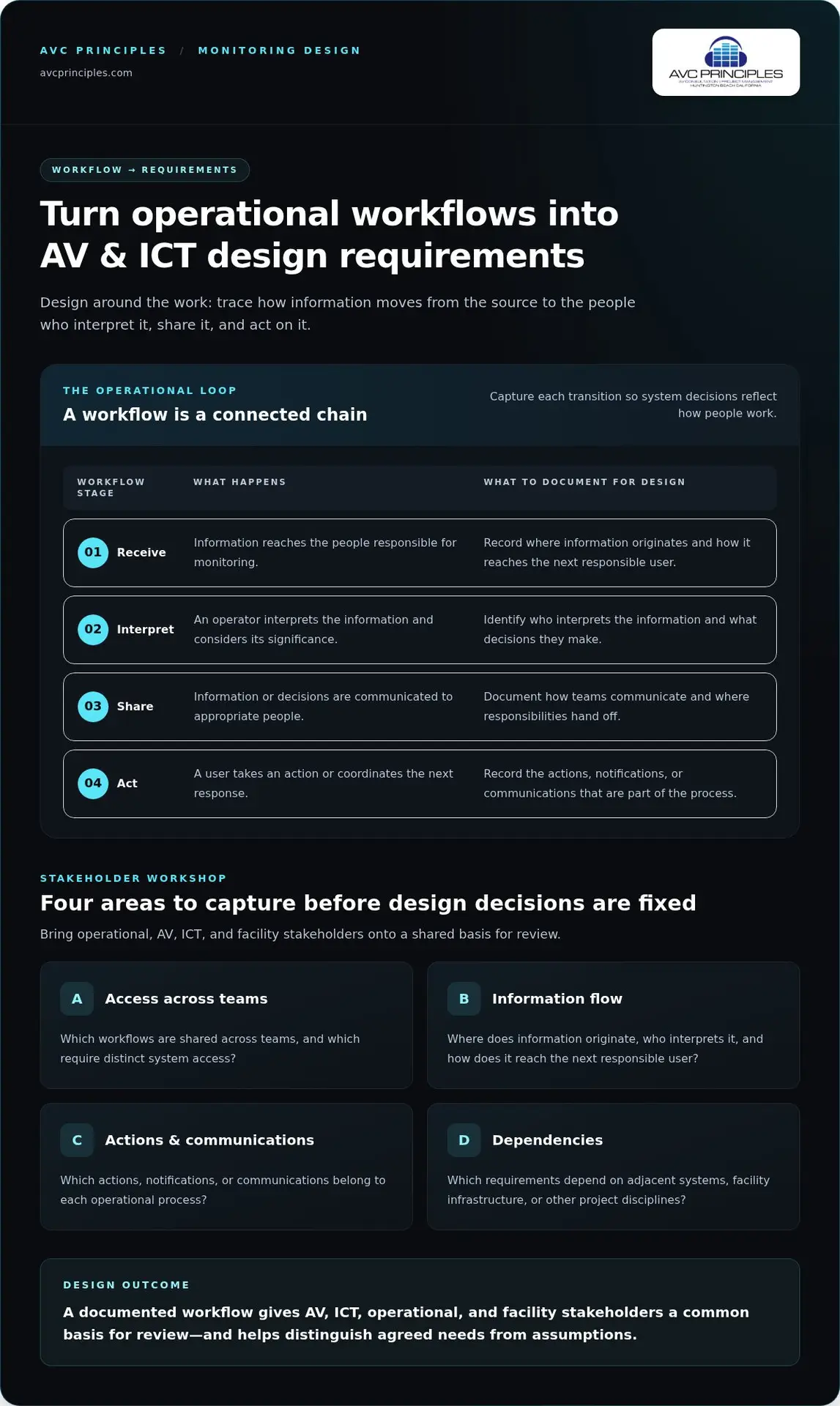
Once the operating model is understood, translate it into requirements for people, information, and system interfaces. A monitoring workflow is a chain: an operator receives information, interprets its significance, shares it with the appropriate people, and takes or coordinates an action. Design should support each step, including transitions between teams and technologies.
Translate operational workflows into design requirements
Begin by identifying user groups and responsibilities. Record the information sources each group uses, the decisions they make, and how they communicate those decisions. For example, a facilities operator may review building-system information and escalate an issue to another team. The requirement is not simply to display information, but to support the relevant review and handoff.
Stakeholder workshops can surface dependencies before design decisions are fixed. Use them to document:
- Which workflows are shared across teams and which require distinct system access.
- Where information originates, who interprets it, and how it reaches the next responsible user.
- Which actions, notifications, or communications are part of each operational process.
- Which requirements depend on adjacent systems, facility infrastructure, or other project disciplines.
This record gives AV, ICT, operational, and facility stakeholders a common basis for review. It also separates agreed needs from assumptions, reducing the risk of making a system decision without understanding who depends on it.
Coordinate AV, control, and low-voltage ICT systems
AV and control systems shape how information is presented, routed, and acted on. Low-voltage ICT infrastructure connects services involved in the operation. Depending on the operating model, interfaces may include local area networks, wireless networks, VoIP, IP public address, or IP video. Listing a technology does not establish how it should connect or whether specific systems will interoperate.
Document each interface as a design relationship. Identify the systems and stakeholders involved, the information or communication exchanged, and the project requirements governing coordination. Make network dependencies, access requirements, and responsibility boundaries visible to the relevant design teams. This lets the team review interfaces alongside operational workflows instead of leaving them as assumptions between separate project packages.
Broader network planning can inform these decisions. The ICT infrastructure design guide provides further context for infrastructure requirements that extend beyond the monitoring room.
For mission critical monitoring environment design, the practical objective is a traceable link between each workflow and its system requirements. AVC Principles brings AV and control design together with low-voltage ICT and project coordination. Integrated AV and ICT design engineering translates project-specific operational needs into coordinated design decisions.
Centralized, Distributed, New-Build, or Retrofit: Compare Design Approaches
There is no universally preferable configuration. The right fit depends on how monitoring work is organized, which teams need to coordinate, and what the project’s physical and technical conditions allow. Compare options against workflows and dependencies, rather than assuming one model automatically improves response or reliability.
When does a centralized monitoring model fit?
A centralized model may suit operations where users need shared situational awareness or coordinate around common information and decision paths. Its design depends on the relationships among system interfaces, information presentation, and operational roles. Consider who needs access to which information, how teams communicate, and how work is handled across locations. Centralization alone will not resolve unclear responsibilities or disconnected systems.
Use the comparison below to guide project discussions. These questions help stakeholders identify requirements and trade-offs before settling on a design direction.
| Approach | Potential fit and trade-offs | Questions for the project team |
|---|---|---|
| Centralized operations | Supports shared workflows and common operational awareness. Requires clear system relationships, access needs, and role definition. | Which users share information or decisions? What interfaces and responsibilities must be coordinated? |
| Distributed operations | Can align monitoring with teams or functions operating in separate locations. Requires clarity about how information and decisions move between them. | Which tasks remain local? What must be shared, and how are handoffs managed? |
| New construction | Allows design requirements to be coordinated with architectural and construction planning. Decisions still need alignment across project disciplines. | How will room, infrastructure, and system requirements be documented and coordinated with the wider design? |
| Retrofit | Must account for existing infrastructure, physical conditions, and constraints established by the project. | Which existing conditions affect the design? What must be retained, adapted, or coordinated? |
How do retrofit and new-construction projects differ?
In a retrofit, the design team works within existing conditions. Infrastructure and room constraints can shape system relationships and coordination, so project requirements should reflect what is already present and what the work permits. Treat existing conditions as design inputs, not details to defer until implementation.
New construction creates opportunities to coordinate monitoring requirements with architectural and construction planning as the design develops. Space, infrastructure, and system interfaces can be considered together, with decisions documented for the project team. The AV design and engineering consulting guide provides broader context for how AV requirements fit into design engineering.
For mission critical monitoring environment design, compare each approach against operational needs, stakeholder relationships, existing conditions, and project coordination. Record the rationale and constraints so later design choices can be reviewed against the same criteria.
A Practical Design Sequence: Requirements, Coordination, and Commissioning
A disciplined delivery sequence turns operational needs into coordinated design information, then uses that information to guide verification. In mission critical monitoring environment design, documentation connects stakeholder decisions, system interfaces, construction coordination, and commissioning.
- Establish requirements. Document workflows, user responsibilities, system functions, information sources, and relevant project constraints. Distinguish required outcomes from assumptions that still need stakeholder agreement.
- Develop the design basis. Translate agreed requirements into AV, control, ICT, and facility design criteria. Identify interfaces and record decisions that affect other project disciplines.
- Coordinate design information. Review drawings, system documentation, and spatial relationships with the project team. Use BIM coordination to make design information easier to review and coordinate, not as a guarantee that conflicts will be eliminated.
- Support construction coordination. Track design decisions and relevant changes across architects, interior designers, contractors, consultants, and integrators. Keep current documentation available to the teams responsible for implementation.
- Commission and hand over. Test and verify installed systems against documented project requirements. Record outcomes and provide operational handover information relevant to the project scope.
Establish requirements and coordinate the design
Requirements need enough detail to guide design and later review. Capture stakeholder inputs, intended system functions, relevant interfaces, and constraints such as existing conditions or project coordination needs. When a requirement changes, document the decision and its implications so affected disciplines can assess it.
AVCPrinciples uses Revit BIM, AutoCAD, and Bluebeam Revu to prepare and review design information. BIM coordination helps project participants examine relationships among systems and the built environment, while project management supports coordination across stakeholder groups. Neither replaces clear requirements or review by the responsible teams.
Coordinate with architects, interior designers, contractors, consultants, and integrators as appropriate to the project. Share relevant drawings, interface information, and decisions in a form those participants can review. The objective is traceability: stakeholders should be able to follow a requirement from its source through design documentation and into project verification.
Plan commissioning and operational handover
Commissioning is a planned verification phase, not a general promise of continuous operation. Define which installed systems will be tested, which project documents establish the requirements, and how findings will be recorded. This makes the review specific and gives the project team a reference for resolving discrepancies.
Verification may cover AV performance, acoustics, broadcast controls, or network reliability when those elements are included in project requirements. The scope should reflect the designed systems and their documented criteria. Detailed calibration methods belong to the relevant technical scope; the priority here is confirming that installed systems and their relationships have been reviewed against agreed project documentation.
AVCPrinciples integrates design engineering, project management, BIM coordination, and commissioning within project delivery. Plan a coordinated AV and ICT design around your project requirements and delivery sequence.
How AVC Principles Approaches Mission-Critical Monitoring Design
AVCPrinciples approaches mission-critical monitoring environment design as a connected engineering and project-delivery process. Full-service AV consulting, design engineering, programming, and project management bring operational requirements into the development of integrated AV and control systems, with low-voltage ICT considered as part of the wider project. The intended use of the environment and the relationships between its systems shape the design.
Connect engineering decisions to project realities
Design decisions must account for more than technical performance. Acoustics, budget requirements, construction schedules, existing conditions, and stakeholder priorities all affect what can be coordinated and delivered. AVCPrinciples applies engineering and project management experience across corporate, education, performance, sports, and government environments, including executive-level leadership on multimillion-dollar projects. The right balance of requirements is established for each project.
The principal holds CTS‑I, CTS‑D, and BICSI RCDD credentials. This combination of AV and ICT expertise supports an integrated view of systems that often cross discipline boundaries. Instead of treating AV, control, and low-voltage infrastructure as unrelated packages, design decisions can be assessed against their operational purpose and interfaces with the wider project.
Move from project objectives to coordinated delivery
Project delivery progresses from concept development to design engineering, project coordination, and commissioning. Early work establishes objectives and design direction. Engineering develops those objectives into coordinated system requirements and documentation. Project coordination supports communication across stakeholders, while commissioning provides a planned opportunity to verify installed systems against documented project requirements. This sequence connects decisions made at the outset with review during delivery.
BIM coordination makes design information and system relationships reviewable across project disciplines. Project management supports coordination among stakeholders as requirements and design information develop. AVCPrinciples uses these methods to align AV and control design with low-voltage ICT, construction coordination, and project-specific operational needs. The purpose is clear responsibility and traceable decisions, not an assumption that coordination tools alone resolve every project issue.
Commissioning is part of the delivery plan, not a promise of uninterrupted operation. Its scope should reflect the project documentation and systems being delivered. Verification criteria and handover information are tied to agreed requirements, giving the project team a clear basis for reviewing completed work and understanding system relationships.
For monitoring environments with interdependent AV, control, ICT, and facility requirements, early coordination helps align design decisions with construction and operational needs. Discuss your monitoring environment design requirements with AVCPrinciples.
Set the Next Design Decision in Motion
The next step in mission critical monitoring environment design is to turn operational priorities into a project basis the full team can use. Identify the decisions that still need alignment, the stakeholders responsible for them, and the requirements that must guide design and delivery. This creates a focused starting point and keeps technical choices connected to the work the environment supports.
AVCPrinciples brings integrated AV and ICT engineering, project coordination, and commissioning experience to complex environments. The principal’s CTS‑I, CTS‑D, and BICSI RCDD credentials support that work, alongside experience in AV systems engineering, BIM coordination, and integrated technology strategies. Each project’s approach reflects its operational needs and delivery context.
Bring your project objectives and coordination priorities into the conversation. Discuss your mission-critical monitoring environment design requirements with AVCPrinciples and establish a clear basis for the decisions ahead.
Frequently Asked Questions
What is a mission-critical monitoring environment?
It is a physical and technical setting where people monitor information that supports important operational decisions. The term covers the room and infrastructure as well as how users access information, communicate, and carry out responsibilities. For example, a facilities team may use a monitoring space to review building-system information and coordinate follow-up. Design begins by identifying the operation’s consequences and users, rather than assuming a particular room layout or technology configuration.
What systems are considered in monitoring environment design?
The systems considered depend on the operation and its project requirements. They may include AV and control systems, low-voltage ICT infrastructure, local area and wireless networks, VoIP, IP public address or intercom, and IP video systems. Facility interfaces may also matter. Map which services provide information, which present or route it, and which support communication, then document the interfaces and responsible project disciplines.
How do you choose between centralized and distributed monitoring?
Choose by examining where decisions are made and how teams coordinate, not by assuming one arrangement is inherently better. Centralized monitoring may suit shared workflows that depend on common information; distributed monitoring may align with responsibilities handled by separate teams or locations. Document which tasks must be coordinated, which can remain local, and how information or decisions pass between groups. Compare those needs with system interfaces and project constraints before selecting an approach.
Can a mission-critical monitoring environment be designed as a retrofit?
Yes. A retrofit can be designed around existing conditions, provided those conditions are treated as project inputs. Review available drawings and relevant infrastructure, identify physical or system constraints, and establish which elements the project will retain, modify, or replace. The design can then account for interfaces between existing and proposed systems. This assessment helps the project team identify coordination needs early rather than relying on assumptions about what is already in place.
What role does commissioning play in monitoring environment design?
Commissioning verifies installed systems against the project’s documented requirements. Before testing, establish what will be checked, which documents define the criteria, and how results or discrepancies will be recorded. Depending on scope, verification may address AV functions, acoustics, broadcast controls, or network reliability. Commissioning provides a structured review of delivered systems; it does not, by itself, guarantee uninterrupted operation or performance beyond the agreed project criteria.
When should an AV and ICT design consultant be involved?
Involve an AV and ICT design consultant during early project planning, before architectural, construction, and technology decisions become difficult to coordinate. Early participation can translate operational needs into design requirements and identify interfaces that affect other disciplines. AVCPrinciples provides AV consulting, design engineering, programming, and project management for new construction and retrofit environments. This support can continue through design coordination and commissioning, with the scope aligned to project requirements.