
What if the greatest risk to an AV system isn’t the technology, but the handoffs between design and construction? On a complex project, large scale AV project oversight helps protect design intent as requirements meet changing site conditions, budget and schedule pressures, acoustics, and technical performance.
A well-developed design is only one part of successful delivery. Architects, contractors, consultants, and AV integrators need to coordinate decisions and responsibilities as the project advances. Without clear review and resolution paths, construction changes can affect system requirements, documentation, and readiness for commissioning.
This article explains how structured oversight connects design, construction coordination, system integration, and commissioning. You’ll learn how to clarify roles and decisions across project phases, keep requirements aligned with field conditions, and use coordinated documentation and verification goals to prepare for acceptance. AVC Principles brings AV engineering, BIM coordination, acoustics, and project management together to support continuity from concept through commissioning.
Key Takeaways
- Understand how project oversight links requirements, design documentation, construction coordination, and verification across project phases.
- Use clear stakeholder roles and decision pathways to manage interfaces among owners, architects, contractors, consultants, and AV integrators.
- Apply large scale AV project oversight to keep design intent aligned with construction conditions, project changes, and technical requirements.
- Distinguish installation completion from commissioning activities such as documented testing, calibration, and operational verification.
- See how AV engineering, BIM coordination, acoustics, and project management support a coordinated path from concept to commissioning.
What Large-Scale AV Project Oversight Covers, and Why It Matters
Large-scale AV project oversight is the engineering and project-management work that connects requirements to design, implementation, and verification. It maintains a traceable path from what a space needs to support, to the system documented and coordinated with construction, to how that system is tested. The scope can include audio, video, control, acoustics, and low-voltage IT interfaces. Because these disciplines affect one another, decisions need clear ownership and documented resolution.
Oversight concerns coordinated project delivery, not a single trade activity. Equipment purchasing covers selection and procurement. Installation covers physical implementation. Ongoing managed IT services address continuing operations. Oversight connects technical decisions, project records, stakeholder responsibilities, and verification goals that guide delivery. A useful foundation is understanding how Audiovisual (AV) systems combine components for different commercial applications.
Which projects need a coordinated AV oversight approach?
The need for coordination tends to grow with system scale, stakeholder count, and the number of interfaces. An auditorium may require teams to align room acoustics, loudspeaker locations, display sightlines, lighting, and control. A corporate campus may need consistent AV approaches across rooms and buildings. Sports arenas and performance facilities can involve additional interfaces among production, broadcast, event operations, and venue infrastructure.
New construction and retrofit projects call for different workflows. In new construction, AV requirements can inform room layouts, pathways, and infrastructure while the building is being designed. A retrofit must account for existing conditions that may constrain equipment locations, cabling routes, and system integration. For both project types, oversight clarifies which decisions require coordination and how changes will be recorded.
How oversight differs from installation or equipment purchasing
Engineering establishes system requirements, architecture, interfaces, and documentation. Contractors coordinate and deliver building work within their project responsibilities. AV integrators implement the system according to project documents and their contracted scope. Consultants connect technical requirements and design decisions with construction coordination and verification. Clear boundaries matter: a drawing, purchasing decision, or installation task should not silently redefine the intended system.
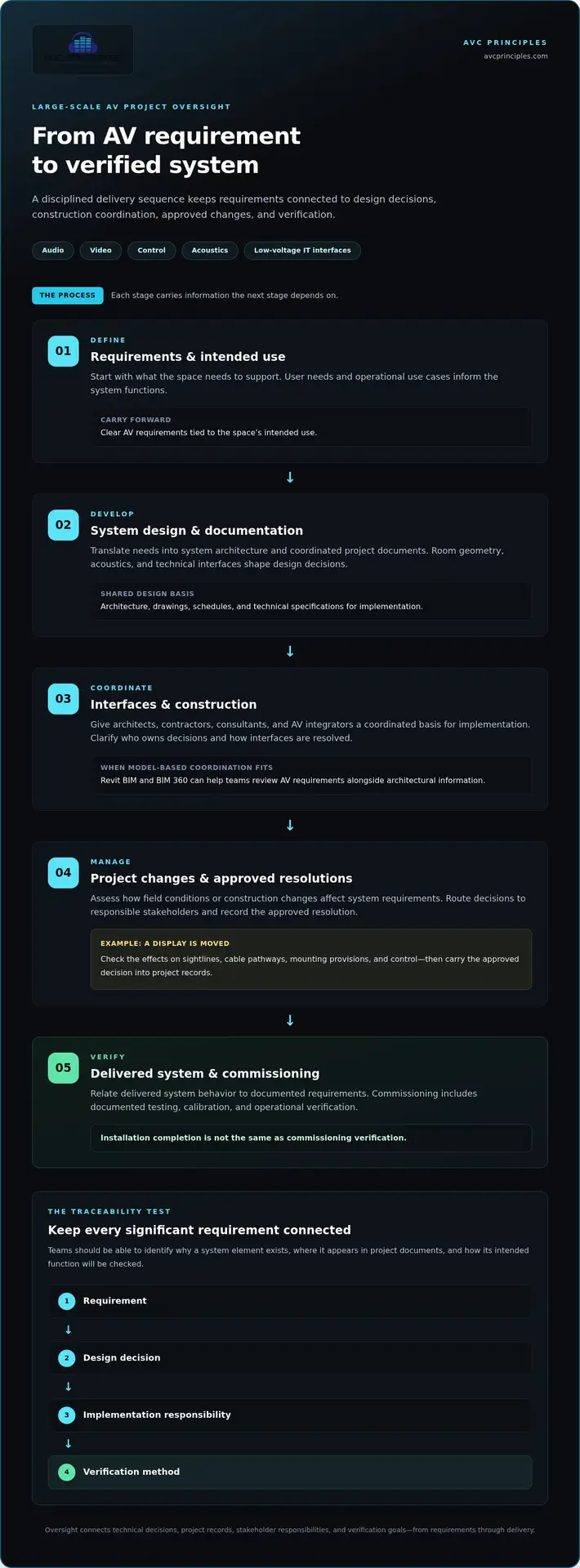
For example, moving a display can affect sightlines, cable pathways, mounting provisions, and control. Oversight identifies the affected interfaces, routes the decision to the responsible stakeholders, and carries the approved resolution into project records. That is the practical difference between tracking equipment and preserving system intent. AVCPrinciples’ AV design and engineering consulting connects requirements, technical design, and project coordination for new construction and retrofit environments.
- Requirements: Define the intended functions and user needs.
- Design: Translate needs into system architecture and coordinated documents.
- Implementation: Track interfaces and assess the effects of project changes.
- Verification: Relate delivered system behavior to documented requirements.
The key measure is traceability. Each significant requirement should connect to a design decision, an implementation responsibility, and a way to verify the result. That continuity helps teams resolve interfaces deliberately instead of discovering gaps during commissioning.
How AV Oversight Connects Requirements, Design, and Construction
Requirements guide delivery only when they become decisions the project team can design, build, and verify. A disciplined sequence makes those connections visible: define requirements, develop the design, coordinate interfaces, manage changes, and verify delivery. Each stage produces information the next one depends on. If an operational need changes, reflect its impact in the system design and relevant project records rather than leaving it as an informal assumption.
Design-intent traceability means carrying each AV requirement through design decisions, construction coordination, approved changes, and verification of the delivered system. This gives large scale AV project oversight a practical measure of effectiveness. Teams should be able to identify why a system element exists, where it appears in project documents, and how its intended function will be checked.
Requirements and technical documentation as oversight controls
Start with the space’s intended use. User needs and operational use cases inform system functions, while room geometry, acoustics, and technical interfaces shape design decisions. Those decisions become system architecture, drawings, schedules, and technical specifications. Together, coordinated documents give architects, contractors, consultants, and AV integrators a shared basis for implementation. A technical documentation checklist for AV systems can help teams organize records, communicate design intent, and track decisions.
BIM coordination and construction-phase change management
When project conditions support model-based coordination, Revit BIM and BIM 360 can help teams review AV requirements alongside architectural, structural, and building-services information. A model helps examine spatial relationships, but it does not replace discipline coordination or field review. Proposed changes still need technical assessment, clear responsibility, and updated records before teams use them for implementation.
Consider a revised ceiling layout. It may affect equipment locations, pathways, access, acoustics, and connections to other systems. An oversight process identifies the affected interfaces, brings the relevant disciplines into the decision, and records the approved resolution. Software supports this review, but cannot by itself guarantee clash-free construction or schedule performance.
A practical change review asks what requirement prompted the original design, what the revision changes, which drawings or schedules need updating, and how the result will be verified. The U.S. Department of Energy’s discussion of large-scale project management oversight offers a broader reference for structured oversight, including performance baseline validation. In AV delivery, the same discipline helps teams assess a proposed change against documented requirements rather than treating it as an isolated field adjustment.
- Define: Record operational needs and technical requirements.
- Translate: Develop coordinated architecture, drawings, schedules, and specifications.
- Coordinate: Review spatial and technical interfaces with project disciplines.
- Control: Assess changes, document decisions, and update affected records.
- Verify: Connect delivered system behavior to the original requirements.
AVCPrinciples brings design engineering and project management together to support this continuity. Explore its AV engineering and project-management approach to see how coordinated technical decisions can carry through project delivery.
How to Evaluate AV Project Oversight Across Stakeholders and Risks
Effective oversight makes project interfaces and decision rights explicit. It does not replace the owner, architect, contractor, consultant, or AV integrator. Instead, it establishes how their work connects, where decisions are recorded, and how unresolved conflicts reach the people authorized to resolve them. This helps close coordination gaps without repeating another participant’s technical or contractual role.
Clear responsibility boundaries reduce coordination ambiguity by showing who provides information, who reviews it, and who approves a decision. The project team can capture these boundaries in a responsibility matrix suited to its contracts and delivery structure.
- Owner: Defines operational priorities, approves project-level decisions, and resolves conflicts that affect scope or intended use.
- Architect: Coordinates AV requirements with room layouts, finishes, sightlines, and other architectural considerations.
- Contractor: Coordinates construction activities, site conditions, and trade interfaces, then routes constraints or proposed changes through the agreed process.
- Consultant: Reviews technical alignment, documents design intent, and identifies AV impacts that need coordinated resolution.
- AV integrator: Plans and executes system implementation within its contracted scope, raising discrepancies between site conditions and project documents.
Which project interfaces deserve explicit ownership?
Map AV dependencies with architectural, electrical, structural, acoustical, and ICT disciplines. Network connectivity, VoIP, wireless networks, IP public address and intercom, and IP video camera systems may share pathways, infrastructure, or operational dependencies with AV. The responsibility matrix should identify who provides interface information and who reviews its effect on the AV design. If requirements conflict or site conditions prevent the documented approach, define an escalation route to the relevant technical leads, then to the owner when a project decision is needed.
How to assess oversight scope without confusing responsibilities
Evaluate oversight by its purpose and outputs, not by the number of meetings it adds. Technical review checks alignment with requirements. Project management tracks decisions, schedule interfaces, and open actions. Installation covers physical implementation. Owner decisions establish priorities and approvals. Project-specific review points should identify the documents or issues under review, the responsible participants, and how comments will be resolved. This keeps lifecycle integration distinct from installation responsibility or owner authority.
Each activity should produce a useful record. Design review may generate coordinated comments. Construction coordination may document interface questions and resolutions. Change control records impacts and approvals. Commissioning preparation aligns requirements with planned verification. Define these outputs for the project rather than relying on vague labels such as “reviewed” or “approved.” Specific records give stakeholders a shared view of open risks. The independent AV project oversight and compliance discussion is relevant to defining review boundaries, while this framework focuses on connecting responsibilities across the delivery lifecycle.
For large scale AV project oversight, the practical test is whether the team can identify the decision owner, the information needed, the escalation path, and the record for each significant interface. That structure helps stakeholders act within their responsibilities while keeping cross-discipline issues visible throughout delivery.
How to Prepare a Large-Scale AV Project for Commissioning
Commissioning readiness comes from project records, not simply from equipment being powered on. Design requirements and approved changes establish what the system should do; current drawings, schedules, and configuration information show what has been implemented. Large scale AV project oversight connects those records to planned verification, so testing can show whether intended functions are present and where correction is needed.
Installation completion and commissioning are related but distinct. Installation completion indicates that contracted work has been carried out. Commissioning adds documented testing, calibration, and operational verification against project-specific requirements. Establish acceptance criteria for the project and its intended functions. No single threshold applies to every system.
Readiness checks before system testing begins
Before testing, review installation status, configuration records, control programming, and outstanding work items. Confirm that test plans trace to approved requirements and describe the functions to be checked. Readiness evidence can include current drawings, coordinated system schedules, and resolved interface issues. Where included in the project scope, coordinate acoustic performance, broadcast controls, and network reliability checks with the relevant technical participants.
- Documentation: Use current design records and system schedules to identify the configuration under test.
- Open work: Record incomplete items and determine whether they affect a planned test.
- Test basis: Connect each planned check to a requirement or intended operational function.
- Interfaces: Coordinate dependencies with other systems before interpreting test results.
This review helps teams distinguish a physically installed system from one ready for meaningful verification. It also clarifies the testing scope before findings are recorded.
Turning test findings into usable project closeout
Record the test method, observed result, relevant system or function, exceptions, and responsible follow-up action. This gives the project team a usable record of what was examined and what remains unresolved. For calibration activities, the AV system performance calibration reference can help frame how measured performance relates to defined project requirements.
When a test identifies a deficiency, document the needed correction, assign follow-up responsibility through the project’s agreed process, and record the result of any retest. Keep exceptions visible instead of treating them as informal notes. The owner and designated project participants can then use completed records, remaining items, and project-specific criteria to inform final operational readiness decisions.
For AV systems that include acoustics, broadcast functions, control programming, or network-dependent operations, coordinate verification with the relevant disciplines. Tests should reflect the approved project scope, not assumptions about what every system must include.
AVCPrinciples connects design engineering, project management, and commissioning preparation across complex AV projects. Engage AVCPrinciples to coordinate AV commissioning preparation around project requirements and verification goals.
How AVCPrinciples Supports Large-Scale AV Project Oversight
AVCPrinciples provides full-service audio visual consulting, design engineering, programming, and project management for integrated AV and control systems in new construction and retrofit environments. This work connects early project goals with technical decisions, construction coordination, and commissioning preparation. The scope is shaped around project requirements, system interfaces, stakeholder responsibilities, and the records needed to carry decisions forward.
For large scale AV project oversight, continuity matters. A design decision should remain clear as it moves through technical documentation, coordination with other disciplines, implementation, and verification. AVCPrinciples works with architects, interior designers, contractors, consultants, and AV integrators to connect those phases and address AV requirements within the broader project environment.
Engineering and project management from concept through completion
Consulting and system architecture establish how integrated technologies support the intended use of a space. Technical documentation communicates those decisions to project participants. Project management supports coordination as work advances, while BIM coordination helps review AV interfaces with other building systems. Acoustics and integrated technology strategies also inform design decisions when they relate to project needs. Commissioning connects system requirements with planned verification.
This work draws on experience across corporate campuses, universities and schools, performing arts centers, sports arenas, broadcast studios, casinos, and entertainment venues. Each environment has distinct operational priorities and technical interfaces. AVCPrinciples accounts for those differences rather than treating every project as the same system in a different building.
The Principal Consultant’s listed credentials include CTS-I, CTS-D, and BICSI RCDD. AVCPrinciples uses tools including Revit BIM, AutoCAD, Bluebeam Revu, EASE audio prediction software, MS Project, and BIM 360 to support engineering, documentation, acoustical work, and project coordination as appropriate to the project.
Discuss the project’s oversight requirements with AVCPrinciples
A focused project discussion can begin with four inputs: the project’s goals, its delivery phases, the systems that must interface, and stakeholder coordination needs. These details help shape engineering and project-management support around actual project conditions. They also clarify which decisions need review, how information should move between participants, and what documentation will support commissioning.
To prepare for an initial conversation, outline the project type, current phase, key AV functions, known construction constraints, and open coordination questions. AVCPrinciples can use that context to shape an engineering partnership around project requirements, from system design and BIM coordination through programming, project management, and commissioning.
To discuss oversight needs for an upcoming or active project, contact AVCPrinciples about AV project oversight at (562) 343-6014 or (562) 714-4151, or email soost@avcprinciples.com.
Set the Next Project Decision in Motion
Make oversight actionable by identifying decisions that could affect system performance, interfaces that need coordination, and records the team will use as work advances. Bringing these items into focus early gives stakeholders a practical basis for resolving questions before they become commissioning obstacles.
Use that starting point to align project goals with the current delivery phase. Whether the work is at concept development, construction coordination, or commissioning preparation, a clear view of priorities can help shape the engineering and project-management approach. That is the value of large scale AV project oversight: disciplined decisions that remain connected to the system the project intends to deliver.
Start a conversation with AVCPrinciples about your project’s coordination and verification priorities. Define the next step and bring the right technical perspective to the project.
Frequently Asked Questions
What does large-scale AV project oversight include?
It coordinates technical decisions and project handoffs from requirements through commissioning. The scope of large scale AV project oversight can include design review, documentation coordination, interface tracking, change assessment, and preparation for system verification. For example, a project team can define who resolves a conflict between a room’s intended use and a proposed equipment location, then record the decision so it informs the relevant drawings and later testing.
When should AV project oversight begin?
Begin oversight while project requirements and design options are still being developed. At that stage, the team can identify AV needs that may affect room layouts, infrastructure, acoustics, or coordination schedules. For a renovation, early review can also identify existing conditions that shape system planning. Continue oversight at project-defined milestones, including design reviews, construction coordination, system integration, and commissioning preparation.
How is AV project oversight different from AV installation?
AV installation is the physical implementation of systems and equipment. Oversight coordinates the engineering decisions and project information that guide delivery. For example, an installer may encounter a pathway that differs from the coordinated documents. Oversight helps route the discrepancy for technical review and an authorized decision, while installation teams carry out work within their contracted scope. Keeping these functions distinct supports clear accountability.
Who is involved in a large-scale AV project?
Participants commonly include the owner, architect, interior designer, contractor, engineering consultants, and AV integrator, with roles shaped by the project’s delivery structure. A useful first step is to identify who supplies information, who reviews technical impacts, and who can approve changes. For example, a network dependency may need input from both ICT and AV participants, while a change affecting room use may require an owner decision.
How does BIM coordination support AV project oversight?
BIM coordination gives project disciplines a shared model-based view for discussing spatial relationships and infrastructure interfaces. Teams can use it to review whether AV equipment locations and pathways align with architectural or building-system information. A model is a coordination aid, not proof that installed work matches the design. Site conditions and approved project documents still need to inform implementation decisions and verification.
What should be documented before AV commissioning?
Prepare approved requirements, current system records, installation status, relevant configuration information, and test plans. For example, if a control function is part of the intended system operation, the test plan should identify that function and how its operation will be observed. Define project-specific acceptance criteria in advance so the team assesses results against agreed requirements rather than applying a generic threshold.
Can AV oversight help manage construction changes?
Yes. Oversight can make the technical and coordination impacts of a proposed change visible before project participants decide how to proceed. Moving a display, for example, may affect viewing positions, pathways, or related documentation. The responsible participants assess those impacts through the agreed change process and record the decision. Oversight supports informed coordination, but cannot prevent every change or guarantee budget, schedule, or performance outcomes.