
A low-voltage design can meet technical requirements and still miss a project’s priorities. When networks, VoIP, IP public address and intercom, and video systems intersect, unclear accountability can turn design decisions into budget and schedule conflicts. Independent engineering for ICT projects gives teams a way to assess those decisions against defined requirements before delivery complexity grows.
Technical design, procurement, construction, and operational needs must align, but their responsibilities are not interchangeable. An independent engineer provides technical review and coordination from the project’s perspective. The role differs from a vendor focused on its equipment, a designer responsible for a defined package, or a project manager coordinating overall delivery.
This article explains what independent engineering contributes, where its boundaries sit, and when to engage it. It also offers a practical framework for defining scope across project phases, coordinating ICT requirements with budget and construction schedules, and verifying installed performance against project requirements through commissioning.
Key Takeaways
- Scope independent engineering for ICT projects around project objectives, system boundaries, design maturity, and decisions requiring review.
- Compare an independent engineer, an owner’s engineer, and a design consultant by their contracted purpose and responsibilities, not title alone.
- Set review outputs and project-stage involvement in advance so technical oversight has clear limits and useful deliverables.
- Map interfaces among ICT, AV, control, and construction teams to surface coordination needs before they affect delivery.
- AVC Principles connects AV and ICT design with project management and commissioning across complex environments, including education, broadcast, sports, and government.
Why Independent Engineering Matters in Complex ICT Projects
Independent engineering for ICT projects is a scoped, objective technical review of design decisions and delivery against stated project requirements. It gives stakeholders a defined basis for assessing whether technical intent, system interfaces, and project priorities align. The term describes an engagement approach, not a universal job description. Responsibilities depend on the agreed scope and contractual relationships.
The systems involved can span more than conventional data infrastructure. Information and Communications Technology (ICT) encompasses technologies used to handle and communicate information. In a building project, local area networks (LANs), wireless networks, VoIP, IP public address and intercom, and IP video can intersect with AV and control systems. Their shared infrastructure and operational interfaces make coordination a design issue, not simply an equipment decision.
What independence means in an ICT engineering engagement
Independence depends on clarity. The engagement should document its review scope, criteria, project responsibilities, and outputs. Criteria may include the owner’s stated requirements, approved design intent, and relevant project documentation. This creates a traceable basis for technical observations rather than relying on informal preferences or assumptions.
An objective review can surface gaps between project requirements, design documents, and the work being delivered. For example, a review may identify an undefined system interface or a discrepancy between a documented requirement and a proposed technical approach. The engineer can record the issue and its relevance to the project. Responsibility for design revisions, approvals, procurement, or installation remains with the parties assigned those duties. A title alone does not establish those boundaries.
That distinction matters. Design engineering defines or evaluates technical solutions and their coordination. Equipment suppliers provide products, while installers carry out installation under their assigned scope. Ongoing managed IT services concern continued operational support, not independent project review. These roles can inform one another, but they are not interchangeable. A written scope keeps accountability visible.
Why ICT project complexity makes early engineering valuable
Consider a project with a LAN, wireless coverage, VoIP, IP video, and IP public address or intercom. These systems may depend on coordinated network infrastructure while serving different users and operational functions. Design choices can affect equipment locations, pathways, room layouts, installation access, and how teams manage systems after handover. AV and control integrations add further interfaces to document.
Early engineering review gives the team an opportunity to examine those interfaces while requirements and design decisions are still developing. It can clarify which system owns an interface, what information each discipline needs, and where a technical assumption could conflict with an architectural or operational priority. It also helps align technical intent, construction coordination, and project constraints without presuming every conflict can be eliminated.
For broader context on infrastructure planning, AVCPrinciples’ ICT infrastructure design guide covers design considerations and standards. The core principle is consistent: define requirements and system boundaries, then coordinate the interfaces that connect them.
What Independent Engineering Covers Across the ICT Project Lifecycle
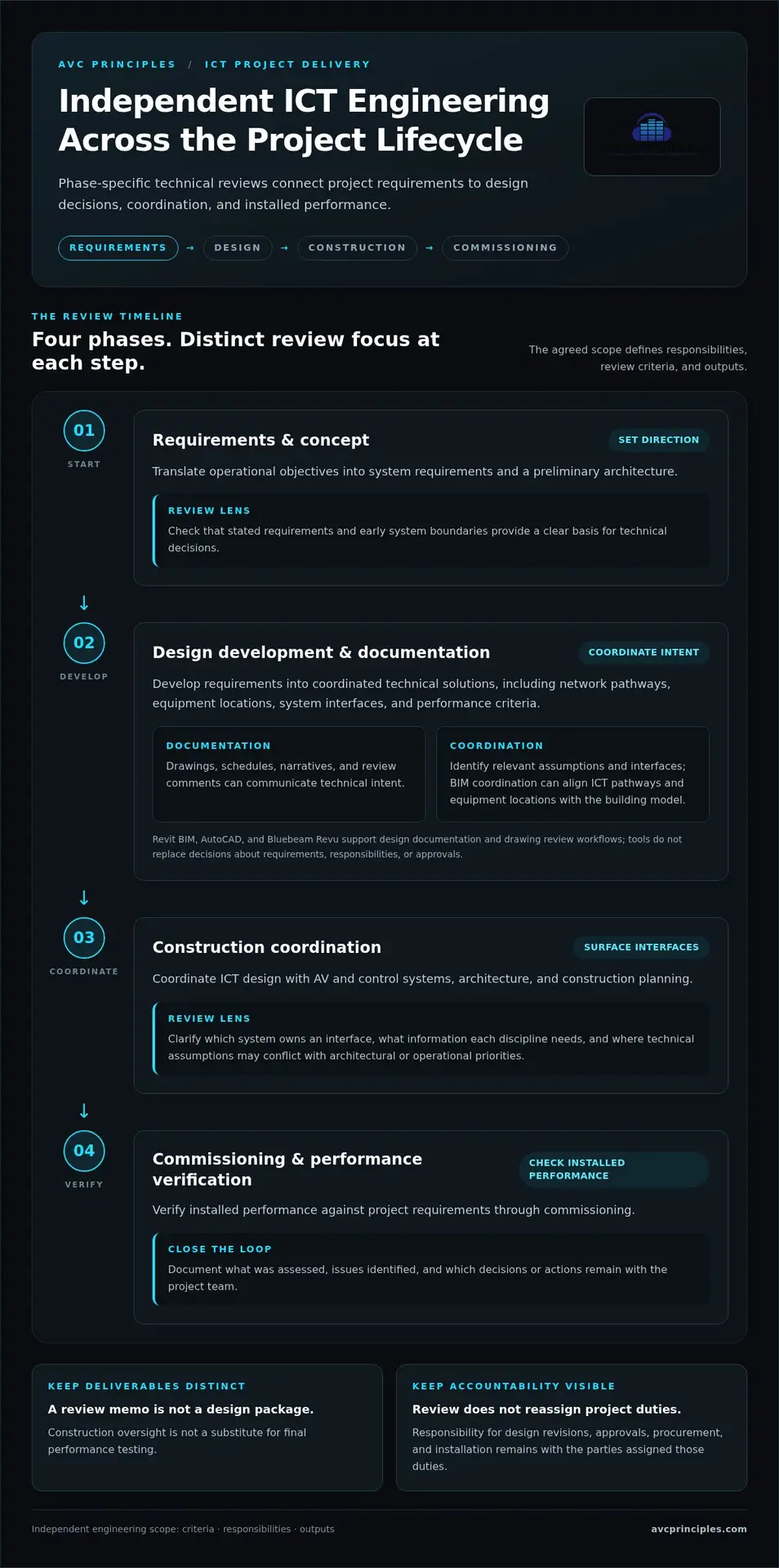
The value of an engineering engagement depends on when it begins and what it is accountable for producing. Independent engineering for ICT projects can span requirements, design development, construction coordination, and commissioning, but each phase calls for distinct work products. A review memo is not a design package, and construction oversight is not a substitute for final performance testing.
Lifecycle engineering is defined by phase-specific reviews and documented deliverables that trace technical decisions back to approved project requirements. This connection helps stakeholders understand what was assessed, what issues were identified, and which decisions or actions remain with the project team.
Design development, documentation, and coordination
At concept stage, engineering translates operational objectives into system requirements and a preliminary architecture. During design development, those requirements become coordinated technical solutions, such as network pathways, equipment locations, system interfaces, and performance criteria. A concept establishes direction; design documentation communicates how that direction is to be delivered.
Technical drawings, schedules, narratives, and review comments should identify assumptions and interfaces relevant to the scope. BIM coordination can help align ICT pathways and equipment locations with the building model. Revit BIM and AutoCAD support design documentation, while Bluebeam Revu can be used in drawing review workflows. These tools support coordination but do not replace decisions about requirements, responsibilities, or approvals.
Coordination must connect ICT design with AV and control systems, architecture, and construction planning. For example, an equipment-room layout affects more than the ICT drawing. It can influence room planning, pathway coordination, and when construction teams need information. Clear review outputs help stakeholders resolve conflicts and track changes before they become delivery issues.
Construction oversight and commissioning
During construction, project oversight can compare submittals, coordination information, and observed work with documented design intent and requirements. The scope should state whether oversight includes scheduled reviews, issue tracking, responses to technical queries, or other defined activities. It should also identify who approves changes and who directs installation. Oversight makes alignment visible; it does not transfer the contractor’s or designer’s responsibilities.
Commissioning addresses a different question: does the installed system perform against the project’s stated criteria? Testing and calibration can verify relevant system functions and document results, exceptions, and outstanding items. In an AV and ICT project, coordinated interfaces matter as much as individual systems. AVCPrinciples’ AV system design and engineering guidance provides related context on AV design and engineering.
Define the phase, reviewer, criteria, and output before work begins. A useful engagement leaves the team with traceable decisions and evidence, not simply a general statement that a design or installation was reviewed. For more on how design and delivery activities can come together, explore AVCPrinciples’ ICT and AV engineering approach.
Independent Engineer, Owner’s Engineer, or Design Consultant?
These titles can describe related work, but they do not establish identical duties. For independent engineering for ICT projects, the engagement’s purpose, contractual relationship, scope, and decision rights matter more than the label. One project may use separate roles; another may combine functions under a clearly defined agreement.
| Role | Purpose | Typical client relationship | Scope and project-stage involvement |
|---|---|---|---|
| Independent engineer | Provide objective technical review against agreed project requirements. | Engaged to assess defined matters for a project stakeholder; the relationship and degree of independence depend on the contract. | May review requirements, design documents, coordination, or installed performance at specified stages. Deliverables should identify findings and their basis. |
| Owner’s engineer | Support the owner’s project interests through technical advice and oversight. | Works in a relationship aligned with the owner’s objectives, subject to the agreed scope. | May support planning, design decisions, coordination, or construction oversight. The engagement defines which activities are included. |
| Design consultant | Develop or document technical systems when design work is part of the engagement. | Typically engaged to provide defined design services to a client or project team. | May develop concepts, system architecture, specifications, and design documents, with involvement shaped by the contracted design phase. |
How the roles differ in purpose and accountability
An independent engineer’s central task is review: assess the design or delivery against project criteria and document observations. An owner’s engineer supports the owner’s decisions and priorities, which may include technical evaluation or coordination. A design consultant creates or documents a solution within its design scope. These functions can overlap, but their outputs differ: a review identifies and assesses, owner-side advice informs decisions, and design work defines the technical solution.
Neither role is automatically preferable. A project seeking a second technical assessment may need review without a new design package. A project still forming its ICT approach may need design development. A project team requiring support with owner decisions may define an owner’s engineering function. The right structure depends on project needs, not title alone.
When role boundaries need explicit definition
Overlap can create duplicated reviews or leave gaps. Before work begins, establish a responsibility matrix and deliverable register. The matrix assigns responsibility for reviewing, preparing, approving, and informing. The register names each output, its author, reviewer, due point, and intended decision. Together, they show where roles meet and where accountability sits.
- Design changes: Identify who recommends, reviews, and approves revisions.
- System interfaces: Assign responsibility for resolving coordination issues across ICT, AV, control, and other disciplines.
- Technical decisions: Name who records decisions, tracks open items, and communicates their effect on project requirements.
Independence is not itself a credential or a guarantee of project outcomes. It is a quality of the defined review relationship and process. A clear mandate, transparent criteria, and traceable deliverables make that distinction practical.
How to Scope Independent Engineering for an ICT Project
A useful scope turns project needs into review tasks, decision points, and defined outputs. For independent engineering for ICT projects, set the boundaries before assigning hours or review milestones. This sequence gives owners, architects, contractors, and integrators a practical basis for defining the engagement.
- Set objectives and stakeholders. Record the operational goals, user needs, facility context, and project constraints the engineering work must support. Identify the owner, design leads, construction team, integrators, and operational stakeholders. State who provides input and who has authority to decide.
- Define system boundaries. List the systems included and excluded, then map their dependencies. A LAN, wireless network, VoIP, IP video, and AV or control systems may share pathways, rooms, or interfaces. Document where one system’s scope ends and another begins.
- Establish design maturity and timing. Describe the current design state and identify the project phase when review begins. Set review gates around actual decision points, such as concept approval, design-package development, construction coordination, or commissioning. State what information must be available at each gate.
- Assign responsibilities and decision rights. Clarify who prepares documents, reviews comments, approves design changes, resolves cross-discipline interfaces, and records final technical decisions. Define an escalation path for issues that remain unresolved or affect project requirements, schedule, or budget.
- Specify review outputs and coordination cadence. Name deliverables, such as documented review comments, an interface register, meeting records, or a status report, and state when each is due. Set a coordination cadence that matches design and construction activities, with a process for tracking responses and closing issues.
- Define acceptance evidence. State how commissioning will verify performance against project-specific requirements. Identify which system functions will be tested, what evidence will be recorded, who participates, and how exceptions or incomplete items will be documented. Use project criteria rather than assuming a standard or acceptance method applies universally.
Scope checklist
Before authorizing the engagement, confirm that the scope addresses:
- Project objectives, stakeholders, facility context, and systems included.
- System interfaces, assumptions, exclusions, and design responsibilities.
- Design maturity, review stages, required inputs, and project timing.
- Deliverables, review deadlines, comment tracking, and issue closure.
- Decision authority, escalation route, and technical recordkeeping.
- Commissioning criteria, test evidence, and treatment of exceptions.
A written scope makes the engagement usable across disciplines. It gives the owner a clear basis for aligning technical review with project priorities, while giving architects, contractors, and integrators defined inputs and decision paths. AVCPrinciples connects ICT infrastructure design with AV systems design and project delivery. Learn more about AVCPrinciples’ ICT engineering approach.
How AVCPrinciples Connects ICT Engineering to Project Delivery
Independent engineering has practical value when technical requirements stay connected to project decisions through design and delivery. AVCPrinciples brings together AV consulting, ICT infrastructure design, project management, and commissioning to support coordination across technical systems and project stakeholders. The work can be shaped around project requirements, interfaces, delivery phases, and defined review outputs.
Integrated AV and low-voltage ICT engineering
ICT infrastructure can include local area networks, wireless networks, VoIP, IP public address and intercom, and IP video camera systems. In many facilities, these systems connect with AV and control requirements. Coordinating them as part of the wider project helps teams consider shared pathways, equipment locations, system interfaces, and operational needs in context.
AV consulting and design engineering establish technical intent. Programming and integrated control solutions address how systems operate together, while project management connects technical decisions with stakeholder coordination and delivery activities. These functions are distinct, but aligning them helps keep design decisions traceable as project requirements move into construction and implementation.
Venue projects bring additional coordination needs across production, broadcast, and facility systems. The broadcast infrastructure engineering guide provides related context for evaluating technical requirements in these environments. AVCPrinciples’ experience includes corporate, education, performance, worship, sports, broadcast, and government projects, where users, spaces, and systems shape engineering priorities.
The principal holds CTS‑I, CTS‑D, and BICSI RCDD credentials. These are individual credentials, not company certifications, and they reflect professional qualifications in AV and ICT disciplines.
A project-specific path from design intent to verification
Project-specific coordination begins with requirements and documentation. BIM coordination, including work using Revit BIM and AutoCAD, can help align technical layouts with project information and support communication among stakeholders. Clear documentation gives design and construction teams a shared reference for interfaces, decisions, and changes. Project management connects those technical records with the project’s coordination and delivery process.
Commissioning provides a defined opportunity to verify installed system performance against the project’s stated criteria. Those criteria should identify the functions to be tested and how results or exceptions will be recorded. This makes verification specific to the project rather than an unsupported promise of a particular outcome.
For a project with interconnected ICT and AV requirements, AVCPrinciples can align design intent, technical coordination, and commissioning within a project-specific scope. To discuss your project requirements, call (562) 343-6014 or (562) 714-4151, email soost@avcprinciples.com, or connect with AVCPrinciples.
Put a Clear Engineering Scope Behind Your Next Project
The next step is to turn project priorities into a practical brief. Identify the technical decisions that need independent review, the interfaces requiring coordination, and the evidence stakeholders will need to accept the work. A focused scope helps the project team address accountability while there is still time to make informed decisions.
That discipline is the foundation of independent engineering for ICT projects: connect technical review to requirements, assign responsibilities clearly, and define how findings will inform project decisions. It gives the team a stronger basis for moving from planning to coordinated delivery.
AVCPrinciples can shape an ICT engineering approach around your project’s requirements and delivery context. Discuss your ICT project requirements with AVCPrinciples and take the next step with a clear technical direction.
Frequently Asked Questions
What does an independent engineer do on an ICT project?
An independent engineer evaluates technical decisions against the project’s defined requirements and review scope. For example, a review might assess whether a proposed network design supports the stated needs of connected conference spaces, then document assumptions or unresolved issues for the project team. Specific tasks depend on the engagement. Independent engineering for ICT projects supports informed decisions, but it does not guarantee project outcomes or replace the responsibilities assigned to designers, contractors, or integrators.
Is independent engineering the same as owner’s engineering?
No. Independent engineering generally focuses on objective technical assessment within an agreed scope, while an owner’s engineer supports the owner’s project interests as defined by the engagement. A project could assign one role to review an ICT design and another to advise the owner on project decisions. Industry usage varies, so compare the contract, deliverables, and decision rights rather than assuming the title determines responsibility.
When should an independent engineer be engaged for an ICT project?
Consider engaging one when stakeholders need a structured technical review or a clearer view of system interfaces. Early involvement can help establish review criteria while requirements are developing. On a project already in construction, the need may concern a design change, an unresolved coordination issue, or a review of commissioning records. Match the timing to the decision at hand, the project’s current phase, and the information available for assessment.
Can independent engineering cover both AV and ICT systems?
Yes, if the engagement defines both disciplines and their interfaces. For example, a meeting space where AV control depends on network connectivity may need a scope that identifies which design information is reviewed and how an interface issue is recorded. AVCPrinciples provides AV consulting and low-voltage IT system design. The project brief should still distinguish technical review from design development and identify who holds authority over each system decision.
What should an ICT independent engineering scope include?
An effective scope should state the project purpose, systems under review, relevant documents, review milestones, deliverables, and responsible decision-makers. Add practical controls such as document names or version references, a method for assigning comments, response expectations set by the project, and a record of accepted or unresolved items. Reviewers should be able to identify which drawing revision supports a comment and which stakeholder is responsible for its disposition.
Does independent engineering replace commissioning for ICT systems?
No, not by itself. A technical review may examine a test plan or results, while commissioning verifies installed systems against the project’s defined performance criteria. For example, a project may need evidence that a specified function operates as intended, alongside a record of exceptions requiring follow-up. An engagement can include review, commissioning, or both, but the scope should assign who performs testing and who documents the results.