
Keeping AV design in-house doesn’t automatically reduce costs or give you better control. In-house vs outsourced AV design means choosing between maintaining internal design capacity and bringing in external expertise when a project calls for it. The right fit depends on workload, specialist requirements, the level of oversight you want, and how intellectual property is handled.
An internal team can offer direct communication and valuable knowledge of your organization. But fixed staffing and training costs can be hard to justify when projects are occasional or technically demanding. Outsourcing adds expertise and capacity without creating permanent roles. Clear scopes and ownership terms help preserve control.
This comparison looks at how the two models differ in cost structure, expertise, decision-making, scalability, and intellectual property. It also explains when a hybrid approach may fit, helping you match the design model to your AV requirements and available resources.
Key Takeaways
- Compare the full cost of internal staffing with the workload and specialist expertise each project requires.
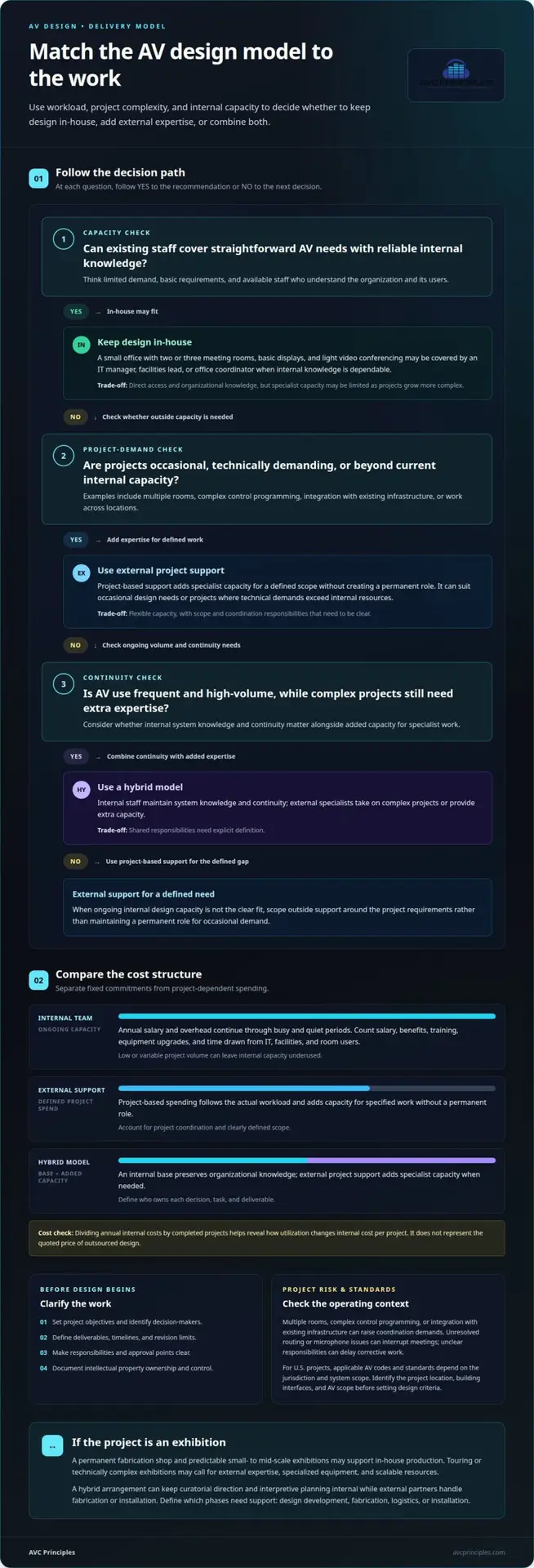
- Match the delivery model to your project volume, system complexity, and internal capacity; a hybrid approach can balance continuity with outside expertise.
- Assess how each model affects technical knowledge, decision-making, and the ability to scale resources as project needs change.
- Define deliverables and intellectual property ownership clearly to establish control over design work.
- Use a structured comparison of cost, expertise, control, scalability, and ownership to identify the model that best fits your organization.
In House vs Outsourced Design: Which Fits?
A useful cost comparison accounts for annual staffing, project volume, operational demands, and delivery risk. In the United States, applicable AV codes and standards depend on the project’s jurisdiction and system scope. No single code set applies to every installation.
Per-Project and Annual Design Costs
Dividing annual internal costs by completed projects gives a clearer view of utilization. These figures show how utilization changes internal cost per project, not the quoted price of outsourced design.
Compare annual staffing commitments with project-based spending over the same period. Project-based spending follows actual workload, while an internal role continues to incur salary and overhead through busy and quiet periods. Project volume is central to the comparison: low or variable demand can leave internal capacity underused.
In-House Team Costs and Responsibilities
An internal team may coordinate room requirements, design decisions, documentation, and support for deployed AV systems. It can also build organizational knowledge and provide on-site assistance. Annual costs include salary, benefits, training, and equipment upgrades, not salary alone.
Internal support also draws on IT, facilities, and room users’ time. For example, staff troubleshooting audio echo or display routing lose time they could spend on their primary responsibilities. Track those hours alongside payroll to identify hidden operating costs. Direct access is an advantage, but specialized capacity can make each completed project more expensive.
Production Costs, Operational Risk, and Standards
Production demands affect both the design budget and delivery risk. Projects involving multiple rooms, complex control programming, or integration with existing infrastructure require more coordination than drawing production alone. Internal teams may need additional training or equipment; external project support can add capacity for a defined scope without creating a permanent role.
For a U.S. project, applicable codes and standards depend on the jurisdiction and systems being designed. Identify the project location, building interfaces, and AV scope before setting design criteria. Operational risk also affects the cost comparison: unresolved routing or microphone issues can interrupt meetings, while unclear responsibilities can delay corrective work.
Use this comparison to separate fixed commitments from project-dependent costs:
| Option | Cost basis | Capacity | Primary trade-off |
|---|---|---|---|
| Internal team | Annual salary and overhead | Ongoing, internally available | Direct access; utilization affects unit cost |
| External project support | Scoped project expenditure | Added for defined work | Flexible capacity; scope requires coordination |
| Hybrid model | Internal base plus project support | Internal continuity with added expertise | Shared responsibilities need clear definition |
Choose a model by comparing annual workload, internal capacity, and the operational impact of delayed or incomplete design support.
Choosing a production model based on resources and project needs
Match the model to internal capabilities, project complexity, demand, and operational risk. The right arrangement may change as workloads, locations, and technical requirements evolve.
An AV design consultant’s contract and scope of work should define project objectives, decision-makers, deliverables, timelines, and revision limits. These terms clarify responsibilities and approval points before design work begins.
For a small office with two or three meeting rooms, basic displays, and light video conferencing, an internal team may be enough. An IT manager, facilities lead, or office coordinator can oversee straightforward requirements when AV demand is limited and reliable internal knowledge is available. This keeps routine decisions close to users, but specialist design capacity may be limited as projects become more complex.
Consider external design support when AV serves boardrooms, training spaces, client-facing rooms, event areas, or multiple locations. Recurring complaints about AV issues can signal that existing support is falling behind. A project-based external team can provide expertise for a defined need. Outsourced AV management is a separate service that may cover troubleshooting, system checks, software updates, user training, equipment maintenance, and long-term planning.
Demand patterns matter. Small to mid-sized businesses with occasional AV design needs may benefit from outsourcing rather than maintaining a full-time design team. Large enterprises with frequent, high-volume AV use may prefer a hybrid model: internal staff maintain system knowledge and continuity, while external specialists take on complex projects or provide added capacity.
Exhibition production calls for a separate capacity assessment. An institution with a permanent fabrication shop and predictable small- to mid-scale exhibitions may keep production in-house. Touring or technically complex exhibitions may require external expertise, specialized equipment, and scalable resources. A hybrid arrangement can retain curatorial direction and interpretive planning internally while external partners handle fabrication or installation.
When engaging an exhibition partner, define which production phases need support, such as design development, fabrication, logistics, or installation. Set project objectives, name decision-makers, establish a timeline, and define revision limits. Clear communication helps an institution retain curatorial authority while coordinating external production work.
- Choose in-house management for simple systems, low demand, and capable internal staff.
- Choose outsourced support for specialized projects, recurring problems, or variable workloads.
- Choose a hybrid model when internal continuity must coexist with outside expertise and scalability.
For complex spaces, structured AV design planning can help align system requirements with project scope and infrastructure needs.
Comparing expertise, control, cost, and scalability
Compare each model by the expertise it provides, the decisions it controls, and its ability to scale. Outsourced AV design can include requirements analysis, system design, integration planning, and documentation for the agreed project scope.
Technology Expertise and Industry Knowledge
An internal team learns the organization’s rooms, users, and operating constraints. That familiarity can support routine decisions, such as adjusting a meeting room’s camera position. External specialists bring experience across different systems and project types, which can help with complex integration requirements. The distinction is continuity and organizational familiarity versus access to specialized expertise for defined work.
Expertise affects control as well as technical quality. Internal designers stay close to day-to-day stakeholder decisions, while outsourced teams make recommendations based on the project brief. A business can retain approval authority by defining decision-makers, review stages, and design deliverables before work starts. For example, facilities staff can set room-use requirements while designated leaders approve the system design.
Expertise Matched to Project Needs
Match design capability to the system being planned. A straightforward conference room may be within an internal team’s experience; a command center or broadcast environment may require specialized coordination across audio, video, control, and infrastructure. External expertise can scale to that complexity without requiring the internal team to cover every discipline. Align specialist input with actual project requirements.
Design quality also depends on how well decisions reflect operational needs. For a training space, designers need to account for presentation, conferencing, and room use. A review process that includes end users and technical stakeholders can surface conflicts before they lead to revisions. Internal teams contribute context; specialists bring focused experience and technical analysis.
Outsourced AV Design Services
Outsourced design translates project requirements into a coordinated AV system plan. Depending on scope, it can cover room requirements, system architecture, display and projection planning, conferencing integration, sound-system design, and documentation. The key difference is access to external capacity and specialized expertise, rather than permanent staff availability.
Keep the boundaries clear: design is distinct from installation, ongoing management, and operational support. A contract should identify the design phases and deliverables included. For example, clarify whether the work covers one room or multiple spaces, and specify who approves revisions. A defined scope helps maintain control while drawing on external technical expertise.
Scalability depends on how quickly expertise can be added or redirected. An internal team offers continuity, but its capacity is limited by staff assignments and competing responsibilities. An outsourced arrangement can bring in specialists for a complex project, then conclude when the agreed design scope is complete. A hybrid model retains internal system knowledge while adding external expertise for specialized planning.
Compare the models against project complexity, flexibility needs, and decision authority. If an internal team has the knowledge and capacity for recurring, familiar work, keeping design responsibility in-house may fit. If a project requires disciplines the team does not routinely handle, external expertise can fill the gap. Make responsibilities, review points, and design approval explicit.
Confidentiality and intellectual property control
Outsourcing AV design can raise concerns about vendor conflicts, ownership of deliverables, and access to sensitive infrastructure information. The contract should define confidentiality expectations, intellectual property ownership, permitted use of project information, and the specific files the organization will receive.
Discuss intellectual property before hiring. Identify ownership of custom drawings, system schematics, control logic, specifications, and design documentation. Distinguish those deliverables from reusable methods or tools the designer brings to the project. For example, a venue may need editable room drawings and final system schedules, not just presentation files. Clear terms make future maintenance and project transitions easier to manage.
Set practical confidentiality boundaries, too. A command center design may reveal room layouts, equipment locations, or network interfaces. Define what project information can be shared, who can access it, and how files will move between the organization and external team. Naming an internal project lead and an approved file-sharing process helps prevent accidental disclosure and keep infrastructure details under controlled access.
Creative control depends on decision rights, not where designers sit. An institution can retain authority over its objectives and final approvals while an external specialist develops technical options. Set review points for the initial brief, concept design, and final documentation. At each stage, identify the approver and consolidate feedback in one response. This helps prevent conflicting instructions from different departments.
Vendor conflicts can arise when project expectations, existing supplier relationships, or preferred technologies differ. During hiring, disclose relevant constraints and document how recommendations will be evaluated. For example, require options to be assessed against room function, integration needs, and documented criteria. This creates a traceable basis for decisions without assuming that any particular vendor has a conflict.
Delivery risk often stems from late decisions, unclear revision limits, or missing information. A hybrid model can help: internal staff retain organizational knowledge and approval authority, while external designers provide defined expertise. Assign a decision-maker, agree on milestones, and document how changes affect scope. If facilities staff revise room requirements after design approval, record the change and its impact on drawings and coordination.
Before work begins, record these controls in the project documents:
- List design deliverables, file formats, and ownership terms.
- Define confidentiality boundaries and authorized access to project files.
- Name decision-makers, approval stages, and the feedback process.
- Set revision boundaries and a method for recording scope changes.
- Document how external recommendations and supplier relationships are reviewed.
These steps preserve organizational oversight while giving the external team a clear process for design development, feedback, and delivery.
In-house versus outsourced design comparison
The in-house vs outsourced AV design decision is clearer when both models are assessed under the same project conditions. The comparison below separates control, capacity, and fit across eight operating scenarios.
| Option | Cost pattern | Control | Capacity and fit |
|---|---|---|---|
| Internal support for a small office | Staff time and existing resources | Direct | Basic systems and low demand |
| Dedicated internal AV role | Ongoing salary and overhead | Direct | Recurring work and steady demand |
| Internal IT or facilities lead | Shared staff time | Close to operations | Routine needs alongside other duties |
| External project design | Scoped project expenditure | Internal approvals remain possible | Defined specialist requirements |
| Outsourced management | Agreement or project-based | Responsibilities shared by scope | Ongoing checks and support needs |
| Hybrid design team | Internal base plus external capacity | Shared by assigned responsibilities | Growing or variable workloads |
| External multi-location support | Scoped across sites | Coordination across locations | Simultaneous or distributed needs |
| Internal exhibition production | Staff, facility, and equipment costs | Direct production oversight | Predictable work and existing facilities |
The table shows why neither model has a universal cost advantage. A dedicated internal role provides continuity, but capacity remains tied to staff schedules and competing responsibilities. External design brings project-specific expertise, while internal leaders retain approval authority through defined review stages. A hybrid arrangement combines organizational knowledge with flexibility for specialized work.
Control depends on governance as much as staffing. An internal team can coordinate decisions directly, but competing priorities may slow reviews. External teams add capacity, while defined deliverables and approval points structure collaboration. A growing organization may use a hybrid arrangement to preserve internal ownership without keeping every specialty permanently in-house.
Use a consistent decision sequence: identify recurring work, assess project complexity, map available expertise, then assign design authority and review responsibilities. A boardroom refresh may suit internal coordination; a multi-location system or broadcast environment may need specialist capacity. The key question is whether the organization can sustain the expertise and delivery capacity its workload requires.
For an in-house vs outsourced AV design comparison, choose internal delivery for stable, familiar requirements and available dedicated capacity. Use external project design when defined work requires specialist input. Select hybrid delivery when continuity and scalable expertise must operate together. To align technical requirements with a delivery model, discuss your AV design requirements.
AVC Principles
AVC Principles helps organizations define AV requirements and establish a suitable design scope and delivery approach. Its AV Systems Design and ICT Infrastructure Design services can support projects where system integration, internal capacity, or technical complexity shapes the choice between in-house and outsourced design.
Turn to AVC Principles when you need to align project objectives, infrastructure requirements, and design responsibilities before implementation. A clear scope establishes where internal teams retain control and where specialist design input is needed. Contact AVC Principles to discuss your AV design requirements.
Turn the decision into a defined project brief
The decision about in-house vs outsourced AV design becomes actionable when it informs the project brief. Set out the intended outcomes, operational constraints, and internal roles responsible for approvals. This gives design work a clear starting point and aligns technical planning with how the space will be used.
AVC Principles supports this planning through AV Systems Design, ICT Infrastructure Design, and Staged Environment Engineering. These services are relevant when AV requirements intersect with building infrastructure, collaboration spaces, or staged environments. A defined brief also gives internal stakeholders a shared basis for discussing scope, priorities, and design responsibilities.
Bring the project objectives and known constraints to the discussion. The design scope can then be developed around the organization’s needs rather than an assumed delivery model.
Contact AVC Principles to discuss your AV design and identify a clear next step for your project.
Frequently Asked Questions
Cost: Which Option Actually Saves Money?
Neither model saves money in every situation; workload determines which offers better value. Compare the annual costs of internal staff, training, and tools with external project spending over the same planning period. For example, an organization with recurring design work may use internal capacity consistently, while occasional projects can leave a dedicated role underused. Account for disruption from unresolved design or coordination issues, not only direct labor or contracted work.
How do I know if my business is ready to outsource its AV needs?
Your business may be ready for external expertise when AV requirements exceed internal capabilities or recurring problems interrupt work. Frequent complaints, projects across multiple locations, or a planned command center can signal a need for specialist design capacity. Start by defining the operational issue, spaces involved, and decisions your internal team will retain. That scope helps distinguish a discrete design project from ongoing operational needs.
Is it more expensive to build an in-house AV team or outsource?
Building an internal team brings continuing staffing, benefits, training, and equipment costs, even when project demand fluctuates. Outsourcing ties spending to an agreed project scope, but coordination and revisions still require internal time. Compare the same period and workload, including staff utilization, required specialties, and competing priorities. A hybrid arrangement can preserve internal oversight while adding capacity for demanding projects.
Quick Answer: In-House or Outsourced Audio Visual Services?
Keep design in-house for recurring, familiar work that the organization can support with existing skills. Use external expertise for specialized requirements, variable workloads, or projects that exceed internal capacity. For example, an organization may manage routine room changes internally while assigning a complex broadcast environment to specialist designers. Base the decision on project requirements, not a blanket preference for either model.
What does in-house AV system design include?
In-house AV system design uses employees to translate user and facility requirements into system plans. Depending on their capabilities, the work can include room needs, system relationships, signal routing, control requirements, and design documentation. For example, an internal designer planning a training room would coordinate presentation and conferencing needs with facilities and IT. The organization must also maintain design knowledge as staff roles change.
What are the pros and cons of in-house versus outsourced AV design?
In-house design enables direct communication and builds knowledge of organizational requirements, but depends on available staff and maintained expertise. Outsourcing adds access to specialized design capacity, but requires clear scope, feedback, and ownership of deliverables. For example, an internal project lead can preserve operational context while an external designer develops a defined technical plan. The trade-off is continuity and direct oversight versus flexible access to expertise.
What skills and staff are needed for an in-house AV design team?
An internal team needs people who can gather requirements, understand AV system integration, coordinate with IT and facilities, and document design decisions. A small organization may assign coordination to an IT or facilities lead, while complex environments require dedicated technical design capacity. For example, planning a room with conferencing, displays, and acoustics calls for coordinated input, not equipment selection alone. Staff must also communicate with users and project stakeholders.
How long does AV design take in-house versus outsourced?
There is no fixed timeline that applies to both models. Design timing depends on project scope, stakeholder decisions, available technical information, and the number of review cycles. Internal work may compete with an employee’s other responsibilities; external work depends on agreed milestones and timely feedback. For example, delayed room requirements can hold up either team. A documented brief and prompt approvals help establish a workable schedule.