
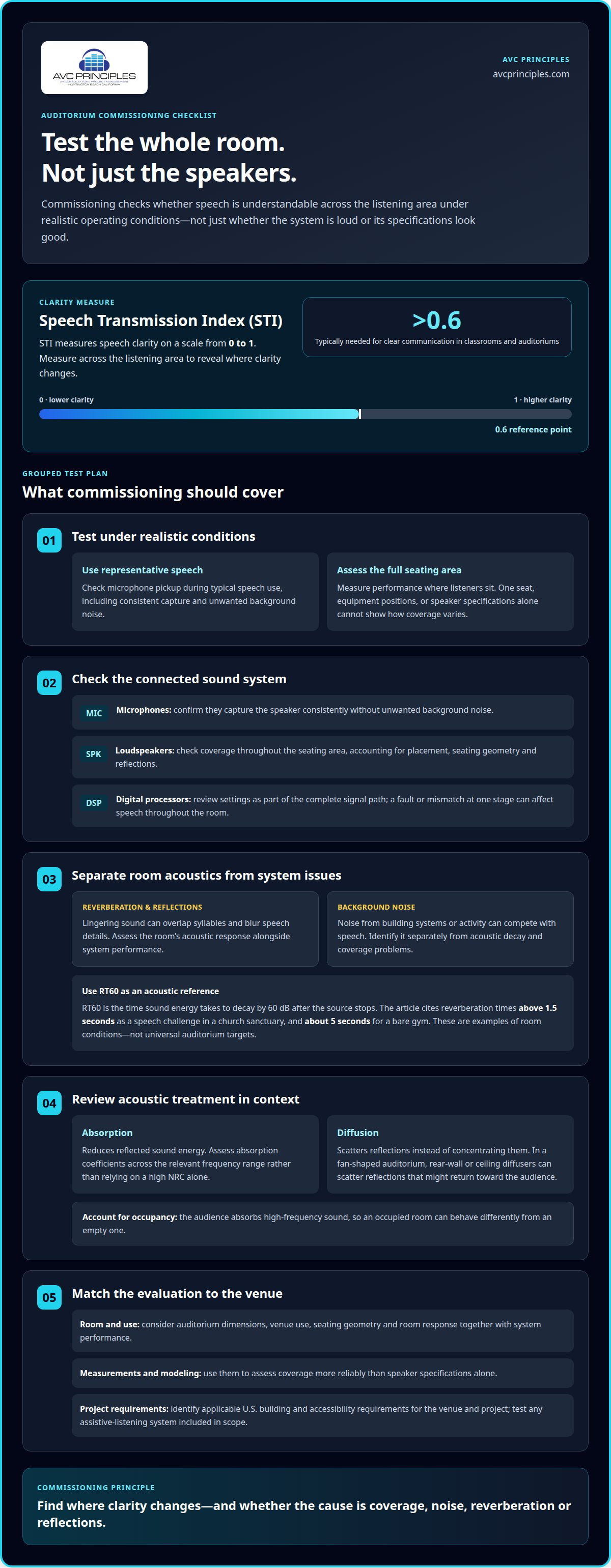
A sound system can be loud across an auditorium and still leave speech difficult to understand. Improving speech intelligibility in auditoriums requires commissioning tests that assess speech clarity, coverage, background noise and reflections under realistic operating conditions. A score above 0.6 STI is typically needed for clear communication in classrooms and auditoriums.
It’s not enough to rely on speaker specifications or a listening impression from one seat. Speech Transmission Index (STI) provides a measure of clarity on a scale from 0 to 1, while measurements across the listening area can reveal where performance changes and what may be affecting it.
This article explains what to test during commissioning, how STI helps assess speech clarity, and how echo control supports better communication in auditoriums and lecture halls. It also shows how loudspeaker coverage, room acoustics and background noise interact, helping you understand what a professional evaluation should address.
Key Takeaways
- Assess speech coverage across the listening area under realistic operating conditions, not from speaker specifications alone.
- Use STI measurements to identify where speech clarity varies and whether performance meets the needs of the room.
- Consider reverberation, background noise and loudspeaker direction together; each can affect how clearly listeners understand speech.
- Evaluate reflections and echo paths to determine whether acoustic treatment or system adjustments can improve clarity.
- Coordinate sound-system design with the auditorium’s dimensions, seating geometry and intended use.
What is Speech Intelligibility and Why Does It Matter?
Speech intelligibility is how accurately listeners understand spoken words in a room. In auditoriums, reverberation and competing sound can obscure speech, even when the sound system is clearly audible.
Reverberation time helps explain why the same announcement may sound clear near the stage but indistinct farther away.
Reverberation Time and Speech Clarity
Reverberation time measures how long sound energy continues in a room after its source stops. RT60 is the time required for sound energy to decay by 60 dB after the source stops.
That decay matters because a speaker’s next syllable can overlap with lingering sound from the last one. In a church sanctuary, reverberation times above 1.5 seconds can make speech harder to understand. During an installation assessment, professionals consider the room’s acoustic response alongside system performance, rather than treating loudness as proof of clarity.
Room geometry and surfaces influence how sound waves reflect and how quickly energy dissipates. A bare gym can have a reverberation time of about 5 seconds. In such a space, a spoken phrase may continue to reverberate after the talker has moved to the next phrase. The result is excessive overlap, not simply a voice that needs more amplification.
Reverberation and Speech Articulation
Speech articulation is the distinction between the sounds and syllables that make up spoken words. Reverberation reduces that distinction when reflected sound masks the changing details of speech.
Consonants often distinguish one word from another, but lingering sound can blur those cues into nearby sounds. A listener, for example, may catch a sentence’s general rhythm but miss a consonant that changes its meaning. The message becomes harder to follow, even if the speaker remains audible.
A reported reverberation decay rate for a very reverberant gym is about 12 dB per second. This illustrates how slowly sound may fade in a reflective room. The rate is not a universal target for auditoriums; it describes the challenge of a particular type of highly reverberant space. Improving speech intelligibility in auditoriums therefore means considering whether reflected energy interferes with articulation, not just whether the system can enhance the direct sound.
Causes of Poor Speech Intelligibility
Speech intelligibility suffers when reflected sound, background noise or weak coverage masks speech details. Reverberation can blur syllables, while noise from building systems or activity competes with the speaker.
Room response is only one factor. Loudspeaker coverage, microphone pickup and audience position also affect the balance between direct speech and reflected sound. A listener outside a speaker’s useful coverage, for example, may hear less distinct speech alongside room reflections. Commissioning should assess the listening area, not just equipment positions.
These causes can interact. In a gym with a 5-second reverberation time, added amplification alone may increase both direct sound and reflections without resolving their overlap. A professional assessment distinguishes acoustic decay from noise and coverage issues, then identifies which factors require attention. This diagnosis gives auditorium operators a clearer basis for choosing system adjustments or room treatments that address the actual source of poor intelligibility.
What Should Be Tested During Auditorium Sound System Commissioning?
Commissioning evaluates whether the complete sound system communicates clearly throughout the auditorium. Tests should reflect realistic operating conditions and account for microphones, speakers, digital sound processors, room acoustics and background noise.
Sound Absorption and Diffusion
Absorption reduces reflected sound energy, while diffusion scatters reflections instead of concentrating them. Both influence how clearly a speaker’s voice reaches listeners.
In a fan-shaped auditorium, diffusers on the rear wall or ceiling can scatter reflections that might otherwise return toward the audience. Absorbers require a frequency-based assessment: professionals consider absorption coefficients across the relevant frequency range rather than relying on a high Noise Reduction Coefficient (NRC) alone. The audience also absorbs high-frequency sound, so an occupied room can behave differently from an empty one.
Commissioning considers how the acoustic design and sound system work together. A treatment that absorbs sound effectively in one frequency range may not address another. Assessing the room’s response alongside the system helps determine whether reflections, absorption or another factor is limiting speech clarity.
Equipment and Sound Coverage
Equipment testing assesses microphone pickup, speaker coverage and digital processor performance as parts of one connected system. A fault or mismatch at one stage can affect speech throughout the auditorium.
Professionals test microphones during representative speech use, checking that they capture the speaker consistently without unwanted background noise. They assess speaker coverage across the seating area, not just near the stage, and review processor settings as part of the signal path. Seating geometry, venue dimensions, speaker placement and reflections can all create uneven coverage. Measurements and modeling offer a more reliable assessment than speaker specifications alone.
U.S. building and accessibility requirements depend on the venue and project. Commissioning should identify applicable requirements and test any assistive-listening system included in the project scope.
The cost of acoustic improvements or a sound-system upgrade depends on project scope, room dimensions, existing equipment and required acoustic treatment; pricing is provided after a quote request.
How Professionals Position and Aim Loudspeakers for Clear Speech Coverage
Loudspeaker positioning and aiming direct useful sound toward the audience’s listening plane. This matters because sound that strikes walls and ceilings can create reflections instead of reaching listeners directly.
Professionals plan speaker arrangements around venue dimensions, seating geometry, manufacturer coverage data and acoustic modeling. In worship spaces, aiming speakers toward the listening plane can reduce sound striking walls and ceilings. Commissioning then assesses coverage across seating areas under realistic operating conditions, identifying gaps or excessive overlap that may affect speech.
How Professionals Set Equalization and Delay for Speech Clarity
Equalization and delay are processor adjustments that coordinate the sound system’s response and timing. Their value depends on measured performance across the auditorium, not on applying generic settings.
During commissioning, professionals assess the processed signal through the installed speakers and adjust settings to address observed coverage or clarity issues. Delay alignment can coordinate sound from multiple speaker locations, while equalization can address frequency response. The room, system configuration and listening positions guide these decisions. Auditorium AV systems design can bring these factors together before final system configuration.
Speech Transmission Index (STI)
The Speech Transmission Index (STI) provides a numerical measure of speech clarity. In an auditorium, it helps assess how well spoken messages reach listeners throughout the audience.
Speech Transmission Index Measurement
STI measures speech intelligibility on a scale from 0 to 1, with higher values indicating better clarity. A measurement gives the auditorium team a structured way to evaluate speech transmission rather than relying on volume or a single listening position.
Professionals measure or model performance across the listening area under realistic operating conditions. They consider how the sound system, room acoustics and background noise affect speech at different audience positions. Speaker specifications alone cannot establish the STI of a completed auditorium because the installed system interacts with the space.
A clear result near the front, for example, does not prove that communication is clear at the rear. Measurements at representative listening positions reveal differences and inform commissioning decisions. STI is useful alongside coverage and room-response checks, not as an isolated equipment rating.
A listening test can indicate whether a message seems understandable, but it does not provide the same consistent numerical scale. STI gives a common reference for comparing measured or modeled speech performance across positions or system configurations. It can help distinguish a sound-transmission problem from a simple need for more volume.
Reverberation and STI Targets
An STI target is a performance benchmark for speech clarity, while reverberation time describes how long sound continues after its source stops. For clear communication in classrooms and auditoriums, a speech intelligibility score above 0.6 STI is typically needed.
Reverberation time also informs the assessment, but the appropriate value depends on the room and its use. In church sanctuaries, reverberation times above 1.5 seconds can make speech harder to understand. That figure describes a condition associated with reduced clarity, not a universal target for every auditorium.
Professionals interpret STI alongside the room’s decay, background noise and seat-by-seat performance. If a modeled or measured score falls below the 0.6 STI reference, the result identifies a need to investigate the system and acoustic conditions. The next step is to determine whether reflections, coverage or noise is limiting clarity, rather than simply increasing speaker volume.
Use STI as a commissioning benchmark, not a guarantee that every listener will perceive speech identically. Audience position and hearing ability can affect the experience. A thorough evaluation combines STI results with room measurements and listening checks, giving venue teams a fuller basis for assessing speech performance.
Controlling echoes and late reflections
Echo control addresses reflected sound that reaches listeners after the direct signal. Effective treatment considers reflection paths, low-frequency buildup and noise from building systems.
Reflection timing affects speech clarity. Early reflections arrive within the first 1/16th second after direct sound, while a later time gap extends from 1/16th to 1/4th second. Reflections within these intervals can reinforce or blur speech, depending on their timing and level. During auditorium design, professionals assess the ceiling, rear wall and side walls as possible reflection paths.
In a large, fan-shaped auditorium, diffusers on rear walls or ceilings can scatter reflections instead of sending them directly toward the audience. Their placement should suit the room’s geometry and reflected-sound paths. Absorbing treatments serve a different purpose: they reduce reflected energy. A combination of diffusion and absorption may be appropriate when neither treatment alone addresses the acoustic issue.
Low-frequency buildup requires a frequency-specific response. Bass traps are designed to absorb low-frequency energy, where ordinary thin treatments may have limited effect. Their position and construction should match the room’s acoustic behavior, rather than being selected by appearance alone. Professionals distinguish low-frequency problems from mid- or high-frequency reflections because each can affect speech differently.
HVAC equipment can introduce mechanical vibration and airflow noise into an auditorium. Vibration isolators can help reduce mechanical noise, while sound-absorbing ductwork and silencers can reduce airflow noise. If ventilation noise remains audible during a speech test, for example, assess its source and transmission path alongside the sound system.
External noise is another way sound enters the room. Traffic or nearby construction can compete with speech, even when the loudspeakers work correctly. Materials with high Sound Transmission Class ratings can help block this noise. Their suitability depends on the building envelope and the route sound takes into the room, such as through a wall or another opening.
Noise sources can combine. Three equally quiet sources together produce an overall noise level 5 dB louder than any one source alone. That means assessing only one fan or one noise path may miss the combined effect. A commissioning evaluation should consider HVAC, external noise and room reflections together, then identify which source most affects speech clarity.
Base placement and treatment decisions on the acoustic diagnosis. A professional can compare reflection paths, frequency response and background noise, then assess the result under realistic operating conditions. This avoids treating every echo as a loudspeaker problem or adding absorption when controlling HVAC noise would better address the cause.
Auditorium and lecture-hall speech clarity
Speech clarity depends on more than how loud a lecturer sounds. In auditoriums and lecture halls, listeners need distinct speech sounds, suitable background-noise levels and consistent coverage across seats. Architectural surfaces, audience absorption and speaker arrangement all affect what each listener hears.
The most important speech-intelligibility information lies roughly between 500Hz and 4kHz. A system’s response in this range can influence whether listeners distinguish consonants and follow spoken instructions. Lower-frequency reverberation can mask higher-frequency sound, so evaluating only overall volume may conceal a clarity problem. Professionals consider frequency response alongside the room’s acoustic behavior.
Signal-to-noise ratio also affects understanding. Speech understanding requires noise to be about 15 dB below the speech signal, corresponding to a 15 dB signal-to-noise ratio. At a 0 dB ratio, understanding is barely possible; a 5 dB ratio is poor, while 10 dB is described as OK. At 20 dB, speech understanding is described as excellent. These reference points show why raising speech volume alone may not resolve persistent background noise.
Listener needs matter, too. People with hearing aids or challenged hearing require about an extra 5 dB of signal-to-noise ratio for the same speech intelligibility as people with undamaged hearing. Hearing loops, infrared systems and FM transmitters can be integrated into sound systems to support people with hearing impairments. Considering these systems during auditorium planning makes accessibility part of the overall design.
Perception also differs from word recognition. Listeners may understand around 90% of sentences even when they clearly hear more than 75% of the words. A missed word can change meaning, especially in a lecture containing technical terms, names or instructions. Testing speech with representative material helps reveal whether listeners can follow the message, rather than merely hear a voice.
For speech, the average preferred loudness is about 65 dB,A. That level is a reference, not a substitute for evaluating seating positions, room noise and listener requirements. Natural speech may vary in level, while a microphone and sound system provide reinforcement. Commissioning assesses whether that reinforcement remains clear across the audience without relying on excessive volume.
Assess the room, system and listening needs together. Architectural surfaces influence reflections, audience occupancy changes absorption, and background noise competes with speech. Measurements, modeled coverage and representative listening tests help identify what limits clarity in a particular lecture hall.
Plan auditorium speech system design around room acoustics, audience needs and measured performance.
AVC Principles
AVC Principles helps auditorium teams turn speech-clarity findings into coordinated system design. Engage the firm when commissioning identifies coverage gaps, excessive reflections, background noise or a need to integrate assistive listening with the wider AV system.
Its work connects room requirements, system performance and project delivery. AV Systems Design addresses the relationship between loudspeaker coverage, processing and auditorium use. ICT Infrastructure Design supports the connected systems that underpin a venue’s technical environment. The project scope should reflect its needs and existing infrastructure.
For a new auditorium or a system upgrade, a defined brief helps establish the venue’s intended use, seating arrangement, current equipment and observed clarity issues. Contact AVC Principles to discuss your auditorium project.
Set the Next Design Phase in Motion
Improving speech intelligibility in auditoriums works best when clarity is considered early in design and carried through commissioning. If an existing room has persistent speech issues, use assessment findings to define the next project scope, from system adjustments to coordinated changes across the wider space.
AVC Principles provides AV Systems Design, ICT Infrastructure Design and Staged Environment Engineering for projects where these disciplines intersect. Set out the venue’s requirements and identified issues in a clear project brief, including its intended use, audience arrangement, existing infrastructure and communication challenges.
Move from acoustic findings to a practical project discussion. Discuss your auditorium project with AVC Principles, and take the next step toward a sound environment designed around clear communication.
Frequently Asked Questions
Why Is Sound Coverage Uneven in Large Auditoriums?
Coverage varies when room geometry, seating layout and loudspeaker arrangement do not align. A balcony overhang, angled seating block or obstructed line of sight can create different listening conditions within one auditorium. Front-row listeners, for example, may receive strong direct sound while seats beneath a balcony hear a less balanced signal. A professional assessment maps performance across seating zones and considers how each zone is used.
How do reverberation time and echo affect auditorium speech clarity?
Reverberation and distinct echoes can blur speech by adding reflected sound to the speaker’s words. Their effect depends on the location of reflective surfaces and when reflections reach the audience. A sharp repeat from a rear wall differs from a diffuse, lingering room response. A useful evaluation identifies the reflection path and affected listening locations, then determines whether speaker direction, room treatment or both should address the cause.
How Can a Professional Use Acoustic Panels, Ceiling Treatments, and Banners to Improve Auditorium Intelligibility?
Professionals select panels, ceiling treatments and banners according to the acoustic issue and frequency range involved. An absorbing ceiling treatment, for example, may address reflections from above, while strategically placed banners can add absorption in a large hall. Material selection should account for absorption across frequencies, not just a single rating. Placement and coverage matter: poorly targeted materials may leave the main reflection path unchanged.
How Can Professional Microphone Selection, Placement, and Sound-System Tuning Improve Speech Intelligibility?
Microphone selection and placement help capture the intended speaker while limiting unwanted room sound. A lectern microphone, for example, should suit the presenter’s position and speaking style; a handheld microphone serves a different use. Professionals then assess the signal path and tune system settings for the room and audience areas. The goal is consistent, intelligible speech, not simply greater volume.
How Can Professionals Reduce Background Noise and HVAC Noise in an Auditorium?
Professionals reduce noise by identifying its source and controlling its path into the listening space. HVAC noise may come from mechanical vibration or airflow, while traffic noise can enter through the building envelope. Vibration isolation, sound-absorbing ductwork, silencers or higher-rated sound-blocking materials can address different causes. Assess noise during normal room operation, since quiet conditions alone can conceal issues that affect presentations.
What tests measure auditorium speech intelligibility, such as STI or STIPA?
STI provides a numerical measure of speech intelligibility, and professionals can measure or model performance at representative listening positions. Commissioning should also assess coverage and background noise under realistic operating conditions. If STIPA is proposed, the test plan should explain how its result relates to the project’s STI assessment and which locations it covers. A single reading cannot describe performance throughout a large auditorium.