
A video stream can be available yet still frustrate viewers with buffering, slow startup, or inconsistent picture quality. Video distribution network engineering addresses these issues by coordinating adaptive bitrate streaming, quality-of-experience (QoE) measurement, and traffic engineering across the delivery path. Each addresses a different factor: changing connection capacity, viewer-perceived performance, or network load.
Viewers expect streams to remain clear as conditions change. Adaptive bitrate streaming selects a suitable video quality as available bandwidth shifts, while QoE measurement shows how those choices affect playback. Traffic engineering manages how content moves through the network, aligning delivery with demand and available capacity.
This article explains how these mechanisms work together, what each contributes, and where their limitations matter. It explores the relationship between bitrate decisions, viewer experience, and traffic distribution, showing how integrated design can support consistent video delivery across devices and network conditions.
Key Takeaways
- Understand how adaptive bitrate streaming adjusts video quality as network conditions change, and why that adjustment alone cannot address every delivery issue.
- Use quality-of-experience measures to identify playback problems from the viewer’s perspective, rather than relying only on network performance indicators.
- See how traffic engineering directs video flows across available network paths to manage congestion and support efficient delivery.
- Recognize the roles of content sources, encoding, distribution infrastructure, and playback devices in the end-to-end delivery chain.
- Learn how coordinated network design can address latency and availability requirements by aligning system architecture with the intended use.
Adaptive Bitrate Streaming
Adaptive bitrate streaming adjusts video quality to the connection available at each viewer’s device. Common delivery options include HLS and MPEG-DASH over HTTP. The protocol affects how players request media segments and manifests.
Adaptive bitrate delivery
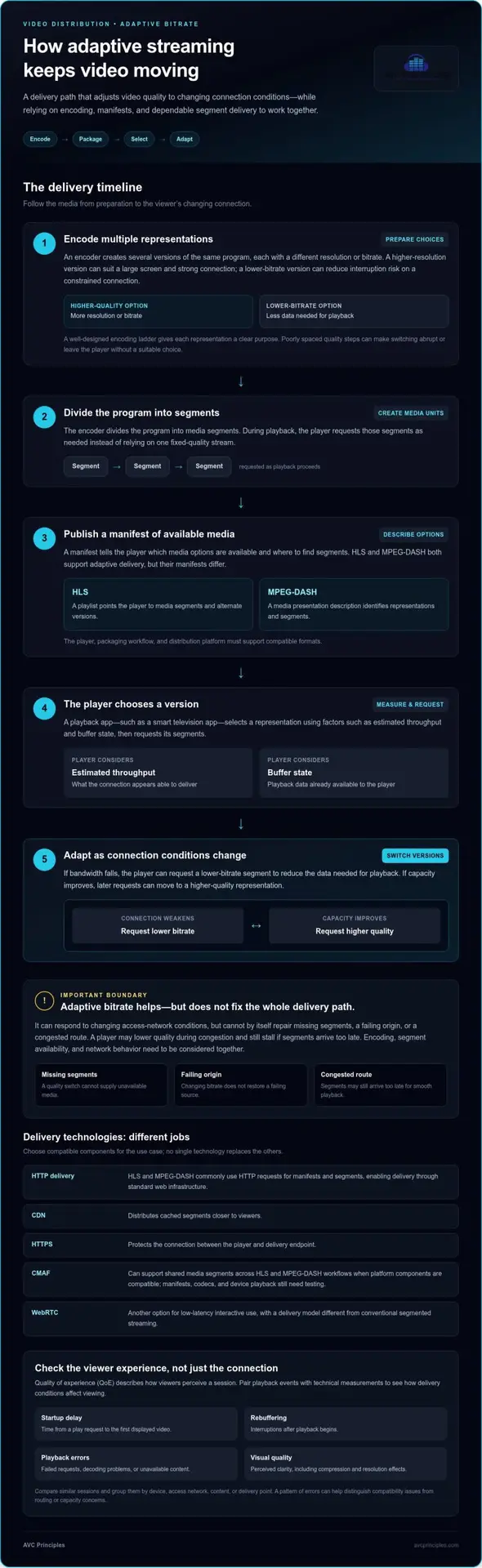
Adaptive bitrate streaming encodes one program into multiple versions, each with a different resolution or bitrate. A player, such as a smart television app, selects among them as viewing conditions change. This can keep playback going when bandwidth falls, rather than relying on one fixed-quality stream.
An encoder prepares the different versions, called representations, and divides the program into segments. A manifest for HLS or MPEG-DASH describes the available media options and segment locations. As playback proceeds, the player requests segments and chooses a version based on factors such as estimated throughput and buffer state.
Consider a viewer whose connection weakens during a live event. The player can request a lower-bitrate segment, reducing the data needed for playback. If capacity improves, later requests can switch to a higher-quality representation. Switching depends on the player’s measurements and the versions available, so a well-designed encoding ladder matters.
Each representation should serve a clear purpose. A high-resolution version can suit a large screen and strong connection, while a lower-bitrate version can reduce interruption risk on a constrained connection. If quality steps are poorly spaced, the player may switch too abruptly or lack a suitable option.
Adaptive selection has limits. It can respond to changing access-network conditions, but cannot fix missing segments, a failing origin, or a congested route on its own. For example, a player may lower quality during congestion and still stall if segments arrive too late. Delivery design must consider encoding, segment availability, and network behavior together.
Video distribution protocols and technologies
Video distribution protocols define how players locate, request, and receive media. HLS and MPEG-DASH commonly use HTTP requests for manifests and segments, enabling delivery through standard web infrastructure. The choice matters because the player, packaging workflow, and distribution platform must support compatible formats.
For example, an HLS workflow provides a playlist that directs the player to media segments and alternate versions. MPEG-DASH uses a media presentation description to identify available representations and segments. Both support adaptive delivery, but their manifests differ. Packaging and playback support must match the target devices.
HTTP delivery can use a content delivery network (CDN) to distribute cached segments closer to viewers. HTTPS protects the connection between the player and delivery endpoint. These technologies address different needs: caching supports distribution, while encryption protects data in transit. Neither replaces correct encoding or reliable segment generation.
Common Media Application Format (CMAF) can support shared media segments across HLS and MPEG-DASH workflows when platform components are compatible. This can reduce duplicate packaging, but manifests, codecs, and device playback still need testing. For low-latency interactive use, WebRTC is another option because its delivery model differs from conventional segmented streaming.
Choose a protocol based on the delivery use case. A recorded presentation, live sports stream, and interactive video session have different latency and playback requirements. Testing HLS, MPEG-DASH, or WebRTC on representative devices helps reveal compatibility issues before distribution reaches viewers.
Quality of experience
Quality of experience (QoE) describes how viewers perceive a video session, not simply how the network performs. Engineers assess indicators such as startup delay, rebuffering, playback errors, and picture quality. Together, these measures show whether delivery conditions affect the viewing experience.
Network quality of service (QoS) and viewer QoE are related, but answer different questions. Packet loss or congestion may indicate a network issue; a rising rebuffering rate shows how that issue affects playback. For example, a network path may report stable throughput while viewers experience slow starts because the video service responds slowly.
Useful QoE analysis combines session-level events with technical measurements. A playback record can capture when a viewer pressed play, when video began, whether playback stalled, and which representation the player selected. Engineers can compare these events with delivery logs to locate where performance changed.
- Startup delay: Time between a play request and the first displayed video.
- Rebuffering: Interruptions after playback begins, often visible as repeated stalls.
- Playback errors: Failed requests, decoding problems, or unavailable content.
- Visual quality: Perceived clarity, including the effects of compression and resolution.
These indicators need context. A single playback error may have a different cause from repeated stalls across a region. Engineers can group sessions by device type, access network, content, or delivery point. Errors concentrated on one device model may point to compatibility; rising stalls around one delivery location may suggest routing or capacity issues.
Measurement also needs a clear baseline. Compare similar sessions, such as the same live event on equivalent devices, instead of combining unrelated viewing patterns. A live stream has different timing demands from an on-demand film. This distinction helps teams determine whether a change relates to the service, content workflow, or viewer conditions.
Objective video-quality tools can provide another perspective. VMAF, for example, estimates perceptual video quality by comparing encoded video with a reference. It can help evaluate encoding choices, but it does not describe the entire session. A strong visual score cannot account for delayed startup, stalled playback, or a failed stream.
For practical analysis, connect viewer symptoms to system evidence. If startup delay increases, inspect manifest retrieval and the first segment request. If playback stalls, compare segment delivery times with player buffer events. If errors appear after a release, examine changes to packaging or device playback. This sequence turns QoE data into a diagnostic starting point.
Reliable QoE assessment combines viewer-facing indicators, system telemetry, and meaningful comparisons. In video distribution network engineering, this evidence helps distinguish a poor viewing outcome from its underlying technical cause. Teams can then focus on the part of the delivery chain most closely linked to the problem.
Video traffic engineering
Traffic engineering directs video flows across network paths and delivery systems. Its design balances viewer demand, available capacity, latency, and resilience.
Network types and distribution models
CDNs, IPTV networks, and broadcast distribution networks use different architectures, which shape how traffic is managed. A CDN distributes internet-delivered content through edge locations; IPTV carries television services over managed IP networks; broadcast networks distribute programming through broadcast infrastructure.
For example, a public on-demand service may use a CDN to serve viewers across regions, while an IPTV service operates within a provider-managed network. Broadcast distribution can reach audiences through transmission infrastructure rather than individual internet requests. Relevant United States regulatory and standards considerations depend on the service, its content, and its distribution model. Assess applicable content rights, privacy, accessibility, and security requirements during system planning.
Network building and operating costs
Network costs cover the infrastructure and resources needed to build, operate, and maintain delivery. In the United States, costs depend on the project. Factors include coverage, capacity, redundancy, equipment, content delivery, and operational requirements.
A small internal video service and a multi-region public platform have different demands. For example, broad geographic coverage may require more delivery capacity than a single-site network. Operating expenses also depend on traffic patterns, storage, encoding, connectivity, and support arrangements. Model expected usage and peak demand before comparing architecture options.
Core network components
A video distribution network combines content preparation, delivery infrastructure, and playback endpoints. An encoder prepares source video, an origin stores packaged content, and a CDN or managed IP network carries it toward viewers. A player on a television, computer, or mobile device requests and decodes the stream.
Planning, deployment, and testing form a connected sequence. Define the audience, content type, and coverage needs; select an architecture; then configure encoding, origins, routing, and playback. Test representative devices and network conditions before release. Use actual streams to check startup, playback continuity, and failure recovery.
Common failures include unavailable origins, broken manifests, failed segment requests, routing problems, and device incompatibility. Security risks include unauthorized access, exposed credentials, and unprotected data flows. Access controls and secure connections, for example, help protect administrative interfaces and delivery traffic. Monitoring should link viewer symptoms with system events so teams can identify the affected component.
Latency and availability design
Low-latency and high-availability design reduces unnecessary delivery delays while limiting single points of failure. Engineers can place content closer to viewers, remove avoidable processing stages, and select a delivery model suited to live or on-demand content. Each choice affects performance and operational complexity.
For a live event, teams can examine the path from source capture through encoding, packaging, network delivery, and playback. Extra processing or long delivery routes can add delay. Redundant origins or paths can provide alternatives when a component fails, provided routing and failover behavior are designed and tested.
Testing should include planned failure scenarios, such as an unavailable origin or disrupted route. Confirm that monitoring detects the event and recovery restores delivery without creating further playback issues. Traffic engineering brings these decisions together: route selection, capacity allocation, and redundancy must reflect the service’s latency and availability priorities.
What are the main components of a video distribution network?
A video distribution network connects content sources to viewer devices through processing, storage, delivery, and control systems. A live sports feed, for example, travels from capture equipment through encoding and packaging before reaching a television or browser.
Source and ingest. Cameras, production switchers, and playback systems create the source feed. An ingest point receives that feed and passes it into the video workflow. For a live event, engineers consider how the source connects, how signals are synchronized, and where faults could interrupt incoming content.
Encoding and transcoding. An encoder converts source video into compressed digital formats for distribution. Transcoding creates additional versions for different devices, resolutions, or available bandwidth. Codec compatibility matters: encoder output must match what the intended players can decode. Processing settings also affect the balance among visual detail, file size, and delivery requirements.
Packaging and origin storage. A packager organizes encoded media into formats that compatible players can request. It creates manifests or playlists and makes media segments available from an origin server. For on-demand content, the origin stores prepared assets; for live video, it supplies newly produced segments as the event continues. Correct manifests and accessible segments are essential for playback.
Distribution and network paths. A content delivery network (CDN) can cache media at edge locations, reducing the distance between content and viewers. In a managed IPTV environment, distribution may instead use a controlled IP network. Routers, switches, and network links carry traffic between systems. The delivery model determines where capacity, routing, and redundancy need attention.
Playback and display. A player on a smart television, computer, or mobile device reads the manifest, requests media, and decodes the selected stream. The display presents the result to the viewer. Device testing matters because operating systems, browsers, and hardware may support different codecs or playback features.
Control, security, and monitoring. Management systems configure components and help operators monitor delivery. Authentication controls access to administrative interfaces, while encryption can protect connections between systems. Logs and monitoring data help trace failures from symptoms to components, such as a failed ingest connection, unavailable origin, or unsuccessful segment request.
These components form an end-to-end chain, not a collection of independent systems. A player error, for example, may originate in a manifest, encoding output, or network route. Mapping interfaces between ingest, processing, packaging, delivery, and playback helps engineers identify dependencies and test the complete path before deployment.
How do engineers design a video distribution network for low latency and high availability?
Engineers design for latency and availability by mapping the complete delivery path, then identifying delays and failure points. For a live sports stream, that path can include capture, encoding, packaging, origin storage, network delivery, and viewer playback. Each stage adds processing time or operational risk, so design decisions must account for the whole system.
Start with the service requirement. An interactive video session needs a different latency profile from an on-demand film, while a live event must keep content moving close to real time. Engineers assess the playback model, audience locations, devices, and network conditions. These factors guide choices about encoding, segment handling, delivery routes, and system placement.
Reduce avoidable delay at each stage. A production team can review encoding and packaging workflows for unnecessary processing, then assess whether content travels along an unnecessarily long route. A content delivery network can place cached media closer to viewers. For interactive use, WebRTC may suit a different delivery pattern from segmented HLS or MPEG-DASH.
High availability depends on managing component and path failures. Engineers identify critical dependencies, such as an origin server, network link, or packaging service. Redundant components can provide alternate routes or resources, but redundancy only helps when failover behavior is designed and tested. A backup origin that cannot serve valid content will not restore playback.
Traffic planning must also account for changing demand. A live event can concentrate requests at the same time, placing pressure on delivery capacity. Engineers model expected audience distribution and identify where congestion could occur. They then assess capacity allocation, route selection, and CDN placement against expected traffic patterns.
- Map the path: Trace the stream from capture through playback, including every processing and delivery stage.
- Locate delay: Compare timestamps or system logs across encoding, packaging, and delivery.
- Identify dependencies: Record which components or links could interrupt the stream.
- Test recovery: Simulate an unavailable origin or disrupted route and observe playback restoration.
Monitoring makes these design choices operational. Teams can, for example, correlate rising startup delays with origin response or delivery-path data. Playback errors during a route change can show whether failover directs viewers to a functioning endpoint. Test normal operation and planned disruptions, then refine routing and recovery behavior based on observed system evidence.
AVC Principles can help translate these requirements into coordinated system planning. Discuss network architecture when a project needs engineering decisions aligned across video workflows, infrastructure, and operational use.
AVC Principles: AV Systems Design
AVC Principles provides AV Systems Design for organizations planning integrated video environments. When delivery depends on coordinated audiovisual systems and network infrastructure, design decisions should reflect how content is created, routed, and used within the space.
AV Systems Design and ICT Infrastructure Design can align system requirements, network architecture, and operational workflows during project development. This is relevant to venues such as auditoriums, command centers, and sports arenas, where video distribution forms part of a wider technical environment. Early design coordination can clarify system interfaces and infrastructure needs before implementation.
For a project involving video systems and connected infrastructure, contact AVC Principles to discuss your design requirements.
Turn Delivery Requirements Into a Design Brief
The next step is to translate performance priorities into a coordinated project brief. Define the intended viewing environments, operational needs, and how the system will integrate with the venue’s wider infrastructure. This gives stakeholders a shared basis for evaluating design decisions throughout planning and implementation.
For projects where audiovisual performance depends on the surrounding network and built environment, consider video distribution network engineering as part of the complete system design. AVC Principles’ AV Systems Design, ICT Infrastructure Design, and Staged Environment Engineering can support coordination across connected project requirements.
Bring your project goals and system requirements together in a focused design discussion. Contact AVC Principles to discuss your needs and identify a clear path from requirements to design.
Frequently Asked Questions
What is video distribution network engineering?
Video distribution network engineering is the design and integration of systems that move video from its source to its intended viewers. It considers how production equipment, encoding, network transport, platform interfaces, and playback devices work together. For example, a corporate presentation delivered to remote offices may require different network and system decisions from video displayed within one venue. The engineering work aligns those technical requirements with the intended viewing environment.
What bandwidth and capacity are needed for video streaming networks?
Required capacity depends on each stream’s bitrate, the number of simultaneous viewers, and the traffic sharing network links. To estimate demand, identify expected concurrent streams, add their delivery bitrates, then account for protocol overhead and other network traffic. A live event with a concentrated audience may create a different peak load from on-demand viewing spread across the day. Network topology, redundancy, and expected growth also shape capacity planning.