
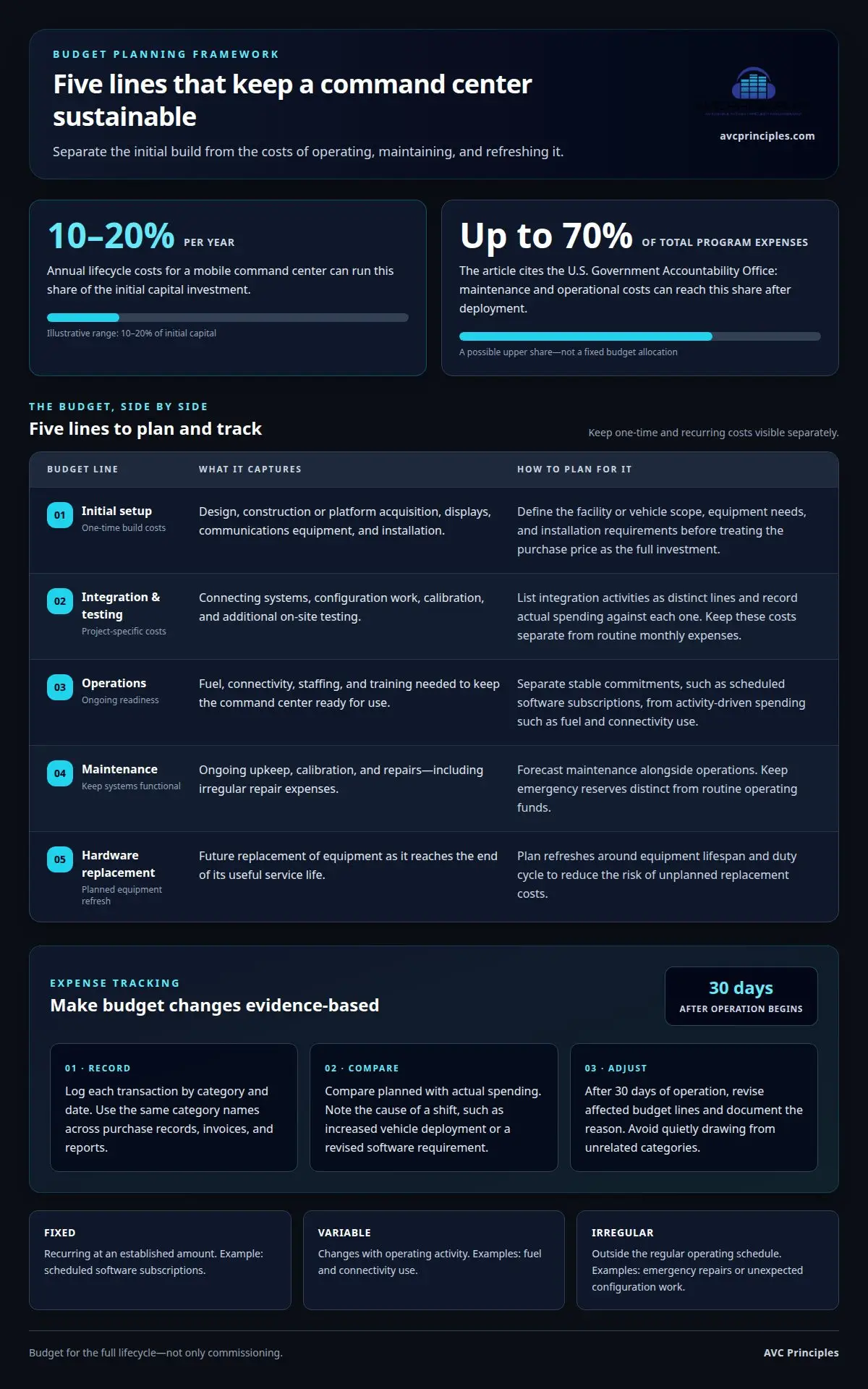
A command center budget is incomplete if it ends at commissioning. To budget for a new command center in 2026, use five lines: initial setup, integration and testing, operations, maintenance, and hardware replacement. For a mobile command center, annual lifecycle costs can run 10-20% of the initial capital investment, so upkeep and replacement need a place in the budget from the start.
It’s reasonable to focus first on equipment and construction. But fuel, connectivity, staffing, calibration, and maintenance also shape the cost of operating a command center. Leave them out, and a setup that looks affordable upfront may be difficult to sustain.
This article explains how to structure a five-line budget, account for unexpected expenses, and plan for ongoing costs and equipment refreshes. You’ll see how the main cost categories relate, which factors can shift the budget, and how to set aside funding for maintenance and replacement without treating the purchase price as the full investment.
Key Takeaways
- Separate startup costs from recurring operations so the initial build doesn’t obscure the resources needed to keep the command center functional.
- Use a five-line budget framework to organize setup, unexpected expenses, operating costs, maintenance, and hardware replacement.
- Assess low-budget and DIY options by their operational needs, not just their upfront cost.
- Account for fuel, connectivity, staffing, and training when estimating the cost of keeping a mobile command center ready for use.
- Plan hardware replacement around equipment lifespan and duty cycle to reduce the risk of unplanned refresh costs.
Adjusting budgets for unexpected expenses
Build an adjustment process into the command center budget before an emergency disrupts operations. Separate predictable costs from variable spending and irregular expenses, then update forecasts using actual spending.
Fixed and Variable Expense Tracking
Fixed expenses recur at an established amount, while variable expenses change with operating activity. Scheduled software subscriptions, for example, are fixed, while fuel and connectivity use can vary. Tracking both categories shows which commitments remain stable and which respond to mission demands. That distinction makes forecasts more realistic when an unexpected expense competes with routine operations.
Record each transaction by category and date in a budget ledger or finance system. Compare planned with actual spending each month, separating recurring commitments from usage-based costs. The comparison can reveal whether connectivity or fuel is consuming more funds than the operating plan allows. Update the affected budget line instead of quietly drawing from unrelated categories.
Keep the tracking process consistent. Use the same category names across purchase records, invoices, and internal reports so changes remain visible. When a cost shifts, note the cause, such as increased vehicle deployment or a revised software requirement. This record helps distinguish a temporary fluctuation from a continuing change that calls for a budget adjustment.
Irregular and Integration Costs
Irregular expenses fall outside the regular operating schedule, while integration costs arise as systems are connected and tested. An emergency repair, unexpected configuration work, or additional on-site testing can change the project forecast. Keep these items separate from fixed commitments to clarify which funds support planned operations and which cover unplanned demands. This also prevents a one-time expense from distorting the recurring budget.
Treat these as project costs, not routine monthly expenses. List integration activities as distinct budget lines, then record actual spending against each one. This makes overruns easier to locate and shows whether additional work stems from system interfaces, calibration, or testing requirements.
According to the U.S. Government Accountability Office, maintenance and operational costs can account for up to 70% of total program expenses after deployment. That figure makes post-deployment costs central to budget adjustment, rather than a secondary reserve. Keep operating and maintenance forecasts visible alongside integration spending, so unexpected project costs don’t erase funds needed to sustain the center.
After 30 days of operation, compare actual spending with the original forecast and revise affected categories. For example, if actual connectivity expenses differ from the estimate, adjust that line and document the cause. Keep emergency reserves distinct from routine operating funds. This approach lets decision-makers respond to a changing situation without automatically treating every variance as a permanent increase.
DIY command center costs and low-budget setups
DIY costs depend on whether the setup is a household planning station or an operational command environment. These examples suit basic organization, not mission-critical communications or coordinated operations.
Reusing an existing tablet or monitor can reduce the initial equipment outlay, but subscriptions, mounting, setup, and replacement still affect total cost. A digital display also needs a defined role, such as showing schedules or shared information, before its cost can be assessed usefully.
For a mobile command center, the vehicle platform is a separate, substantial budget category. Platform selection depends on required mobility, operating environment, and the equipment the vehicle must support.
Subscription costs recur after purchase, so list each software or connectivity subscription separately from one-time device spending. Record the renewal frequency and the function each subscription supports. This makes recurring commitments visible during budget reviews and helps distinguish essential operating capability from optional features.
There is no single average cost to build a new command center that applies across projects. The total depends on facility or vehicle scope, equipment, integration, installation, and operating requirements. Typical cost categories include design, construction or platform acquisition, displays and communications equipment, installation, and recurring subscriptions. Their relative weight varies with the system’s scale and intended use.
Renovating or expanding an existing facility may allow you to reuse usable space and infrastructure, while a new build requires its own site and construction scope. Compare the condition of existing systems, required capacity, integration needs, and changes needed to support operations. Size and location also affect the space, infrastructure, and site work required.
Applicable building, accessibility, and security requirements depend on the site, facility use, and project scope in the United States. Federal, state, and local requirements may all apply, so the design must account for the rules and authorities relevant to the site and occupancy.
Federal, state, or local grants and incentives may be available when a project fits a program’s purpose and eligibility criteria. Because funding depends on the applicant, location, and project scope, list potential awards as a separate funding assumption, not guaranteed project revenue.
For a complex facility or integrated system, Command and Control Center Design can help align the planned environment with its operational requirements.
There is no single average cost that applies across projects. The total depends on facility or vehicle scope, equipment, integration, installation, and operating requirements.
Fuel, connectivity, staffing, and training
A mobile command center’s operating budget must cover more than its vehicle and installed systems. Fuel, communications, staffing, and training support readiness, but their demands shift with deployment frequency and mission requirements. Separate these categories so decision-makers can prioritize essential capacity and see which operating assumptions affect spending.
Estimate fuel from the vehicle’s planned use, routes, and deployment schedule. A unit that travels to multiple sites has different fuel demands from one kept close to its base. Track actual fuel use against scheduled deployments, then update the forecast when operating patterns change. This ties the estimate to real activity rather than an initial assumption.
Connectivity planning should account for the networks and backup paths required at deployment locations. Record that expenditure in the connectivity line, separate from recurring network service. Design decisions should reflect where the unit operates and how it maintains communications when a primary connection is unavailable.
Software, cybersecurity, and network infrastructure costs depend on system scope and operating requirements. Software licensing and support, network components, integration needs, security controls, and connectivity all shape the budget. List these elements separately, then identify which are initial costs and which recur. This structure helps teams set priorities without relying on unsupported dollar estimates.
Staffing is also an operating cost. Many mobile command center units require at least 1-2 full-time equivalent staff to keep the vehicle ready, maintained, and deployment-capable. Budget for that capacity alongside fuel and connectivity, rather than treating staff availability as incidental. The required workload depends on readiness expectations, maintenance duties, and deployment demands.
Tie training to the systems and tasks personnel must use. For example, operators need to understand communications procedures and the command center’s installed technology. Include training time and materials as distinct budget items, then plan for updates when workflows or systems change. This separates initial familiarization from recurring instruction.
Operational efficiency also has a budget consequence. Manual screen sharing or verbal briefings can delay relevant incident data by 5 to 10 minutes. That delay can affect how quickly personnel receive information and act on it. Budget discussions should therefore consider not only equipment and staffing costs, but also how communication workflows support timely coordination.
Review the four categories together before approving the operating plan. If connectivity redundancy is a priority, confirm that fuel and staffing assumptions still support deployment. If staffing is constrained, account for how readiness and training tasks will be covered. A clear allocation makes trade-offs visible and gives managers a practical basis for adjusting resources as operational demands change.
Hardware lifespans and duty-cycle considerations
Replacement planning starts with expected service life and daily operating demand. A display used continuously has a different duty cycle from equipment activated only during deployments. Record each component’s role, operating pattern, and expected refresh period. This creates a practical replacement schedule instead of treating every device as if it ages at the same rate.
Direct View LED displays used in mission-critical environments are listed with a 100,000-hour lifespan. LCD panels are listed with a 50,000-hour half-life. These figures provide planning reference points, not interchangeable measures. A half-life describes a change in panel brightness, while a lifespan estimate relates to expected operating duration. Budget each screen according to its technology and operational role.
Duty cycle matters because continuous operation places ongoing demands on equipment. A primary display wall may remain active through extended shifts, while a backup screen may see less use. Track operating hours where available and connect them to maintenance records. This evidence helps forecast when performance changes could affect visibility or require a planned replacement.
Communications equipment in mobile command centers frequently has a 5-10-year refresh cycle. A refresh plan should identify which devices need replacement together and which can remain in service independently. For example, budgeting for communications equipment by lifecycle group can reduce the risk of a dated component limiting a newer system. Aligning refresh timing with operational priorities also supports orderly procurement.
A well-maintained mobile command center typically remains operational for 10 to 15 years. Organizations budgeting for permanent or enterprise mobile command centers should account for estimated 10-15 year replacement cycles. These timelines apply to the center or platform, not necessarily every installed component. A lifecycle schedule should therefore distinguish vehicle or facility planning from shorter equipment refresh intervals.
Build the replacement reserve around the equipment inventory. For each display, communications device, and supporting system, record its expected service period, duty cycle, and operational importance. Then map the anticipated refresh to the budget period when it will occur. This makes replacement a planned expenditure rather than an emergency request triggered by component failure.
Review the schedule when operational requirements change. A command center that shifts from occasional deployment to consistent use may place more demand on screens and communications systems. Update expected operating hours and move affected equipment into the appropriate refresh plan. A clear record of duty cycle, maintenance, and planned replacement keeps lifecycle decisions connected to actual use.
Five-line command center budget worksheet
A five-line worksheet turns the question of how to budget for a new command center in 2026 into a clear financial structure. It separates setup, unexpected expenses, operations, maintenance, and hardware replacement so each project phase remains visible.
Budget Worksheet Categories
Use one line for each major cost category: setup, unexpected expenses, operations, maintenance, and hardware replacement. This worksheet helps decision-makers see how funding moves across the project lifecycle. For example, place a planned screen refresh under replacement, while recurring service commitments belong under operations. Keep estimates, actual spending, and assumptions visible beside each category.
Label one-time and recurring costs separately within each line. This prevents an installation expense from being mistaken for a monthly commitment. Compare estimates with actual spending monthly and record the reason for any variance. A consistent record helps finance and technical teams interpret the same figures and identify which budget assumptions need adjustment.
Planning Steps and Timeline
Plan from operational requirements through design, cost allocation, implementation, and post-deployment review. This sequence connects scope decisions with funding before purchasing or installation begins. Set the timeline around the work required in each phase, including integration, testing, and commissioning, rather than relying on a generic schedule.
First, define the command center’s operational purpose and system scope. Next, assign anticipated costs to the five worksheet categories and note when each expense is expected. During implementation, compare commitments with estimates and document changes. After deployment, use operating results to refine future forecasts. These stages provide a practical framework for teams deciding how to budget for a new command center in 2026.
For example, setup covers the initial facility or vehicle platform, core equipment, and installation. The unexpected-expense line records identified risks that could change the approved scope. Operations includes recurring obligations, while maintenance tracks planned service activity. Hardware replacement captures future refresh needs. Keep project estimates distinct from operating costs so each line has a clear purpose.
Write the assumptions beside each estimate. Note whether it represents a one-time activity or an ongoing commitment, and identify the project phase when the cost applies. When scope changes, update the affected line and preserve the reason for the adjustment. This creates a traceable record for reviews and makes it easier to understand how to budget for a new command center in 2026 as requirements evolve.
Use the worksheet as a shared control document through design and commissioning. A monthly review can compare approved allocations with actual commitments, highlight upcoming obligations, and show where forecasts have shifted. For project planning grounded in operational requirements, develop your command center project plan.
AVC Principles: Command and Control Center Design
AVC Principles provides Command and Control Center Design to align the facility, technology, and operational requirements within a coordinated project scope. This is the natural next step when budget planning needs to move from broad cost categories to an integrated design.
AV Systems Design and ICT Infrastructure Design address the audiovisual and network systems that support command center operations. Where the environment includes staged or event-based requirements, Staged Environment Engineering can inform that part of the design. These disciplines connect system-scope decisions with setup, integration, and lifecycle planning.
Bring your operational requirements and budget priorities to AVC Principles to discuss Command and Control Center Design.
Turn Budget Priorities Into a Project Brief
Planning how to budget for a new command center in 2026 is only the start. The next step is to translate funding priorities into a design brief that connects operational needs, user workflows, facility requirements, and system integration. Clear scope gives project stakeholders a shared basis for evaluating decisions as planning advances.
AVC Principles offers AV Systems Design, ICT Infrastructure Design, and Staged Environment Engineering. These services can inform the design brief when audiovisual systems, network infrastructure, or staged environments are part of the project. A coordinated design approach brings technical and operational requirements into the same planning conversation.
Set out the intended use, operating environment, and priorities for the command center before moving into detailed design discussions. This gives the project a defined starting point and helps clarify which decisions need attention first. Discuss your needs with AVC Principles to consider how Command and Control Center Design can support your planning. A clear brief is a practical foundation for the work ahead.
Frequently Asked Questions
How should I budget for maintenance or replacement?
Use an asset register to connect each major component with its condition, maintenance history, and replacement priority. For example, a display with recurring faults may need attention before a less critical backup device. Separate planned servicing from replacement funding, then review both during budget planning. This helps identify which costs can be scheduled and which risks could interrupt operations if deferred.
How much do command center video walls, consoles, and AV systems cost in 2026?
Costs depend on project scope and system configuration, including display requirements, console layout, integration, and installation. A video wall designed for one room may differ substantially from a system supporting multiple operational roles. Separate equipment and installation assumptions from design and integration requirements in the estimate. The service fee for a specific project depends on its scope and is provided after a quote request.
How much should a command center budget for staffing, training, and ongoing maintenance?
Set these allocations from the operating model: staff responsibilities, required competencies, training needs, and maintenance tasks assigned to each system. For example, distinguish operator instruction from technical training for personnel responsible for system configuration. Record who owns each task and when it must occur. This connects funding to responsibilities and helps prevent operational duties from being overlooked during budget reviews.
What contingency percentage should be included in a command center budget, and what cost risks should be planned for?
Build contingency from identified project risks rather than applying an unsupported blanket percentage. Review scope changes, site conditions, system integration dependencies, testing requirements, and equipment delivery assumptions. Assign each risk to the budget line it could affect, with a clear rationale for the reserve. This makes contingency traceable and helps decision-makers distinguish a specific exposure from general uncertainty.