
Home /
AV Consulting That Prevents Costly Field Changes
October 1, 2026·15 min read
·
2,928 words 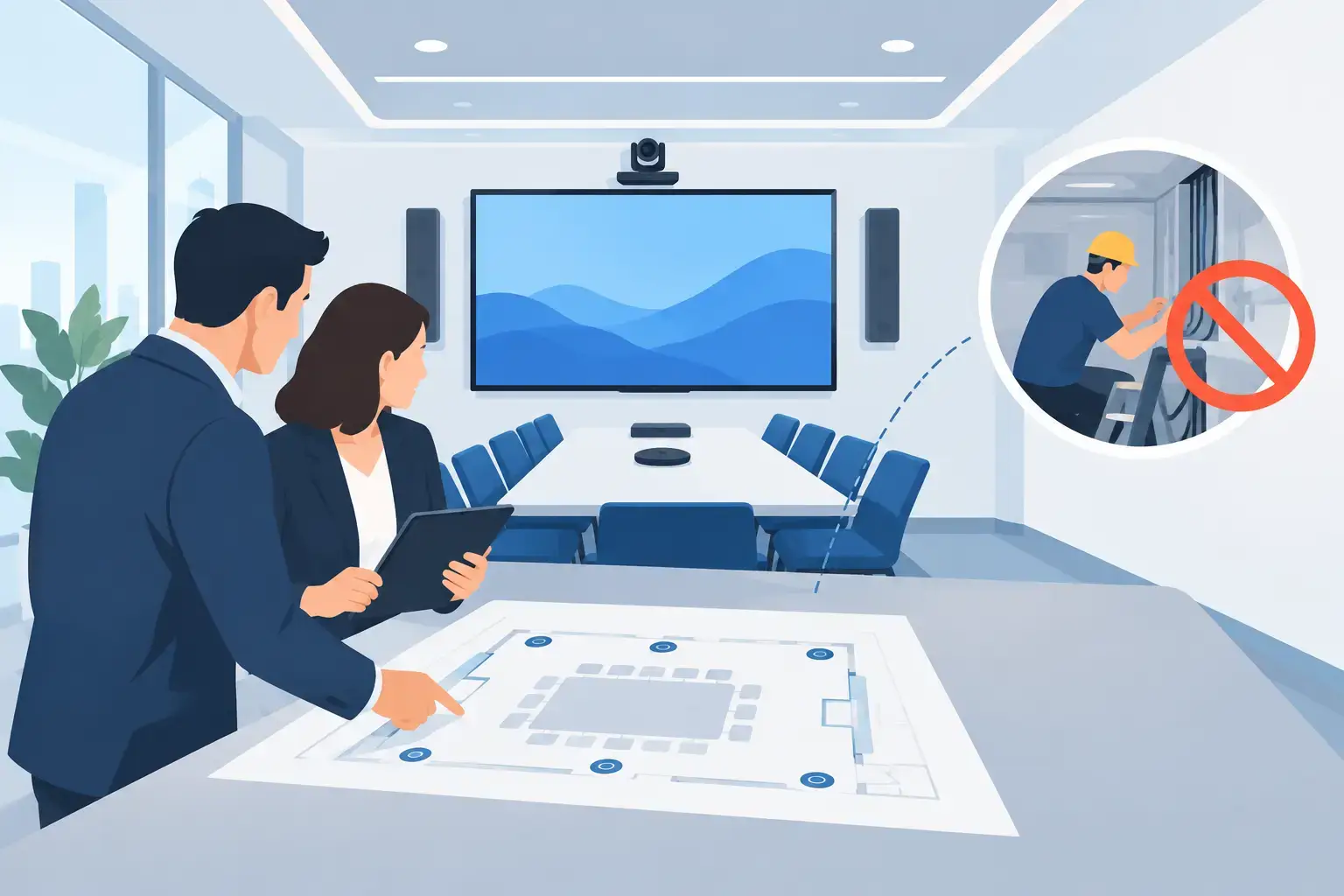
A conference room can look complete on an architectural plan and still be impossible to build correctly. The display has no confirmed backing, the camera conflicts with a soffit, network ports were not sized for the system, and the electrical scope stops short of the equipment rack. AV consulting addresses these issues before they become RFIs, change orders, and delayed occupancy.
For commercial construction, audiovisual design is not a finish-selection exercise. It is an engineering and coordination discipline. The work connects how a space must operate with the pathways, power, networking, control, documentation, and construction sequencing required to make that operation reliable.
What AV Consulting Should Deliver
A qualified AV consultant starts with operational requirements, not a preferred equipment list. A boardroom, training center, emergency operations center, lecture hall, worship venue, and sports facility may all use displays, microphones, cameras, loudspeakers, and control systems. Their technical requirements are not interchangeable.
The consultant must establish how people use the space, who operates the systems, what must happen during a failure, and which functions need to integrate with enterprise IT. That includes meeting workflows, presentation sources, hybrid meeting platforms, content distribution, recording, assistive listening, room scheduling, occupancy data, and support access. In public-facing or high-occupancy rooms, speech intelligibility, viewing angles, ambient light, acoustics, and emergency paging interfaces may also drive the design.
The output must then be buildable. A complete scope typically includes plans, reflected ceiling coordination, elevations, system diagrams, rack layouts, cable schedules, device details, equipment schedules, bills of materials, and Division 27 specifications. On larger projects, those documents should be coordinated in Revit or AutoCAD with architecture, interiors, electrical, mechanical, structural, IT, security, fire alarm, and building automation disciplines.
A narrative that says provide AV system is not construction documentation. It leaves critical decisions to bidders and installers, often after pricing is complete. That approach may appear flexible at the start, but it shifts risk directly into the field.
Why AV Systems Fail When They Are Added Late
Late AV decisions create conflicts that are expensive because they affect multiple trades at once. A display location may require wall blocking that was never installed. A projector may need a structural support point that clashes with ductwork. A ceiling microphone layout may be compromised by lighting, diffusers, sprinklers, or architectural features. A rack may not fit through the designated access route or may lack heat rejection and service clearance.
These are not isolated AV problems. They are coordination failures.
The same applies to infrastructure. An AV system that relies on the owner network needs more than a data outlet near the table. It may require dedicated switch capacity, power over Ethernet budgets, fiber uplinks, VLAN assignment, quality-of-service policies, multicast planning, cybersecurity review, and remote-management access. If those decisions are deferred until commissioning, the system may be physically installed but unable to function as designed.
AV and ICT Need One Coordinated Design Conversation
Modern AV increasingly uses IP transport. Networked audio platforms such as Dante, video-over-IP systems, control processors, digital signage players, and room scheduling devices all place requirements on the network and structured cabling system. The design team must define those requirements early enough for the ICT infrastructure to support them.
This does not mean every AV device belongs on a single shared network. The appropriate topology depends on the system, owner standards, security requirements, traffic volume, operational criticality, and support model. A small conference suite can often use a straightforward approach. A command center, campus-wide paging system, or multiroom broadcast environment requires greater segregation, resilience, monitoring, and documentation.
When AV and ICT are designed separately, the project team often discovers the gap during installation. The contractor has installed cable. The IT team has provided network service. Neither scope supports the actual system architecture. Good consulting eliminates that ambiguity before procurement.
Independence Changes the Recommendation
A consultant that sells equipment has an inherent incentive to shape the solution around products it represents, stocks, or installs. That does not automatically make the design unsuitable, but owners should understand the distinction.
Independent AV consulting separates professional advice from hardware sales. The consultant can evaluate products against documented performance, compatibility, lead times, maintainability, warranty requirements, and owner standards without protecting a resale margin. The result is a specification that can be competitively bid and evaluated on a comparable basis.
Neutrality also does not mean vague specifications. The documents should state the required performance, acceptable manufacturers, integration requirements, submittal obligations, testing criteria, and installation standards. Clear requirements protect both the owner and qualified bidders.
A Construction-Focused AV Consulting Process
The strongest AV consulting engagement begins before the project team has committed to room layouts and continues through commissioning. The level of effort changes by project phase, but accountability should remain consistent.
Programming and Technology Planning
At the outset, the consultant works with owners, users, architects, IT, and facilities teams to identify space types, operational priorities, standards, budget constraints, and future expansion needs. This phase is where a project decides whether rooms need basic presentation capability, fully integrated collaboration systems, distributed audio, broadcast support, command-and-control functions, or a combination of these.
Early planning also identifies infrastructure that cannot be easily added later. Examples include pathways between buildings, fiber counts, telecommunications room capacity, rack locations, floor boxes, conduit, backup power, and ceiling support. These decisions have lasting cost and operational consequences.
Design Development and Documentation
During design, broad requirements become coordinated systems. The consultant confirms display sizes and locations, camera coverage, loudspeaker zones, microphone strategy, control interfaces, equipment-room needs, and network dependencies. Each decision should be reflected in drawings and specifications that are sufficiently detailed for pricing and installation.
Coordination is especially important at room boundaries. A divisible training room may need partition sensors, independent control, audio zoning, and camera presets that change with room configuration. A courtroom or council chamber may require recording, reinforcement, overflow feeds, assistive listening, and integration with owner-furnished systems. These conditions must be documented rather than assumed.
Bidding, Construction, and Commissioning
After documents are issued, the consultant should support bid administration by answering technical questions, reviewing proposed substitutions, and identifying exclusions or qualifications that change the intended scope. The lowest bid is not necessarily the lowest project cost if it omits infrastructure, programming, commissioning labor, or required interfaces.
During construction, submittal review, site observations, and coordination meetings help catch deviations before they are concealed behind finishes. Near completion, commissioning verifies that the installed system aligns with the design intent and owner requirements. Testing should cover signal flow, control, audio performance, network connectivity, labeling, failover behavior where applicable, user workflows, and closeout documentation.
Commissioning is not a ceremonial final step. It is where incomplete installation, programming assumptions, and missing interfaces become visible. A consultant involved from concept through commissioning is better positioned to resolve those issues because the design basis and coordination history are already understood.
The Right Scope Depends on the Project
Not every project requires the same depth of AV consulting. A tenant improvement with a few standardized meeting rooms may need a focused survey, prototype room design, infrastructure drawings, and bid support. A new campus, healthcare facility, government building, entertainment venue, or enterprise headquarters may require technology master planning, extensive BIM coordination, phased construction support, and detailed acceptance testing.
The mistake is treating all scopes as commodity work. A simple room can become complicated when it must integrate with secure networks, standardized collaboration platforms, legacy systems, or strict facilities requirements. Conversely, overspecifying a basic space wastes capital and creates support burdens. The appropriate design is the one that meets operational needs with clear infrastructure, maintainable components, and defined responsibilities.
What to Ask Before Selecting an AV Consultant
Ask who will perform the engineering work and who will remain involved during construction. Senior-level participation matters when field conditions challenge the original design. Ask whether the firm designs both AV and ICT infrastructure, how it coordinates with other low-voltage systems, and what construction documents it provides.
Also ask whether the consultant sells hardware. If the answer is yes, understand how product selection and bid evaluation are kept objective. Finally, request clarity on commissioning support. A design that ends at permit submission leaves the owner without the same technical advocate when installation decisions matter most.
Before drawings move to the next phase, confirm that AV has a defined owner, a coordinated infrastructure path, and documents a contractor can price without guessing. That discipline costs far less than resolving technology conflicts after walls and ceilings are closed.
Previous articleBICSI Network Design for Buildable InfrastructureNext articleLow Voltage Engineering That Builds Cleanly
More Articles
Broadcast Control Room Design: A 2026 Reference Guide
Sep 30, 2026 · 15 min read
Stadium Broadcast System Design Requirements: An Engineering Guide
Sep 29, 2026 · 15 min read
Sports Arena Broadcast Engineering: A Systems-First Guide
Sep 28, 2026 · 15 min read