
What if the first time an ICT system is tested as a whole is after installation is complete? At that point, unclear responsibilities, interface conflicts, or missing test records can make it difficult to show whether the system meets project requirements. Technical commissioning for ICT systems reduces that risk by connecting design intent to planned verification and documented results.
Installation alone doesn’t demonstrate that a system performs as intended. A commissioning plan defines what will be tested, who is responsible, what must be ready, and what evidence will support review and acceptance. Start planning during design, then carry the process through construction, integration, and handover instead of treating commissioning as a final checklist.
This article explains what ICT commissioning verifies, when to plan each activity, and how to coordinate testing across connected low-voltage systems such as local area networks, wireless networks, VoIP, IP public address and intercom, and IP video. It also covers how to define responsibilities, create project-specific test procedures, and organize records to support owner review, troubleshooting, acceptance, and operational readiness.
Key Takeaways
- Technical commissioning for ICT systems connects documented project requirements to planned tests and verifiable performance.
- Set commissioning scope, responsibilities, readiness criteria, and evidence requirements before installation is complete.
- Translate drawings, schedules, and system narratives into project-specific checks for connected ICT systems.
- Use test results and organized records to support issue resolution, owner review, acceptance, and operational handover.
- Integrate commissioning with design engineering and project oversight to coordinate verification across networks, VoIP, intercom, and IP video.
What Technical Commissioning for ICT Systems Verifies
Technical commissioning for ICT systems is the documented verification that installed systems perform in accordance with project requirements. It compares delivered infrastructure and its functions with design intent and the project’s performance criteria. Commissioning is not the installation itself, and it doesn’t guarantee uninterrupted operation after handover.
Each project phase serves a different purpose. Design review examines requirements, drawings, schedules, and interfaces before work proceeds. Installation completion records whether specified equipment and infrastructure have been installed. Commissioning tests whether components and connected systems function as required. Owner acceptance is a separate review under the project’s acceptance process, informed by commissioning evidence. Operational support begins after handover and addresses ongoing use and maintenance.
Commissioning, testing, and acceptance: what each activity means
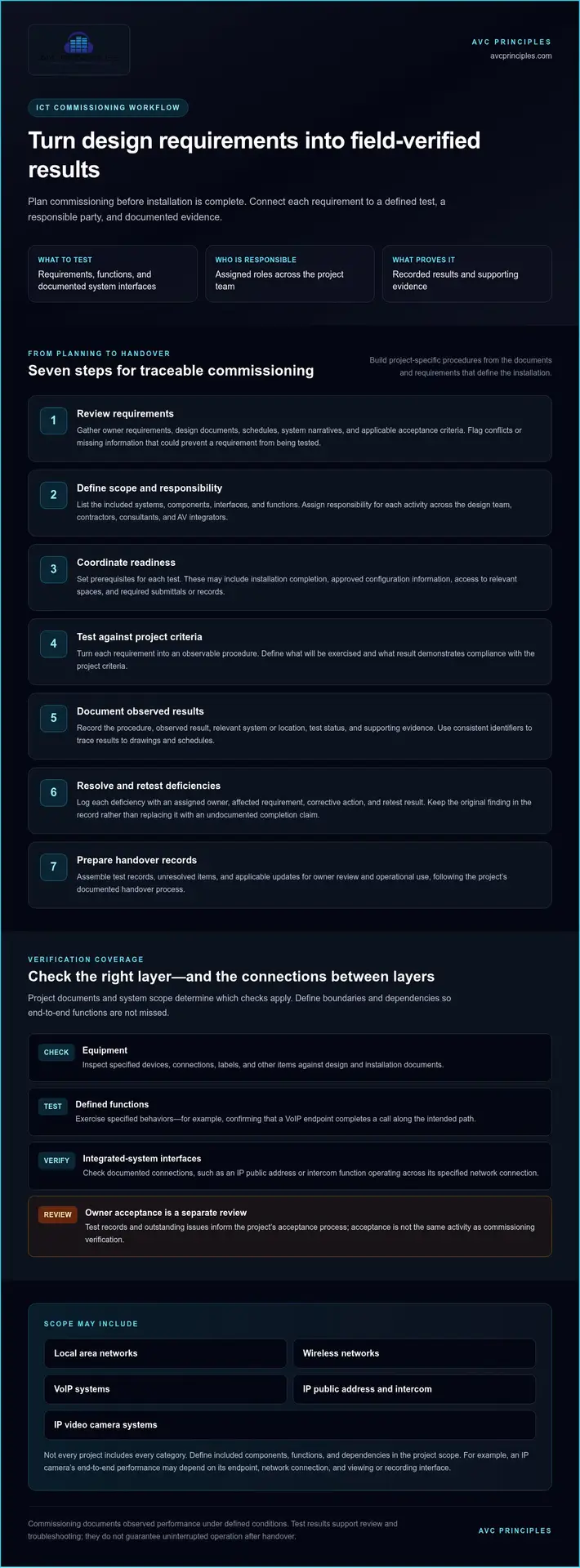
Commissioning can include several levels of verification. The project documents and system scope determine which checks apply:
- Equipment checks: Inspect specified devices, connections, labels, and other items against the design and installation documents.
- Functional tests: Exercise defined functions, such as confirming that a VoIP endpoint can complete a call along the intended path.
- Integrated-system verification: Check documented interfaces between systems, such as whether an IP public address or intercom function operates across its specified network connection.
- Owner acceptance: Review test records and outstanding issues against the project’s acceptance process.
Set acceptance criteria from the project requirements and related documents rather than assumed industry defaults. The Project commissioning overview describes commissioning as a process spanning design, installation, testing, and operation. For ICT, defining the process early clarifies what to verify, who will take part, and what evidence to retain. A test result records performance observed under defined conditions; it does not promise future fault-free operation.
Which ICT systems may fall within commissioning scope?
Project scope may include local area networks, wireless networks, VoIP systems, IP public address and intercom, or IP video camera systems. Not every project includes every category, so define the commissioning boundary by listing the components and functions being verified, as well as their dependencies. For example, an IP camera’s performance may depend on its endpoint, network connection, and viewing or recording interface. Testing only the camera may leave the end-to-end function unverified.
Define these boundaries during design by coordinating ICT requirements and interfaces. Drawings and system narratives can show where systems connect and which functions rely on shared infrastructure. The ICT infrastructure design guide provides related context on engineering requirements and system planning.
How ICT Commissioning Carries Design Requirements Into the Field
Commissioning translates design intent into field activities that can be observed, recorded, and reviewed. Drawings locate devices and pathways, equipment schedules identify specified components, and system narratives describe intended functions and interfaces. Use these documents to write procedures for the actual installation instead of relying on a generic checklist.
Clear design documentation turns commissioning requirements into repeatable tests and traceable evidence. To make that connection work, establish scope and responsibilities before field verification begins:
- Review requirements. Gather owner requirements, design documents, schedules, narratives, and applicable acceptance criteria. Flag conflicts or missing information that could prevent a requirement from being tested.
- Define scope. List the systems, components, interfaces, and functions included. Assign responsibility for each activity across the design team, contractors, consultants, and AV integrators.
- Coordinate readiness. Set project-specific prerequisites for each test. These may include installation completion, approved configuration information, access to relevant spaces, and required submittals or records.
- Test. Turn each requirement into an observable procedure. For a network reliability requirement, specify what will be exercised and what result demonstrates compliance with the project criteria.
- Document. Record the procedure, observed result, relevant system or location, test status, and supporting evidence. Use consistent identifiers to trace results to drawings and schedules.
- Resolve. Log deficiencies with an assigned owner, the affected requirement, corrective action, and retest result. Keep the original finding in the record rather than replacing it with an undocumented completion claim.
- Hand over. Assemble test records, unresolved items, and applicable updates for owner review and operational use, following the project’s documented handover process.
Establish requirements, responsibilities, and test plans
Make system boundaries and responsibilities explicit. For each test, identify the requirement being checked, who provides access or configuration details, who performs or witnesses the test, and what evidence to retain. The ICT infrastructure design companies guide offers broader context on how design decisions shape coordinated infrastructure. In the test plan, reference the relevant drawing, schedule, or narrative so results remain tied to design intent.
Coordinate commissioning with construction and integration
Readiness requires coordination, not just a decision on test day. Architects, contractors, consultants, and AV integrators may each control information or work that affects access, installation status, configuration, and system interfaces. A network dependency can affect connected AV or other low-voltage functions, so coordinate prerequisites and issue ownership across those boundaries. AVC Principles integrates design engineering, project management, and commissioning. Learn about its ICT project approach.
For technical commissioning for ICT systems, keep requirements, field observations, corrective actions, and handover evidence connected in a controlled workflow. A traceable record makes review more consistent and gives the owner a clearer basis for acceptance.
What ICT Commissioning Tests and Records Should Demonstrate
A useful commissioning record links a project requirement to a defined procedure and an observed result. It should show more than whether a device powered on. Component checks confirm that individual equipment and connections are present and functioning; integrated tests show whether connected components deliver the intended end-to-end service. Set test procedures and pass or fail criteria from project requirements, not assumed performance thresholds.
Build a project-specific ICT test matrix
Organize the test plan so each result can be traced to its system, requirement, prerequisite, responsible party, and supporting record. The examples below are illustrative. Select the checks that apply to the project and align them with its documented acceptance criteria.
| System category | Intended function | Illustrative verification | Evidence to retain |
|---|---|---|---|
| Local area network and wireless | Provide the network connectivity defined for connected devices and users. | Check relevant physical connections and documented network configuration; exercise representative network functions against project requirements. | Test record with locations or device identifiers, observed results, applicable configuration details, and any exceptions. |
| VoIP | Carry calls along the documented path between intended endpoints. | Place representative calls and verify the specified call path and expected endpoint behavior. | Call-test record identifying endpoints, route exercised, result, and any issue requiring correction. |
| IP public address and intercom | Deliver the specified announcement or intercom function across the intended system interfaces. | Exercise representative functions across applicable endpoints or zones and verify the documented behavior. | Tested locations and functions, observed outcome, exceptions, and retest results if needed. |
| IP video | Provide the specified camera view and associated system function. | Verify a representative camera path through the applicable network and viewing or recording interface, where included in scope. | Camera identifier, function tested, observed result, relevant configuration record, and outstanding issue status. |
A device-level check does not establish that an integrated function works. A camera may power up while its intended view is unavailable at the receiving interface. A VoIP endpoint may register while its required call path remains untested. Distinguish the equipment checked from the system behavior demonstrated. For network reliability, test the functions and conditions specified in the project documents. Don’t substitute generic thresholds for agreed criteria.
Document results for review and handover
Retain completed test records, issue logs, approved changes, and relevant configuration documentation. For each exception, record the affected requirement, observed condition, assigned issue owner, corrective action, and retest outcome. Preserve both failed and passed results in the traceable history so reviewers can see how discrepancies were resolved.
Organized evidence supports owner review and gives operations teams a useful baseline for troubleshooting. It can help them distinguish the documented configuration at handover from later changes. For broadcast environments, related coordination considerations are covered in the broadcast infrastructure engineering guide. Across system categories, technical commissioning for ICT systems is strongest when each record shows what was tested, the project requirement used, and the result.
Common ICT Commissioning Gaps, and How to Prevent Them
Commissioning can get reduced to a final walk-through or an installer’s checklist. Those activities may confirm that equipment is present and installation tasks are complete, but they don’t necessarily verify that systems work together as documented. A checklist serves as commissioning evidence when it connects to project requirements, records observed results, and explains how exceptions are resolved.
Three gaps often weaken verification: requirements that are too broad to test, coordination that starts after dependencies become constraints, and records that omit what was tested or what happened when a test failed. For example, “wireless coverage complete” needs project-specific criteria and a defined verification method before it can support a clear pass or fail. Without them, teams may interpret the requirement differently.
Resolve scope, readiness, and coordination gaps early
Before testing, identify unclear requirements, system boundaries, and dependencies between ICT infrastructure and connected systems. A responsibility matrix can name who prepares each test, provides access or configuration information, witnesses results, reviews evidence, and resolves findings. That clarity helps prevent gaps between trades from becoming owner issues at closeout. Include retest planning in project coordination, with affected parties and prerequisites identified in advance.
- Log: Record the test, affected requirement, location or system, and observed result.
- Assign: Identify an issue owner and the party responsible for reviewing the correction.
- Correct: Document the corrective action and any approved change that affects the original requirement or test method.
- Retest: Repeat the relevant test under the defined procedure and record the new result.
- Retain: Keep the initial finding, resolution, and retest evidence together for review and handover.
This sequence preserves a traceable history and distinguishes a completed installation item from a demonstrated system function. If a network dependency prevents an IP intercom test, record the blocked prerequisite and responsible party. Link a later successful test to the original exception so the change in status has a clear explanation.
Keep commissioning distinct from managed IT support
Commissioning verifies project-stage performance against documented requirements; it doesn’t provide continuous network monitoring or ongoing IT support. Test results describe conditions observed during defined procedures, not guaranteed uptime after handover. Records give operations teams a reference for system configuration and known issues, but they don’t replace owner procedures for monitoring, maintenance, or incident response.
Effective technical commissioning for ICT systems depends on defined responsibilities and a controlled response to findings, not just a signed checklist. AVC Principles integrates technical commissioning with design engineering and project oversight to support coordinated project verification. Explore ICT commissioning as part of project delivery.
How AVC Principles Integrates Technical Commissioning Into ICT Projects
AVC Principles brings technical commissioning into a broader project framework that includes AV consulting, design engineering, programming, and project management. This connects design decisions to coordination and verification instead of treating commissioning as a separate closeout activity. For projects with relevant ICT scope, work may include local area networks (LAN), wireless networks, VoIP, IP public address and intercom, and IP video camera systems.
Project context shapes the coordination. A corporate workplace, education facility, performance venue, worship environment, or government project may combine AV and control functions with shared low-voltage infrastructure. In new construction and retrofit work, documenting system boundaries and dependencies helps the project team coordinate interfaces across drawings, installation, and testing. Scope and procedures are tailored to project requirements.
Coordinate integrated AV and low-voltage ICT scope
Design coordination links intended functions to the spaces, pathways, equipment, and interfaces needed to deliver them. Revit BIM can support model coordination, while AutoCAD, Bluebeam Revu, and BIM 360 can support the review and management of drawings and project information. These tools help organize the design record; project-specific decisions about scope, acceptance criteria, and test evidence still need to be defined.
Coordination also clarifies where AV and ICT responsibilities meet. A system narrative can describe an interface, while coordinated drawings show its location and related infrastructure. Establishing those connections during design gives construction and integration teams a clearer basis for readiness and verification.
Move from project requirements to documented verification
AVC Principles provides technical commissioning and testing, including verification and calibration of installed systems. The work follows project requirements from design intent and coordination into defined field checks, documented results, and review of outstanding findings. Relevant testing may include network reliability, with systems and procedures selected for the project rather than assumed to apply universally.
This is project delivery support. Commissioning documents observed system performance and provides records for review and handover; it isn’t equipment retail or ongoing managed IT. The principal’s listed credentials include CTS-I, CTS-D, and BICSI RCDD. These are the principal’s credentials, not company certifications, and complement AVC Principles’ integrated design and commissioning work.
For a project requiring coordinated ICT engineering and documented verification, discuss technical commissioning for your ICT project.
Set the Commissioning Direction Early
Treat verification as a project decision, not a closeout task. Before design and construction activities are fixed, identify what the owner needs to review and how the project team will demonstrate readiness. This gives the team a practical basis for aligning engineering, integration, and delivery priorities.
AVC Principles provides ICT infrastructure design and technical commissioning, supported by AV consulting, design engineering, programming, and project management. The principal’s listed credentials include CTS-I, CTS-D, and BICSI RCDD. These capabilities support a coordinated approach to defining project scope and documenting system performance.
Bring commissioning into project planning while requirements and interfaces can still inform delivery decisions. Plan your ICT engineering and commissioning scope with AVC Principles. A clear direction helps your team work toward acceptance and operational handover with a traceable record.
Frequently Asked Questions
When should technical commissioning for ICT systems begin?
Begin planning during design, while requirements, system boundaries, responsibilities, and evidence needs can still shape project documents. On-site verification happens later, when relevant systems and prerequisites are ready. For example, a test involving an interface between wireless infrastructure and an AV system depends on both sides being available in a suitable configuration. Follow the project documents and construction coordination rather than a universal calendar.
Is ICT commissioning the same as network testing?
No. Network testing can be one commissioning activity, but commissioning puts test results in the context of project requirements and intended system functions. A connectivity check may show that a device communicates, while a separate functional test may be needed to verify its role in a connected service. Define the scope, procedures, and pass criteria from project documents rather than assuming tools or thresholds.
Can ICT systems be commissioned in an existing building?
Yes. Commissioning can be scoped around existing systems and project objectives, including a retrofit or changes to selected infrastructure. Access restrictions, available drawings, known configurations, and the need to maintain building operations can shape test planning. A preliminary review can identify record gaps or areas that need investigation before procedures are finalized. This project-specific verification is distinct from continuous monitoring or ongoing IT support.
Does commissioning guarantee uninterrupted network or system performance?
No. Commissioning records results observed under defined project conditions; it can’t guarantee uninterrupted future performance. System behavior may change after configuration updates, device additions, maintenance, or shifts in operating conditions. Retained records help operations teams compare current behavior with the tested baseline and investigate later discrepancies. Ongoing reliability also depends on separate operational procedures, change management, and assigned responsibility after handover.
Who should witness or review ICT commissioning tests?
Project documents and responsibility assignments should determine who performs, witnesses, reviews, and accepts each test. Participants may include owner representatives, design consultants, contractors, or system integrators, depending on the system and contract. For a test involving an interface, the plan can specify which parties need to observe the functions and review the evidence. This avoids assuming that attendance or approval authority is the same on every project.
Which standards govern technical commissioning for ICT systems?
There isn’t one universal standard for every ICT commissioning effort. Applicable references depend on project requirements, system scope, contract documents, and adopted codes or specifications. Identify the relevant references and acceptance criteria in the commissioning plan, then verify them against current project documents before testing. Where a project covers different systems or disciplines, confirm that each reference applies to the scope being tested.