
What if the right broadcast partner is the one that engineers the operational system, not just the signal path? Comparing broadcast infrastructure engineering firms can be difficult when provider pages blur engineering consultancy, equipment sales, system integration, and ongoing operations. The distinction matters when broadcast systems must work with venue infrastructure, networks, production workflows, and day-to-day operating requirements.
Comparing proposals takes more than reviewing equipment lists or technical terminology. Different assumptions, deliverables, and responsibility boundaries can conceal important gaps. Use this framework to assess project fit, technical scope, accountability, and lifecycle support. You’ll learn how to distinguish an engineering consultancy from a vendor or integrator, compare the work and responsibilities included in each proposal, and assess whether a partner can define a clear path from requirements and design through commissioning.
Key Takeaways
- Compare broadcast infrastructure engineering firms against the same project requirements, deliverables, and responsibility boundaries.
- Assess whether a firm’s relevant experience matches your project type and the technical interfaces it must coordinate.
- Use your RFP to surface assumptions, exclusions, dependencies, proposed phases, and decisions that remain with the owner.
- Evaluate engineering capability through project-relevant examples and clearly defined technical documentation.
- Confirm how the proposed scope connects requirements and design to commissioning, and check which phases and deliverables are included.
What Broadcast Infrastructure Engineering Firms Do, and Where Their Scope Begins
A broadcast infrastructure engineering firm plans and documents the technical systems that support production and distribution, and coordinates their requirements with the wider facility. Its work can include system architecture, design documentation, and technical coordination. The scope depends on the venue, production model, project phase, and existing infrastructure.
Broadcast engineering covers the technologies and technical work that support the creation and transmission of broadcast content. Infrastructure engineering applies that expertise to the systems and interfaces a venue needs. The focus is not simply on selecting equipment. It is on defining how broadcast requirements fit with the building, network, production spaces, and operational needs.
How engineering firms differ from vendors and integrators
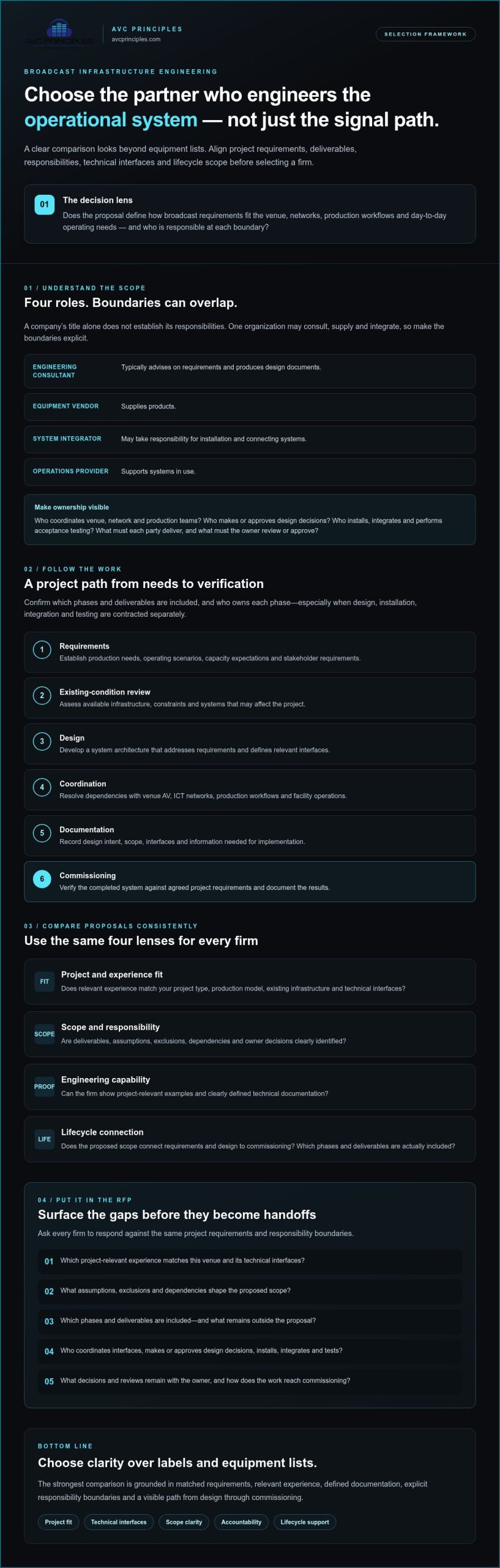
An engineering consultant typically advises on requirements and produces design documents. An equipment manufacturer or vendor supplies products. A system integrator may take responsibility for installation and connecting systems, while an operations provider supports systems in use. These roles can overlap: one organization may consult, supply, and integrate. A company’s title alone does not establish its responsibilities.
Make the boundaries explicit. Ask who leads coordination with venue, network, and production teams; who makes or approves design decisions; who installs and integrates the systems; and who performs acceptance testing. Confirm what each party must deliver and what the owner must review or approve. If responsibilities are divided across contracts, identify who resolves gaps between them.
Which projects require broadcast infrastructure engineering?
Sports arenas, entertainment venues, and other facilities that support live or recorded production may need broadcast infrastructure engineering. The need can arise during new construction, renovation, a change in venue capacity or production requirements, or a technology refresh. In each case, the work should account for the venue’s production model and existing systems rather than assume a standard package.
Scope varies with the project. A new facility may require planning from early concept development. A renovation may begin with a review of existing conditions and constraints. A change in how content is created or distributed can also affect system requirements and interfaces. For broadcast infrastructure engineering firms, the relevant test is whether the proposed work addresses these conditions and clarifies where engineering ends and other parties’ responsibilities begin.
How Broadcast Engineering Scope Runs from Requirements to Commissioning
A defined project lifecycle connects production needs to a system that can be reviewed, coordinated, and tested. For broadcast infrastructure engineering firms, the phases and deliverables depend on project scope and procurement structure. Confirm who is responsible for each phase, especially when design, installation, integration, and testing are contracted separately.
- Requirements: Establish production needs, operating scenarios, capacity expectations, and stakeholder requirements.
- Existing-condition review: Assess available infrastructure, constraints, and systems that may affect the project.
- Design: Develop a system architecture that addresses requirements and defines relevant interfaces.
- Coordination: Resolve dependencies with venue AV, ICT networks, production workflows, and facility operations.
- Documentation: Record design intent, scope, interfaces, and information needed for implementation.
- Commissioning: Verify the completed system against agreed project requirements and document the results.
Requirements, existing conditions, and system design
Start with how the venue will produce and use content. Identify operating scenarios, production spaces, expected capacity, and stakeholder needs before selecting a design direction. Then review existing systems and constraints. A renovation, for example, may need to account for infrastructure that will remain in service, while a new build may require coordination with facility planning at an earlier phase.
Design documents support coordination and implementation, but they do not replace an agreed scope. Define what the documents include, which interfaces they address, and which decisions still require owner approval. The Society of Broadcast Engineers is a professional resource for broadcast engineering. Consider relevant qualifications alongside project-specific experience and clearly defined responsibilities.
Coordination, testing, and handover
Broadcast systems cross organizational and technical boundaries. Coordination may involve the owner, architects, contractors, integrators, and network stakeholders. The engineering scope should identify how design information moves between these parties and who resolves conflicts or approves changes. Without that clarity, an interface can fall between contracts.
Installation completion is not the same as functional testing or commissioning. Commissioning is documented verification of system performance against agreed project requirements. Confirm who conducts the tests, which requirements form the basis of acceptance, and how issues are recorded and resolved. Handover may include test results, system documentation, and a list of unresolved items, but specify these deliverables for the project rather than assuming they are included.
For a project requiring coordinated AV and ICT design, review AVC Principles’ broadcast design and engineering approach as one example of concept-to-commissioning scope.
How to Compare Broadcast Infrastructure Engineering Firms
Use the same criteria for each proposal. A polished presentation does not prove technical fit. Ask for project-relevant examples, defined deliverables, and clear responsibility for decisions and coordination. Compare what each firm will do, what it assumes others will do, and how its work will be reviewed.
| Criterion | What to compare |
|---|---|
| Relevant experience | Examples comparable in venue type, production model, project phase, and scope. Ask what work the proposed team performed. |
| Scope and interfaces | Included phases, systems addressed, coordination boundaries, dependencies, exclusions, and owner responsibilities. |
| Documentation | Proposed design records, interface information, assumptions, and implementation references. |
| Commissioning | Who defines acceptance criteria, conducts or observes testing, records results, and tracks unresolved items. |
| Project governance | Named leads, design review points, issue escalation, change control, and owner decisions. |
Normalize proposals before comparing them. If one includes design review and commissioning while another stops at documentation, prices or schedules alone will not show which is the closer fit. Request a consistent breakdown of phases, deliverables, assumptions, exclusions, dependencies, and change-management procedures. This makes responsibility gaps visible before they become project issues.
Technical fit, standards, and interoperability
Ask how each firm evaluates interoperability among broadcast systems, venue AV, and ICT networks. SMPTE ST 2110, NMOS, and AES67 may be relevant examples, but they are not default technology prescriptions. Applicability depends on project requirements and existing systems. Ask how the firm documents interfaces, dependencies, and design assumptions, and how it checks that any proposed standard or protocol is relevant to the project. Because broadcast workflows depend heavily on the underlying network, it can also help to understand how ICT infrastructure design companies are evaluated on engineering standards and selection criteria.
Independence, accountability, and evidence
Clarify how recommendations are developed and ask firms to disclose relevant commercial relationships that could influence them. Request verifiable work samples or references that match the project’s scope. The Society of Broadcast Engineers provides professional resources for the field, but credentials alone do not establish project fit. Confirm who is accountable for design review, coordination, issue resolution, and acceptance criteria.
Consultant involvement should have a defined purpose, not add review steps without clear value. Tie each proposed task to a project decision, interface, or risk it addresses. If a task has no clear output or decision point, ask why it belongs in scope. This helps distinguish necessary engineering oversight from duplicated effort.
What to Put in an RFP and Ask During Firm Evaluation
A useful RFP gives each firm the same project context and asks for comparable responses. Include the information needed to define scope, interfaces, and accountability. Require respondents to identify their assumptions, exclusions, and which decisions remain with the owner. This makes it easier to compare proposals from broadcast infrastructure engineering firms on substance rather than presentation.
Information to include in a broadcast engineering brief
Describe the venue’s use and production scenarios, project stage, key stakeholders, and known constraints. State the expected design outputs and the interfaces that need coordination across broadcast, AV, ICT, facilities, and production teams. If existing systems or documentation are available, identify them so firms can explain what they need to review.
Clarify the procurement structure. State which parties are expected to supply, install, integrate, and operate systems, and identify responsibilities that have not yet been assigned. Include the following in the brief:
- Objectives: The production needs and operational outcomes the project must support.
- Venue conditions: Relevant existing infrastructure, planned changes, and known constraints.
- Interfaces: Systems and stakeholder groups requiring technical coordination.
- Expected deliverables: Requested design documents, reviews, testing, and handover records.
- Project structure: Procurement roles, anticipated phases, owner decisions, and known dependencies.
Questions that expose gaps in a proposal
Ask each firm how it will validate requirements and address conflicting stakeholder priorities. Request a phase-by-phase description of the work, with outputs, review points, and dependencies. Then probe assumptions that could affect design coordination, testing, or handover.
- What is excluded, and which other party is expected to perform that work?
- Which owner decisions or third-party inputs are required, and when are they needed?
- How will changes to requirements or existing conditions be assessed and documented?
- Who defines commissioning and performance testing criteria, performs the tests, and records results?
- How will findings, deficiencies, acceptance decisions, and outstanding items be documented?
Look for specific answers, not broad assurances. A proposal should connect each phase to a deliverable or decision and state who is accountable. If testing, coordination, or acceptance responsibilities are unclear, request clarification before comparing scope or finalizing the engagement.
For project-specific discussion of broadcast design and engineering scope, discuss your broadcast engineering requirements with AVC Principles.
Selecting a Broadcast Engineering Partner for the Full Project Lifecycle
Selecting a partner is a sequence of decisions: define project requirements, compare evidence of relevant capability, align responsibilities across parties, then confirm the scope in writing. For broadcast infrastructure engineering firms, lifecycle fit means more than a strong design proposal. The work should connect project objectives to documented decisions and a defined path through commissioning.
When an engineering consultancy is the right fit
An engineering consultancy may be appropriate when broadcast requirements need to be planned alongside venue AV, ICT infrastructure, production workflows, and facility needs. This is especially relevant when the project team needs technical coordination before equipment selection and implementation. Clear design responsibilities help owners understand what is being specified, which interfaces must be addressed, and which decisions remain theirs.
Assess the proposed scope, not just the firm’s label. Confirm what the consultancy will produce, how it will coordinate with other project parties, and whether commissioning or technical testing is included. A well-defined scope can clarify how the design is intended to proceed into implementation. It does not establish who will supply or install systems, so state those roles separately.
How AVC Principles aligns with broadcast projects
AVC Principles provides Sports & Entertainment Broadcast Design alongside AV systems design and ICT infrastructure design. Its engineering consultancy work can support projects from concept development through system design, technical documentation, and commissioning. Assess how requirements inform system architecture, how documentation supports coordination, and how testing relates to agreed project criteria.
For a project involving multiple venue systems, clarify the desired scope at the outset. Consider which production scenarios the facility must support, what existing conditions need review, which stakeholders must be involved, and what design and commissioning deliverables are required. These details help establish whether the proposed engagement is an appropriate fit instead of assuming every project needs the same phases.
Share your project objectives, existing conditions, stakeholders, and required scope to discuss a broadcast infrastructure engineering engagement.
Set a Clear Path from Design to Commissioning
Selecting a partner starts with clear requirements. Compare proposals against the same criteria, including technical fit, deliverables, interface responsibilities, and commissioning scope. Resolve assumptions, exclusions, and owner decisions before confirming the engagement. This process helps distinguish broadcast infrastructure engineering firms by how their work fits the project, not simply by how they describe their capabilities.
AVC Principles provides AV and ICT system design from concept development through commissioning, including sports and entertainment broadcast design. Technical commissioning and testing can address broadcast controls and network reliability, based on the agreed project scope. These capabilities can support venues that need coordinated engineering across broadcast and related systems.
To discuss your project objectives, existing conditions, and required scope, discuss your broadcast infrastructure engineering requirements. A well-defined engagement gives your team a stronger foundation for coordinated decisions and a clearer route from concept to commissioning.
Frequently Asked Questions
What does a broadcast infrastructure engineering firm do?
A broadcast infrastructure engineering firm plans, designs, and coordinates the technical systems that support a venue’s broadcast production. Its scope may include requirements development, system architecture, design documentation, coordination with AV and ICT teams, and commissioning, depending on the contract. The firm helps define how systems and project responsibilities fit together. It is not automatically the equipment seller, installer, integrator, or ongoing operations provider, so confirm those boundaries in the proposal.
How do I choose a broadcast engineering company?
Choose by comparing evidence of relevant project experience, proposed deliverables, interface coordination, and accountability. Ask each firm for examples that match your venue type, production model, and project phase. Compare assumptions, exclusions, owner responsibilities, and commissioning scope on the same basis. The strongest fit is the firm that explains how its work addresses your requirements and identifies who is responsible for design decisions, coordination, testing, and acceptance.
What is the difference between a broadcast engineering consultant and a system integrator?
A broadcast engineering consultant typically develops requirements, system designs, and technical documentation, and may coordinate interfaces or support commissioning if those tasks are in scope. A system integrator generally focuses on implementing and connecting systems, which can include installation responsibilities. These roles can overlap, and some organizations perform both. Review each proposal for explicit responsibility assignments, including who approves design decisions, coordinates other parties, installs systems, and verifies acceptance criteria.
What should a broadcast infrastructure engineering RFP include?
A broadcast infrastructure engineering RFP should define project objectives, venue use, production scenarios, project stage, stakeholders, existing conditions, and known constraints. Identify required design outputs and interfaces with broadcast, AV, ICT, facilities, and production teams. Describe the procurement structure and clarify which parties are expected to supply, install, integrate, and operate systems. Ask respondents to list proposed phases, deliverables, assumptions, exclusions, dependencies, owner decisions, and commissioning responsibilities.
When should a broadcast engineering firm be involved in a venue project?
Involve a broadcast engineering firm when production requirements need to be coordinated with venue planning, AV systems, ICT infrastructure, or facility operations. Early involvement can help establish requirements and interfaces before design decisions become difficult to change. Engineering input may also be appropriate for renovations, capacity or production changes, and technology refreshes. The right timing depends on project scope and procurement structure, so identify the decisions the firm is expected to inform.
What is included in broadcast system commissioning?
Broadcast system commissioning is documented verification of the installed system against agreed project requirements. Depending on the contract, it may include reviewing test criteria, conducting or observing functional tests, recording results, and tracking deficiencies or unresolved items. Confirm who performs the testing, who makes acceptance decisions, and what records will be handed over. Commissioning scope can vary, so do not assume installation completion alone confirms that every required function has been tested.
Do broadcast infrastructure engineering firms sell or install equipment?
Some firms may combine engineering with equipment supply or installation, while others provide design and consulting only. The firm’s title does not establish its commercial or delivery role. Ask whether its proposal includes product sales, installation, integration, commissioning, or ongoing operations, and identify who is accountable for each task. AVC Principles provides AV and ICT system design and sports and entertainment broadcast design. It does not sell equipment or provide residential AV installation.
One Response