
The greatest vulnerability across modern operations floors isn’t display hardware failure; it is proprietary architecture. When critical facilities rely on closed, monolithic processors, signal distribution latency and siloed data streams inevitably compromise real-time situational awareness. Successfully engineering resilient command center visualization systems demands a disciplined departure from single-vendor lock-in toward modular, standards-based network topologies. You already know that managing high-density telemetry shouldn’t force operators to navigate cognitive overload or endure unexpected downtime during critical events.
Discover how evolving visualization architectures, standardized AVoIP protocols, and fine-pitch direct-view LED technologies are reshaping mission-critical command centers. This analysis outlines a rigorous engineering evaluation framework for display panels, processing engines, and network fabrics, establishing vendor-neutral specifications that secure continuous 24/7 operational resilience. What follows is an architectural blueprint for building scalable, high-performance control environments engineered for 2026 and beyond.
Key Takeaways
- Modern command center visualization systems are moving away from fixed-matrix hardware toward distributed, software-defined AV-over-IP architectures to eliminate single points of failure.
- Transport protocol selection directly impacts end-to-end latency and visual fidelity, determining how effectively operators maintain real-time situational awareness.
- Direct-view LED has superseded legacy display solutions for continuous 24/7 operations, requiring precise evaluation of pixel pitch, viewing geometry, and thermal performance.
- Applying ISO 11064 human factors engineering ensures individual operator console arrays and central overview video walls work in tandem to minimize cognitive fatigue.
- Vendor-neutral technical specifications and structured factory and site acceptance testing safeguard mission-critical facilities against premature obsolescence and proprietary lock-in.
Evolution of Command Center Visualization Systems in 2026
Modern operations rely on continuous visual synthesis. Within a high-stakes control room, command center visualization systems aggregate telemetry, geographic mapping, access control alarms, and ultra-high-definition video streams into a unified operational canvas. Historically, these feeds remained fragmented across dedicated hardware consoles. Today, operational velocity demands immediate cross-functional visibility across network operations centers (NOCs) and emergency operations centers (EOCs). Achieving this requires separating the physical display canvas from underlying data networks, ensuring that physical monitors operate as dynamic software-defined surfaces rather than hardwired endpoints.
Defining the Modern Mission-Critical Visualization Stack
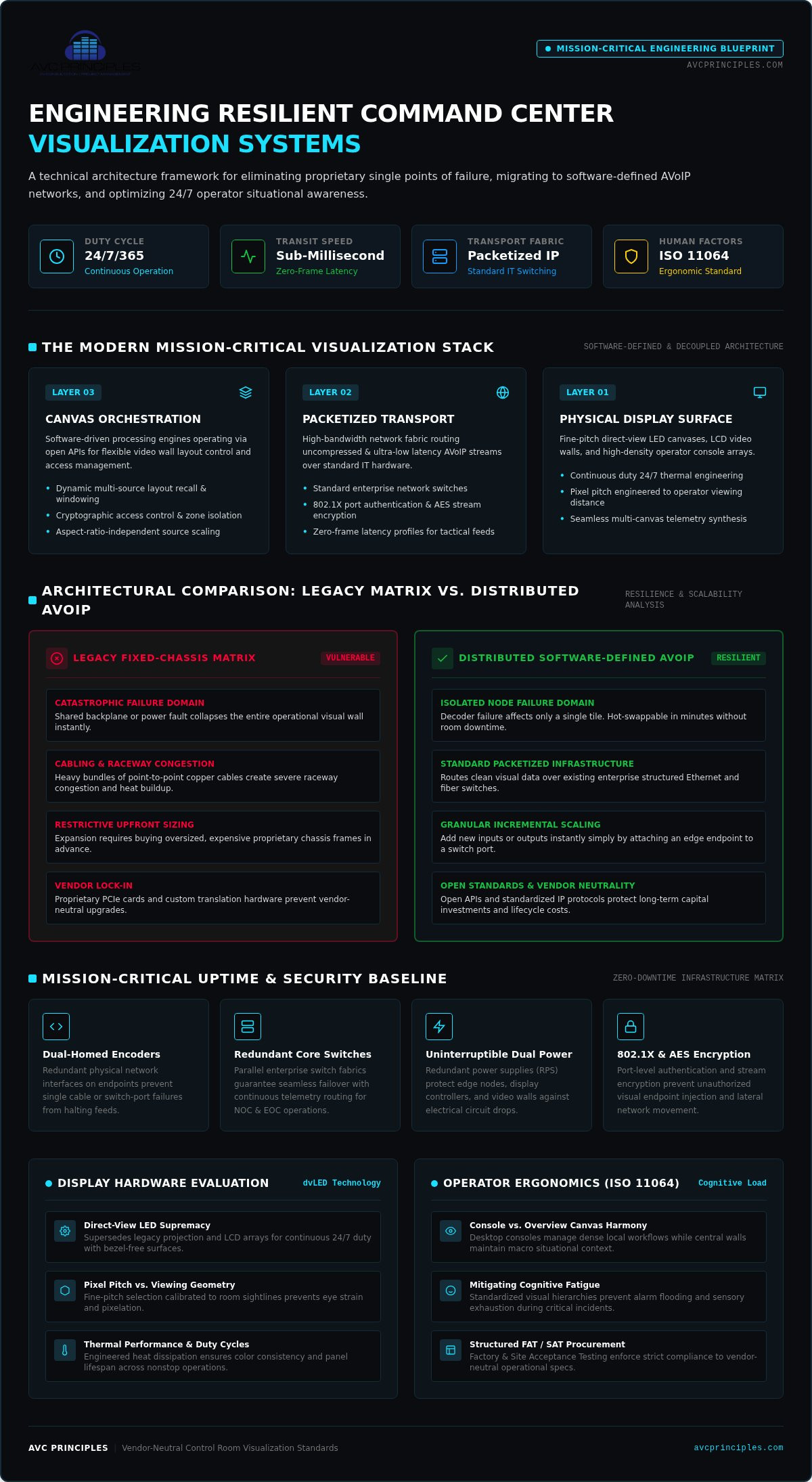
Engineering a modern visualization workflow involves three distinct structural layers:
- Physical Display Layer: Fine-pitch direct-view LED canvases, LCD arrays, and dedicated operator console monitors engineered for thermal efficiency and continuous duty.
- Transport Layer: High-bandwidth packetized network fabrics routing signals via standard enterprise IT switches rather than specialized matrix routers.
- Canvas Orchestration Layer: Software-driven processing engines managing windowing, multi-source layouts, cryptographic access control, and dynamic preset recall.
Decoupling signal ingest from the display hardware allows engineering teams to scale inputs independently of display aspect ratios. When systems rely on open standards and vendor-neutral application programming interfaces (APIs), operators ingest diverse data streams without custom proprietary translation boxes. This architectural independence prevents single-vendor lock-in, simplifying hardware lifecycles and preserving long-term capital investments.
Drivers of Architectural Shifts: From Fixed Matrix to IP Distribution
Fixed-chassis matrix switchers once dominated mission-critical environments. However, cross-point matrix chassis present severe operational limitations. Expansion requires purchasing oversized, expensive frames in advance. High-density copper cabling creates severe raceway congestion and single points of catastrophic failure. If an internal backplane faults, the entire visual field collapses.
The industry has shifted decisively toward distributed, software-defined AV over standard enterprise IP infrastructure. Packetized visual transport eliminates physical chassis constraints. Adding inputs or outputs requires only connecting an edge endpoint to an existing network switch port. Furthermore, uncompressed and ultra-low-latency compression protocols deliver sub-millisecond signal transit. This zero-frame latency profile ensures that tactical decisions rely on instantaneous, uncompromised real-time feeds, establishing true resilience across 24/7 command center visualization systems.
Core Architectural Topologies: Processing, Transport, and AVoIP Protocols
Resilience in command center visualization systems hinges on network topology and endpoint isolation. Dual-homed network encoders, redundant core enterprise switches, and uninterruptible dual power supplies form the baseline for mission-critical uptime. Visual data transport must also integrate rigorous cybersecurity controls. Applying 802.1X port-level authentication and AES encryption across transport streams prevents unauthorized endpoint injection and lateral network movement across operational zones.
Centralized Video Wall Processors vs. Distributed AVoIP Nodes
Centralized processors rely on large chassis architectures housing dedicated input, output, and switching cards across a proprietary PCIe backplane. While offering centralized routing, they introduce a catastrophic failure domain: an internal backplane or shared power supply fault disables the entire visual array. High-density chassis configurations also create severe thermal loads and require massive bundles of point-to-point cabling.
Conversely, distributed AV-over-IP architectures decouple routing across independent edge transceivers. Failure domains shrink to a single node. If an individual decoder fails, only one display tile drops offline, and technicians can hot-swap the hardware in minutes without disrupting adjacent operations. Distributed topologies shift thermal dissipation away from concentrated rack footprints, routing video over standard structured CAT6A or enterprise optical fiber.
Evaluating Codec Performance: Latency, Artifacting, and Bandwidth
Transport protocols dictate operator reaction speed and legibility. Mission-critical environments generally balance three compression tiers:
- Uncompressed / SDVoE (10GbE): Delivers true zero-frame latency and pixel-for-pixel fidelity. It eliminates frame delays for local interactive KVM control but demands a robust 10Gbps enterprise switching fabric.
- Intra-frame Compression (1GbE): Codecs such as JPEG2000 and JPEG-XS compress individual frames independently, operating effectively over 1GbE networks with low latency (typically 30 to 40 milliseconds) and visually lossless output.
- Inter-frame Streaming (H.264 / H.265): Highly efficient for backhauling surveillance streams over wide-area networks (WAN). However, temporal motion prediction creates notable latency and visible ringing around high-contrast alphanumeric data.
Alphanumeric legibility remains vital. Motion-optimized compression schemes often blur single-pixel geospatial lines, numerical metrics, or SCADA process diagrams, increasing operator fatigue. Engaging independent engineering for command and control center design ensures transport protocols match operational latency thresholds without sacrificing visual precision.
Display Hardware Selection: Direct-View LED, LCD Video Walls, and Projection
Display selection directly governs operator visual acuity and lifecycle expenditure. Direct-view LED (dvLED) has emerged as the benchmark canvas for continuous common operational pictures. Over 60 percent of control room tenders now specify dvLED, driven by an estimated 22 percent lower five-year total cost of ownership compared to legacy projection and tiled liquid crystal systems. While ultra-narrow bezel LCD arrays present lower upfront capital costs, long-term operational expenditures rapidly accumulate through thermal load dissipation, continuous panel recalibration, and panel replacement friction.
Narrow-Pixel-Pitch dvLED Engineering Parameters
Pixel pitch determines the spatial threshold where individual diodes resolve into a continuous optical canvas. In command facilities, sub-1.5mm pixel pitches allow operators situated close to the video wall to read dense telemetry, alphanumeric labels, and complex mapping without perceptible diode separation.
Encapsulation technology determines structural durability and optical performance:
- Chip-on-Board (COB): Encapsulates diodes directly within a hardened resin substrate, providing superior impact resistance, dust rejection, and wide off-axis viewing angles without color shift.
- Surface-Mount Device (SMD): Mounts packaged diodes individually to the circuit board, offering serviceable repairability but greater vulnerability to physical impact.
Thermal management dictates panel longevity. Utilizing common cathode architectures provides dedicated, lower-voltage paths to individual color diodes, minimizing waste heat and preventing premature chromatic drift across the wall.
Ultra-Narrow Bezel LCD: Lifecycle Limitations in Mission-Critical Facilities
LCD matrices introduce structural compromises across continuous data canvases. Even sub-millimeter bezels sever critical visual elements, dissecting geospatial coordinates, schematic lines, and live sensor overlays across mechanical seams.
Continuous 24/7 duty cycles accelerate panel-to-panel degradation. Edge-lit and direct-lit LCD backlights decay unevenly, creating visible color temperature mismatches that demand labor-intensive software recalibration. Furthermore, rapid consumer panel manufacturing cycles make procuring identical replacement panels four or five years post-commissioning exceptionally difficult. For long-term installations of command center visualization systems, these maintenance vulnerabilities frequently negate initial equipment savings.
Ergonomics, Human Factors, and Operator Workspace Integration
Technical architecture fails if operators cannot process the information presented. System engineering must prioritize human sensory limits. In high-density monitoring environments, aligning command center visualization systems with the ISO 11064 standard provides the baseline for ergonomic workspace layout, ambient lighting coordination, and environmental acoustic thresholds. Mitigating operator cognitive overload requires balancing immediate personal console arrays against shared overview video walls, preventing physiological strain while preserving situational awareness.
Sightline Geometry and Canvas Information Hierarchy
Sightline geometry determines the efficiency of visual data ingestion across an operations floor. Field-of-view engineering establishes structured optical zones:
- Primary Visual Zone (±15° vertical, ±15° horizontal): Reserved for time-critical alerts, primary telemetry, and active dynamic camera feeds requiring instantaneous response.
- Secondary Visual Zone (±30° vertical, ±35° horizontal): Positioned for contextual monitoring, secondary SCADA loops, and ongoing trend analysis.
- Tertiary Visual Zone (beyond 30°): Designated for persistent geographic reference maps, non-urgent status metrics, and ambient enterprise dashboards.
Adhering to ISO 11064 calculations prevents excessive cervical extension and repetitive saccadic eye tracking. Canvas orchestration engines must incorporate programmed multi-window presets, shifting instantly from balanced ambient tracking to prioritized emergency incident layouts during active critical events.
Secure Dynamic KVM and Multi-Domain Operator Interfaces
Modern operations centers rarely manage a single, unified network. Operators regularly supervise discrete systems across disparate security enclaves and air-gapped classifications. Dynamic KVM switching architecture allows operators to control multiple isolated workstations using a single keyboard, mouse, and desktop display surface without cross-contaminating network enclaves.
Hardware-isolated KVM switches with seamless cursor roaming let operators glide peripherals across separate physical screens and overview walls without manual hotkey toggling. Maintaining physical data isolation across secure networks requires strict adherence to vendor-neutral engineering standards rather than closed black-box solutions. You can partner with independent engineering specialists for professional AV systems design that harmonizes human-centric ergonomics with secure network separation.
Engineering Framework for Resilient Visualization Procurement
Procuring mission-critical infrastructure demands rigorous governance. Command center visualization systems represent significant capital investments that intersect structural design, mechanical cooling, and enterprise ICT networks. Without clear, cross-disciplinary technical documentation, projects risk scope gaps, budget overruns, and severe schedule slip. Establishing a structured procurement framework protects operational integrity by prioritizing functional performance over proprietary brand allegiance.
Developing Vendor-Neutral Technical Specifications
Engineering specifications must define system capabilities rather than reproduce closed manufacturer cut sheets. Specifying proprietary hardware locks facilities into single-vendor ecosystems, making future expansions prohibitively expensive and vulnerable to supply chain disruptions.
Resilient procurement specifications prioritize open criteria:
- Open API Control Architecture: Mandating fully documented, non-proprietary REST or WebSocket APIs ensures long-term interoperability with third-party orchestration platforms.
- Standardized Network Transport: Requiring compliance with open network standards prevents reliance on specialized, single-source switching fabrics.
- Lifecycle and Spares Commitments: Enforcing strict five-to-seven-year minimum component availability guarantees prevents premature system obsolescence.
Performance-driven tenders generate competitive contractor bidding. They force systems integrators to compete on engineering execution, cabling craftsmanship, and installation quality rather than proprietary markups.
Independent Commissioning, Calibration, and Oversight
Equipment installation alone does not guarantee operational readiness. Systematic Factory Acceptance Testing (FAT) validates pre-staged rack topologies, thermal stability, and base configurations before hardware arrives on site. Following physical deployment, Site Acceptance Testing (SAT) evaluates total system performance under simulated failure states.
Technical commissioning verifies critical operating parameters:
- Optical Uniformity Calibration: Spectroradiometric calibration verifies uniform luminance, gamma tracking, and white-point balance across every display tile to prevent visual seams.
- Latency and Jitter Measurement: Hardware analyzers confirm glass-to-glass signal transit meets strict operational thresholds across all network hops.
- Automated Network Failover: Technicians simulate core switch, link, and power drops to confirm zero-downtime routing failovers.
Integrators naturally face conflicting incentives when evaluating their own installations. Engaging AVC Principles for independent engineering consulting provides the unbiased technical oversight required to verify specifications, manage commissioning protocols, and safeguard mission-critical uptime across the facility lifecycle.
Architecting Resilient Operations Floors for 2026 and Beyond
Modernizing command center visualization systems requires looking past proprietary product claims to focus on architectural fundamentals. Transitioning to distributed AV-over-IP topologies isolates failure domains, ensuring continuous operational velocity. Simultaneously, pairing narrow-pixel-pitch direct-view LED surfaces with ISO 11064 sightline standards minimizes cognitive fatigue during high-stress monitoring. True operational resilience isn’t bought in an off-the-shelf equipment bundle; it’s engineered into the underlying network and physical environment.
Securing long-term mission reliability depends on vendor-neutral technical oversight that protects infrastructure against rapid hardware obsolescence. Bridging AV systems, ICT networks, and mission-critical workflows requires comprehensive engineering discipline from initial schematic design through final site acceptance testing. With the right structural standards in place, your operations floor will adapt seamlessly to future technological shifts. Explore independent command center engineering consulting with AVC Principles to establish a resilient, high-performance visualization foundation for your facility.
Frequently Asked Questions
What is the primary difference between centralized video wall processors and AVoIP architectures?
Centralized processors rely on dedicated chassis hardware routing signals across proprietary backplanes, creating concentrated thermal loads and single points of system failure. Distributed AV-over-IP architectures replace fixed frames with packetized network transport over standard enterprise switches. Individual edge transceivers handle encoding and decoding independently. If one endpoint malfunctions, adjacent feeds remain operational, drastically reducing failure domains while allowing modular, port-by-port system expansion.
How do ISO 11064 standards impact command center visualization system engineering?
ISO 11064 establishes ergonomic design benchmarks for control center workstations, lighting, acoustics, and viewing geometries. For command center visualization systems, the standard dictates visual hierarchy, requiring critical alerts within ±15 degrees of the operator’s primary line of sight. Adhering to these specifications prevents physical cervical strain, limits repetitive eye fatigue, and optimizes information legibility across both personal console monitor arrays and shared overview video walls.
Which display technology is best suited for 24/7 continuous command center operations?
Fine-pitch Direct-View LED (dvLED) is the preferred display technology for mission-critical operations floors. Unlike LCD video walls, dvLED eliminates distracting mechanical bezels that segment continuous maps and data streams. Modern dvLED modules using common cathode power distribution run significantly cooler, consume less power, and avoid uneven backlight degradation. This results in superior color uniformity, high ambient contrast, and a lower five-year total cost of ownership.
How does uncompressed video transport compare to compressed codecs in mission-critical environments?
Uncompressed transport protocols, such as SDVoE over 10GbE networks, eliminate frame latency and visual artifacts, ensuring pixel-for-pixel accuracy for high-contrast alphanumeric data and real-time KVM interaction. Lightly compressed codecs like JPEG2000 or JPEG-XS operate within 1GbE network limits, adding minimal latency (around 30 to 40 milliseconds) while maintaining visual fidelity. The optimal choice depends on whether network infrastructure can support high-bandwidth throughput.
Why is vendor-neutral engineering design critical when procuring command center visualization systems?
Vendor-neutral design prevents facilities from getting locked into single-manufacturer hardware ecosystems. Proprietary architectures force clients to purchase exclusive replacement parts and expansion licenses at inflated costs. Developing vendor-neutral specifications based on open APIs, standard network protocols, and modular interfaces allows facilities to integrate best-in-class components. This protects initial capital investments and ensures system longevity over seven-to-ten-year operating lifecycles.
How do command centers maintain visualization across separated, secure network classifications?
Facilities isolate secure classifications by combining hardware-enforced dynamic KVM switches with air-gapped network fabrics. Secure multi-domain KVM appliances let operators manage multiple discrete security enclaves using a unified desktop mouse and keyboard without physical data crossover. Fiber-optic transport and unidirectional data diodes guarantee that high-security video and telemetry feeds display on shared canvases without exposing sensitive networks to external vulnerabilities.
What role does technical commissioning play in command center visualization deployments?
Technical commissioning provides independent verification that visualization systems satisfy functional requirements before entering active service. Commissioning engineers conduct spectroradiometric calibrations to align color balance and luminance across all display modules. They also stress-test automated network failover routines, measure glass-to-glass latency across signal paths, and audit cybersecurity controls. This rigorous testing prevents undetected failure points from compromising active mission-critical operations.