
A SCIF is not a standard meeting room with added access controls. It’s an accredited area, room, or building used to handle Sensitive Compartmented Information, and designing SCIF compliant AV systems means accounting for security requirements from the outset. AV devices in secure zones must not have cellular, Wi-Fi, RF, or Bluetooth capabilities; simply disabling those functions isn’t acceptable.
That changes how systems are selected, connected, documented, and reviewed. Security and accreditation authorities determine how applicable requirements are applied to each project, so AV planning must be coordinated with the facility’s security process rather than treated as a standalone technology package.
This article explains how SCIF AV design differs from conventional AV, who coordinates security review and accreditation, and how to plan for multiple classification levels within one facility. It also covers how to bring AV, infrastructure, and secure-room requirements together, helping project teams coordinate the system concept through commissioning.
Key Takeaways
- Bring designated security and accreditation authorities into planning early; their project-specific decisions shape how requirements apply and what system documentation is needed.
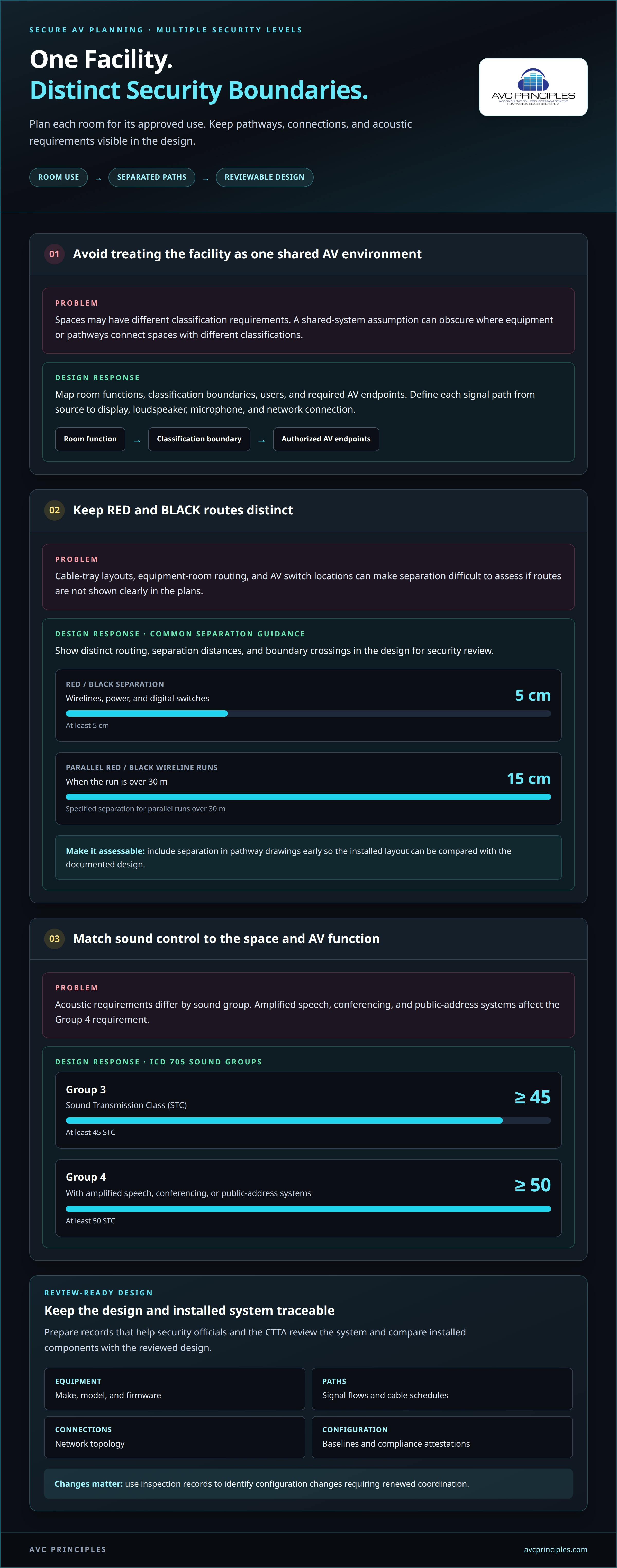
- Plan AV architecture around classification boundaries, with distinct pathways and controls rather than treating the facility as one shared system.
- Account for sound-group requirements: Group 3 spaces require at least 45 STC, while Group 4 spaces with amplified speech, conferencing, or public-address systems require at least 50 STC.
- Coordinate RED/BLACK cabling separation and boundary crossings in the design; common separation guidance includes 5 cm, with 15 cm for parallel runs over 30 m.
- Include CATV and satellite feeds in the security design. Feeds crossing a SCIF or SAPF boundary require at least 12 dB of one-way RF amplifier and attenuator isolation.
Security coordination and accreditation responsibilities
SCIF, SAPF, and collateral secure environments require project-specific security coordination. AV design, inspections, and accreditation records must follow decisions made by the designated authorities.
AV equipment with recording capabilities requires prior written approval before use in a secure environment. Designated authorities approve systems, while security officers review them. Acceptance depends on the project and its security requirements.
For U.S. projects, the governing framework includes Intelligence Community Directive 705 and its technical specification. Intelligence Community Standard 705-02 addresses SCIF accreditation and reciprocal use; designated accrediting authorities apply the requirements to each facility.
Common risks include unapproved recording, uncontrolled connections, and undocumented configuration changes. A June 2021 memorandum bars personally owned headsets, microphones, desktop telephones, and webcams in secure spaces. It also prohibits USB peripherals from crossing classified and unclassified boundaries.
Security Official and CTTA Coordination
Coordinate the AV design with facility security officials and the CTTA before selecting equipment or inspecting infrastructure. Their review connects the system design with the security and accreditation process, including how requirements apply to a SCIF, SAPF, or collateral environment.
Prepare system information for review, including equipment make, model, and firmware; signal flows and cable schedules; network topology; configuration baselines; and compliance attestations. During inspections, use these records to show how installed components match the reviewed design and to identify changes requiring renewed coordination.
Secure Conferencing and Encrypted Communication
Secure video conferencing requires coordinated review of endpoints, network connections, and operating configuration. Encrypted audio and video conferencing tools can protect communications from eavesdropping, but encryption alone does not establish that a device is approved for a particular facility.
Keep classified content within its authorized environment and treat recording functions as a separate approval decision. Plan cross-domain connections with security officials; USB peripherals must not cross the classified and unclassified boundary under the June 2021 memorandum. Document approved connection paths and configuration changes for accreditation review.
Inspections should trace the installed system against its documented design, from endpoints through cabling and network interfaces. Firmware updates in secure environments should be performed on-site under strict supervision. This coordination helps preserve the reviewed configuration and gives accreditation authorities a clear record of system status.
A de-accredited SCIF controlled at the SECRET level under 32 CFR parts 2001 and 2004 may be re-accredited if less than one year has passed. Treat that possibility as conditional rather than as an automatic continuation of prior accreditation: the stated time limit is central to whether this route remains available. In coordination discussions, establish whether the facility falls within the described control level and whether the elapsed period is under one year before relying on re-accreditation. Keep the distinction clear between a facility that may qualify for re-accreditation under this condition and one for which the condition is not met. This gives project participants a precise point to raise with the designated authorities, without assuming that earlier approval alone settles the present status. Any conclusion should remain tied to the stated facility category and time condition.
Managing Multiple Security Levels in AV Design
Government and defense facilities may contain spaces with different classification requirements. Designing SCIF compliant AV systems means accounting for each space’s approved use rather than treating the facility as one shared environment. Start by mapping room functions, classification boundaries, users, and required AV endpoints. This provides a basis for assigning visual and audio systems to the correct spaces and defining technical specifications for review.
Multi-classification AV architecture depends on deliberate separation. Map each signal path from source to display, loudspeaker, microphone, and network connection. Identify where equipment or pathways could connect spaces with different classifications. RED/BLACK separation is a core design consideration: plans should show distinct routing, separation distances, and boundary crossings for security review. For example, a shared room display needs a clearly defined connection path for each authorized source.
Common separation guidance specifies at least 5 cm between RED and BLACK wirelines, power, and digital switches. For parallel RED and BLACK wireline runs over 30 m, the specified separation is 15 cm. These distances affect cable-tray layouts, equipment-room routing, and AV switch locations. Include separation in pathway drawings early, so the installed layout can be assessed against the documented design.
Sound control also differs by space. ICD 705 Sound Group 3 spaces require a Sound Transmission Class (STC) rating of at least 45. Group 4 spaces with amplified speech, conferencing, or public-address systems require at least 50 STC. These ratings connect room construction with AV function. For example, conferencing or amplified speech in a Group 4 space must be considered alongside the room’s acoustic separation.
Coordinate room assignments with intended AV use before finalizing equipment locations. For example, a display in a classified operations room should receive signals through a pathway assigned to that room’s classification. In facilities with multiple levels, separate system diagrams can distinguish authorized sources, destinations, and connections. The project’s security and accreditation authorities determine how requirements apply to the facility.
Keep the design traceable. Show classification boundaries, cable routes, equipment locations, and sound-group requirements on coordinated drawings. Document proposed pathway crossings as controlled items for review. During installation planning, compare intended routes with available space and adjacent power or data services. This helps identify conflicts before they affect the separation specified in the technical documents.
For teams designing SCIF compliant AV systems, the central task is to assign each AV function to its permitted environment and preserve that separation in pathways and room design. Coordinate RED/BLACK routes, STC requirements, and signal destinations early. This gives security officials a clear basis for review and keeps system planning aligned with each space’s classification.
Building a SCIF: Professional AV Design Expectations
New construction, retrofit, and temporary facilities differ in their available pathways and infrastructure, but each requires project-specific security coordination. Coordinate cable routes, penetrations, and rack locations with facility officials, then document the installed design for inspection.
Red/Black Cabling and Pathways
Pathway design separates RED and BLACK wiring and shows how each route reaches AV hardware. Common guidance specifies at least 5 cm between RED and BLACK wirelines, power, and digital switches. For parallel wireline runs over 30 m, the separation is 15 cm. Drawings should identify routes, crossings, and equipment connections so the installed cabling can be assessed against the design.
Category 6 or 6A cabling and fiber infrastructure should be assessed against the required signals, endpoints, and approved pathways. The cable type alone does not establish that a route is suitable for a secure environment. For example, a design connecting a conferencing endpoint to a display should show its complete signal path, including switches and rack connections, and distinguish that route from other classified or unclassified infrastructure.
For new construction, coordinated drawings can define pathways before walls and ceilings are complete. Retrofit work must account for existing infrastructure and space for separated routes. Temporary facilities still need documented cable paths and project security review; temporary status does not replace approval of the proposed configuration.
SCIF Boundary Cabling
Every cable crossing at a SCIF boundary is a controlled item that requires approved treatment and documentation. Metal-encased cables are prohibited across SCIF boundaries; Kevlar or other approved materials are recommended instead. Project drawings should identify each crossing and its treatment, giving inspectors a clear reference for reviewing installed conditions.
Penetrations and rack locations need coordination with the boundary pathway plan. Professionals document where cables enter or leave the secure space, how the route continues to equipment racks, and which hardware the cable serves. For a Protected Distribution System, the cited standard is CNSSI 7003. The applicable treatment is coordinated with the project’s security authorities.
At inspection, compare installed cable routes, boundary crossings, and rack connections with the documented design. Record deviations for review instead of treating an altered pathway as an informal field adjustment. This supports consistent inspections across new builds and retrofits, where existing walls, service routes, and rack spaces can constrain integration.
What is a SCIF, and what makes AV design different inside one?
A SCIF handles Sensitive Compartmented Information, so AV installation must control information paths, sound, and emissions. CATV and satellite feeds crossing a SCIF or SAPF boundary need specific RF isolation.
Acoustic Isolation and Speech Privacy
Speech privacy depends on the room, its boundaries, and the AV functions installed inside it. Conferencing microphones, loudspeakers, and public-address systems can carry speech beyond their intended audience if room acoustics and system placement are not coordinated. Map microphone pickup areas and loudspeaker coverage against adjoining spaces, then coordinate treatments with the facility design. In military and government spaces, review these interfaces before finalizing equipment locations.
Power Isolation and Conditioning
AV power planning should coordinate equipment loads, circuit routes, and rack locations with the facility’s electrical design. For example, a conference processor and display may share a rack but require different power connections. Document the intended arrangement and how power reaches each AV component. This makes electrical interfaces visible during design review and helps resolve conflicts among AV hardware, other building systems, and available infrastructure before installation.
Information Isolation and RF Devices
AV devices in secure zones must not have cellular, Wi-Fi, RF, or Bluetooth transmission capabilities. Disabling those functions is not an acceptable substitute, so wireless microphones that rely on them are unsuitable. Infrared can be acceptable for AV devices. Review each endpoint’s transmission functions and signal path, including conferencing peripherals, before assigning it to a sensitive space.
RF isolation also applies to external feeds. CATV or satellite feeds crossing a SCIF or SAPF boundary require at least 12 dB of one-way RF amplifier and attenuator isolation. Show the feed, isolation components, and boundary crossing in the system design. This gives reviewers a defined path to assess, rather than an undocumented connection introduced during installation.
Information isolation extends beyond individual devices. Most secure environments should be isolated from the Internet and external communications, including email and social media. This affects how conferencing, content sources, and network connections are arranged. Treat each connection as a defined design decision, documenting its destination and permitted use for review.
For a wireless microphone, Wi-Fi, or Bluetooth device, the key question is whether it has restricted transmission capability, not whether staff intend to use it. A device with cellular, Wi-Fi, RF, or Bluetooth capability should not be included in the secure AV design merely because its radio can be switched off. Review device capability and feed routing together, as both affect the information boundary.
ICD 705-compliant SCIF and SAPF design
ICD 705 design connects physical construction, technical security, and operational requirements. For SCIF and SAPF projects, AV decisions must align with the facility design and the accreditation process, not sit outside them.
The Intelligence Community technical specification implements ICD 705, ICS 705-01, and ICS 705-02 for SCIF construction and management. Version 1.5.1 of the IC Technical Specifications for Construction and Management of SCIFs provides design criteria for new construction and renovations. Its purpose is to satisfy ICS 705-01 when applied to that work. Project authorities determine how these requirements apply to the specific facility.
Coordination should begin while room functions and infrastructure are still being defined. Map AV endpoints, signal paths, network interfaces, and controlled connections against the architectural and security design. A command room, for example, may need displays, conferencing, and communications equipment. Consider each system’s location and connections within the facility’s approved security design, rather than adding them after construction decisions are complete.
Equipment review also depends on function. DoDI 8100.04 requires products providing or supporting DoD Unified Capabilities, including unified communications audio and video conferencing, to be certified for interoperability and information assurance. FIPS 140-2 and FIPS 140-3 are validation standards for cryptographic modules used in collaboration and video teleconferencing hardware. These references address distinct considerations: product certification and cryptographic-module validation.
Physical design and AV integration must also account for installed transducers. A speaker or other transducer in a SCIF, when part of a system not wholly contained there, must be protected if installed for life-safety or fire-regulation purposes. Identify the system boundary and device purpose, then coordinate its treatment with the facility design and relevant security review.
Operational planning continues through installation and documentation. Equipment schedules, network topology, configuration baselines, and signal-flow drawings give reviewers a coherent record of how the design is intended to operate. Assess proposed changes to equipment or connections against that documented configuration and the applicable project requirements before implementation.
The practical takeaway is to treat ICD 705 as a coordinated design framework, not a label applied to AV equipment. Align physical spaces, approved system functions, technical specifications, and accreditation documentation from concept through commissioning. For DoD collaboration systems, include the applicable certification and cryptographic validation considerations in equipment planning, then keep the installed configuration traceable to the reviewed design.
Treating ICD 705 as an integrated design effort means SCIF console planning can cover workstations, displays, computers, communications equipment, equipment storage, power and data integration, cable management, ergonomics, and technician service access.
AVC Principles: AV Systems Design
AVC Principles provides AV Systems Design for secure-facility projects where system architecture must align with operational requirements and security review. Its design work can coordinate AV functions with ICT infrastructure, room layouts, signal paths, and documented project requirements.
Engage AVC Principles when a SCIF or SAPF project needs AV planning integrated with the broader facility design, including command and control environments. Early coordination helps define system interfaces and design documentation for review by the project’s designated security and accreditation authorities.
For a secure-facility AV design discussion, contact AVC Principles.
Move from Requirements to a Coordinated Design
The next step is to translate operational needs into a design brief for engineering and security review. Define intended room functions, user workflows, conferencing needs, content paths, and interfaces with facility infrastructure. A shared brief gives the project team a clear basis for resolving design decisions before procurement and installation.
For projects involving designing SCIF-compliant AV systems, early coordination helps align AV architecture with ICT infrastructure and the intended use of each space. AVC Principles can bring AV Systems Design, ICT Infrastructure Design, and Staged Environment Engineering into the planning process. This is especially relevant when secure AV must integrate with broader facility systems or staged environments.
Contact AVC Principles about your SCIF AV project to discuss the design requirements and next steps. A clearly defined engineering path gives your project a stronger foundation for moving forward.
Frequently Asked Questions
How do AV design professionals manage cables in a SCIF console?
Coordinate cable management with the console layout, equipment locations, and technician access needs. A console plan can account for workstations, displays, computers, communications equipment, power and data integration, storage, and cable routing. Reviewing room-layout drawings before console manufacture helps identify space or circulation conflicts. The design should also show how cables reach equipment and service points, keeping the console arrangement consistent with the facility’s approved pathways.
What are the current ICD 705 and TEMPEST requirements for AV systems in a SCIF?
Relevant design references include ICD 705, ICS 705-01, ICS 705-02, and CNSSAM TEMPEST/1-13. The IC Technical Specifications for Construction and Management of SCIFs are identified as Version 1.5.1. These references address SCIF construction, management, and technical security considerations; their application depends on the project. A useful planning step is to map each AV function and interface against the project requirements, then document the design basis for authority review.
How do SCIF acoustic, sound masking, and speech intelligibility requirements affect AV design?
Room acoustics influence microphone pickup, loudspeaker placement, and speech clarity for intended listeners. Coordinate conferencing and public-address functions with the room’s acoustic design instead of treating sound masking as a standalone AV setting. Where speech intelligibility is a concern, define listening areas and system purpose, then align speaker coverage and room treatments with those needs. The project’s assigned sound group also informs acoustic design criteria.
What steps do professionals take to coordinate SCIF AV design with the SSO, security staff, and accrediting authority?
Begin by aligning the AV scope with the SSO, security staff, CTTA, and designated accrediting authority. Establish which room functions, devices, and connections require review, then prepare system drawings and configuration records for coordination. During installation review, compare the built system with the documented design and record changes for authority assessment. The accrediting authority determines how applicable requirements are applied to the specific facility.