
A small scope change can create a larger margin problem when extra work is added without review or approval. Managing AV project scope creep starts with a clear baseline: defined deliverables, boundaries, responsibilities, and acceptance criteria. Scope creep is the uncontrolled expansion of project goals, tasks, or deliverables beyond the agreed plan.
Accommodating valuable new requirements can make sense. The risk arises when teams absorb them without assessing their effects on effort, schedule, resources, and cost. Work that isn’t recorded or approved can consume project capacity without a corresponding change to the plan or budget.
This article explains how to set practical project boundaries, recognize scope creep and assess proposed changes before they affect delivery. It also covers which scope tools can help smaller projects, how to document decisions, and why disciplined change control matters to project margins. The aim is a workable process: enough structure to protect the agreed outcome, without adding unnecessary administration.
Key Takeaways
- Use a proportionate change-control process: record each request, assess its effects, and document who approved the decision.
- Match scope tools to the project. A charter, work breakdown structure, and acceptance criteria can clarify responsibilities and completion requirements.
- Communicate boundaries and decision-making roles early so stakeholders understand how new requirements will be handled.
- Define deliverables, milestones, exclusions, and success criteria before work begins to reduce ambiguity during delivery.
- Assess the schedule, resources, and cost impact of proposed changes before accepting work that could erode project margins.
1. Do formal scope management processes work for smaller or shorter projects?
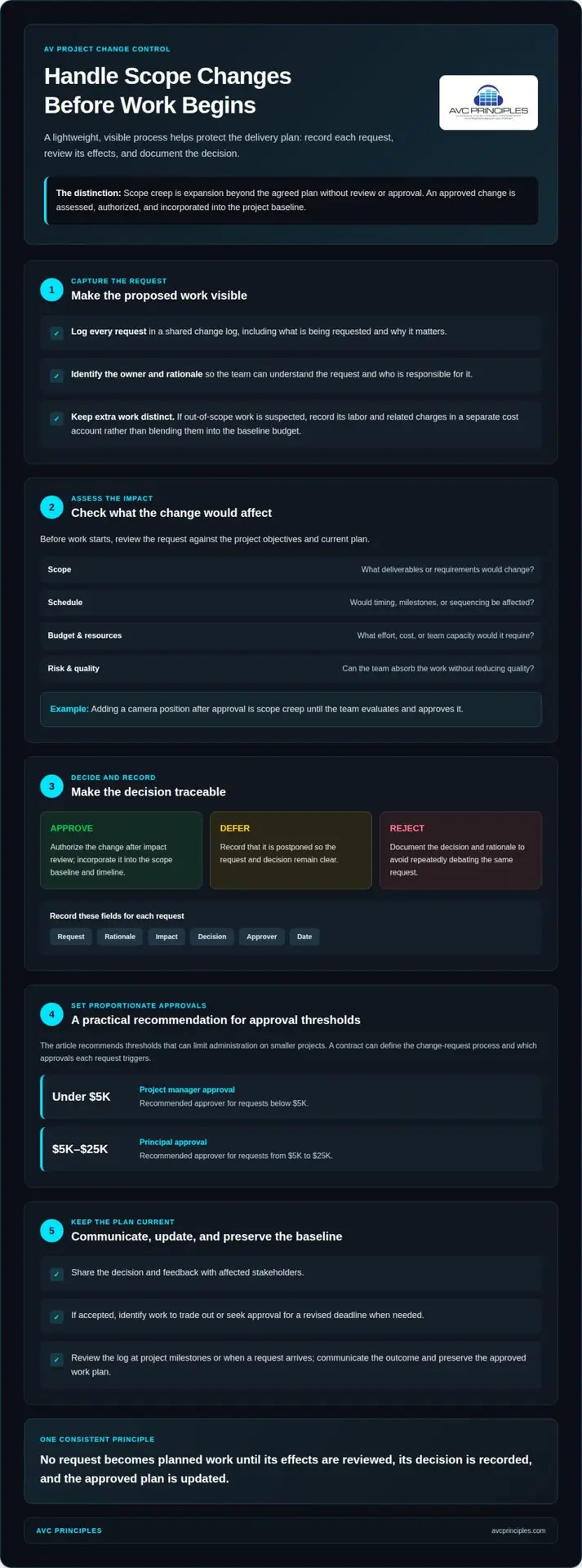
Yes. Smaller AV projects still benefit from a proportionate change process: a written request, a clear impact review, and recorded approval. Scope creep occurs when project goals, tasks, or deliverables expand beyond the agreed plan without review or approval. An approved scope change is different: its effects are assessed, authorized, and incorporated into the project baseline. For example, adding a camera position after approval is scope creep until the team evaluates and approves the change.
How should AV project managers handle client requests outside the approved scope? Log each request, identify its owner and rationale, then assess its effects before work starts. Share the decision and feedback with affected stakeholders. The request should explain what would change and why it matters; the impact review should address scope, schedule, budget, resources, and risk. Record who approved the change, when, and why.
Use the project’s objectives to distinguish valuable changes from unnecessary additions. Ask whether the request supports the intended outcome, whether its benefit justifies the effort, and whether the team can absorb the work without reducing quality. Repositioning a display, for example, may affect drawings, coordination, and installation sequencing. Estimate those effects, identify work to trade out, or seek approval for a revised deadline.
Approval thresholds can keep a short project from accumulating excessive administration. One practical recommendation assigns project manager approval to change requests under $5K and principal approval to requests from $5K to $25K. A contract can define the change-request process and specify which approvals each request triggers. Once approved, update the scope baseline and timeline; if rejected or deferred, document the decision so the same request isn’t repeatedly debated across messages.
Predictive and agile approaches handle timing differently, but both need visible decisions. In a predictive project, log and review each request, then approve, defer, or reject it after assessing impacts. In an agile project, teams set scope for each sprint and can adjust scope across the project; changes still need prioritization against objectives and available capacity. Either way, schedule a brief review when needed, communicate the outcome, and preserve the approved work plan.
A formal process needn’t mean a complex board or lengthy paperwork. A small project can use a shared change log with fields for the request, rationale, impact, decision, approver, and date. Review it at project milestones or when a request arrives. This lightweight record helps teams manage scope changes consistently, protect the delivery plan, and clarify which work is approved.
2. Project charters, work breakdown structures, and acceptance criteria
A project charter records why an AV project exists, who makes decisions, and what outcome it must deliver. A work breakdown structure divides that outcome into manageable components, such as room requirements, system drawings, coordination, and review milestones. Together, these tools help assign responsibility and trace deliverables to the approved objective.
How do you define and document AV project scope in a statement of work? List each deliverable, its acceptance criteria, responsible parties, key milestones, and explicit exclusions. For example, specify which rooms receive design documentation and what qualifies as an accepted drawing package. Clarify ambiguous specifications and statement-of-work language with the customer before signing so both parties interpret the requirements consistently.
What AV project management tools and methods help prevent scope creep? Use a charter to establish purpose, a work breakdown structure to organize tasks, and acceptance criteria to define completion. Maintain a requirements or change log linking each deliverable to its owner, status, and approval. For a control-room project, a checklist can track whether each agreed room and system deliverable has been reviewed against its stated criteria.
What contract terms protect AV projects from unapproved scope changes? Put the change-management process in the contract, including how requests are submitted, assessed, approved, and documented before implementation. Specify who can authorize a change and how revisions to previously approved design phases are handled. Contracts can state that such revisions are additional services, following the AIA B101-2017 framework.
When suspected out-of-scope work arises, record its labor and related charges in a separate cost account. Note the request and its rationale instead of blending the work into the baseline budget. This makes the effort visible for review and helps distinguish approved deliverables from unapproved additions. If the request is accepted, identify a task to trade out or seek approval for a changed deadline.
Capacity is part of scope control. Adding a new deliverable without adjusting assignments can overload the team, delay reviews, or reduce the attention available for quality checks. Before implementation, compare the request with current tasks, available resources, acceptance criteria, and the intended outcome. For a command-and-control project, command and control center design requires clear deliverables and review boundaries across the project work.
3. What is scope creep?
Scope creep is the uncontrolled expansion of a project’s goals, tasks, or deliverables beyond its original plan. It happens when a stakeholder adds a requirement without clear review or approval, or when internal teams interpret a decision differently. In an AV project, adding a room to the design after scope approval is a change, not automatically part of the original work.
Communicate boundaries to everyone who can request, approve, or deliver work. At kickoff, the project manager can review the intended outcome, agreed deliverables, exclusions, decision-makers, and review points with stakeholders. For example, a venue team might designate one representative to consolidate feedback on an auditorium design, so separate requests from operations, facilities, and leadership aren’t mistaken for one approved direction.
Sign-off establishes a shared reference point. Before work proceeds, obtain approval of the scope baseline from the sponsor and key stakeholders, then distribute the approved version to the project team. Record who approved it and which version controls. If a later meeting changes a requirement, distinguish discussion from authorization; meeting notes alone shouldn’t silently redefine the agreed boundaries.
Keep scope visible throughout delivery, not just at kickoff. A concise status update can identify completed deliverables, current work, pending decisions, and requests that could affect the baseline. Review scope regularly to identify additions early. For instance, a request to add confidence monitors during a design review should be logged as a proposed change, with its owner and decision status visible to relevant stakeholders.
Remote teams need the same decision trail as teams working in one location. Use a shared source for the current scope, design revisions, meeting decisions, and stakeholder feedback. After a video meeting, circulate a written summary that separates agreed actions from open questions. A remote engineer reviewing revised room plans should be able to identify the current drawing and see whether a requested change has approval.
Clear communication also assigns responsibility for responses. State who consolidates feedback, resolves conflicting requirements, and can approve a change. If facilities requests a new connection while the AV team is coordinating drawings, clarify whether it supports an existing deliverable or requires a scope decision. This prevents informal comments from becoming assumed instructions and makes clear why project boundaries shift.
With consistent communication, stakeholders can see what happens to each request: it remains within the approved scope, awaits a decision, or proceeds through change control. That distinction protects the original objective while allowing justified adjustments to be considered transparently.
4. Defining project scope and boundaries
A useful scope definition connects the project objective to deliverables, exclusions, responsibilities, milestones, and acceptance criteria. For an AV project, identify the rooms or spaces covered, the design documents required, and the reviews needed. State who supplies decisions and when they’re due. This gives stakeholders a basis for setting expectations, estimating effort, and evaluating later requests against the original agreement.
What should an AV project scope include: equipment, installation, programming, training, and support? It should state which activities are deliverables, define their boundaries, and list exclusions explicitly. For example, name the spaces covered and clarify whether the project includes system programming or only design documentation. Avoid broad phrases such as “complete AV solution” unless the statement defines the work that phrase means.
Build the timeline from defined work, not just a preferred deadline. Break the project into phases, such as requirements review, design development, stakeholder review, and final documentation. For each phase, identify dependencies, responsible team members, decision points, and the information needed to proceed. If stakeholder approval is required before drawings advance, show that review as a milestone; otherwise, the estimate may omit time for feedback.
Poorly defined initial criteria invite competing interpretations. A phrase like “support the presentation space” could mean different things to facilities, IT, and event teams. Replace it with observable acceptance criteria, such as an approved drawing package covering the named room and agreed system elements. Clarify ambiguous specifications and statement-of-work language before signing, then record the agreed version as the project baseline.
Scope creep is uncontrolled expansion beyond the baseline, often through requirements added without review or approval. Not every change is scope creep: a change assessed and formally approved becomes part of the revised scope. When a request arrives, compare it with the deliverables, exclusions, objectives, and timeline. Estimate its effects on effort, resources, dependencies, and deadlines before deciding whether to accept it.
Define boundaries precisely enough to support decisions, without trying to anticipate every possible request. If a venue adds another room, determine whether existing deliverables can be adjusted or whether the new space requires separate work. Document the effect on the estimate and timeline, then agree whether to trade out an existing task or revise the deadline. This makes the scope definition a working control document throughout delivery.
5. Scope creep’s effect on project margins
A fixed project budget assumes defined deliverables and an estimated level of effort. Each unapproved feature consumes labor assigned to planned work. The organization may meet expanded expectations, but the added effort can reduce the margin available from the original agreement. Managing AV project scope creep is therefore also about protecting the relationship between planned work, actual effort, and project revenue.
A customer portal example shows how unrecorded changes can accumulate. The project was estimated at 480 hours but used 720 hours, leaving 240 unbilled hours. The arithmetic illustrates the mechanism: when actual effort rises without an approved scope change, revenue doesn’t rise with it.
AV work can face similar exposure through design revisions, additional coordination, or new deliverables. Adding another space, for example, may require updated drawings, system coordination, and further reviews. Each task uses resources assigned to the original scope. If the team absorbs the work without revising the budget or timeline, planned tasks may be delayed or receive less time for quality review.
Track effort against deliverables, not only against the project total. A task-level record can show which feature or revision consumed additional hours and whether the work was authorized. Keep suspected out-of-scope effort in a separate cost account, documenting the request and rationale. This gives project leaders visibility into actual progress and keeps additional work from disappearing inside the baseline estimate.
Before accepting a scope change, assess its effects on labor, schedule, resources, and risk. Then decide whether to approve additional work, trade out another deliverable, or seek approval for a revised deadline. If stakeholders request a new design feature, the impact review should show the work required and which planned task could move to make room. Managing AV project scope creep means making those trade-offs visible before implementation.
Review project documents together to connect authorized changes with updated estimates and delivery plans. Record each request, assess its impact, obtain approval, and update the baseline before implementation. This process lets an organization consider useful changes without absorbing unplanned labor as included work. Discuss scope and margin controls for an AV project as part of project planning.
AVC Principles
AVC Principles helps organizations translate AV project objectives into coordinated system design and defined deliverables. The firm’s engineering consultancy supports projects where multiple stakeholders, technical interfaces, and design decisions make early scope definition important. Turn to AVC Principles when a project needs structured AV or ICT design, or when staged environments require coordinated engineering. Clear requirements and documented design decisions give the project team a sound basis for managing proposed changes and their effects on delivery. For complex operational environments, Command and Control Center Design can address system design needs within the agreed project scope. To discuss your project’s design requirements and scope boundaries, contact AVC Principles.
Carry scope discipline into the next project
Make scope control part of project governance from the earliest planning decisions. This gives technical requirements, stakeholder priorities, and commercial boundaries a common reference point as the project develops. A disciplined approach to managing AV project scope creep also helps teams treat change as a considered project decision, rather than an informal addition that quietly reshapes delivery. Apply that discipline to the specific environment, interfaces, and outcomes your project must support.
AVC Principles provides AV Systems Design, ICT Infrastructure Design, and Staged Environment Engineering for projects where coordinated technical planning matters. If you’re preparing a project or reassessing its design requirements, contact AVC Principles to discuss your project. A focused conversation can help establish a clear starting point for the work ahead.
Frequently Asked Questions
What is scope creep?
Scope creep is project work expanding beyond the agreed plan without controlled review. It can begin with small additions, such as extra review rounds or documentation that weren’t part of the original deliverables. The practical test is whether the team is doing work that wasn’t agreed or approved. If so, record it and determine whether to formalize it, replace another task, or defer it.
Do formal scope management processes work for smaller or shorter projects?
Yes, provided the process is scaled to the project. A short project may need only a shared request log, one person responsible for decisions, and a brief review when a request affects delivery. For example, a single-room AV design can track requested revisions and their status in one document. A larger approval board would add overhead without improving control if the project’s decision path is already clear.
How Do You Recover When Project Scope Has Already Grown?
Pause new discretionary work and establish what the team is currently delivering. Compare active tasks with the approved baseline, then list additions, completed work, remaining effort, dependencies, and unresolved decisions. Ask the sponsor to prioritize the outcome the project must protect. Then agree whether to remove lower-priority work, revise the schedule and budget, or separate additional requirements into a later phase.
How Do You Spot Scope Drift in Your Project Data?
Compare current task records with the approved deliverables, schedule, and effort estimates. Look for repeated design revisions, work marked complete without matching acceptance, rising effort on unchanged tasks, and requests appearing in meeting notes but not the change log. For example, if AV drawing revisions keep increasing while the milestone remains unchanged, investigate why before treating the difference as normal progress.
How do I get my team to actually track scope changes instead of just accommodating requests?
Make recording requests part of the team’s normal workflow, not an extra reporting exercise. Give team members a consistent place to note each request, its source, affected deliverables, and decision status. Clarify that logging a request doesn’t mean rejecting it. Managers should review open entries and reinforce that work proceeds once its status and authorization are clear.
How do I handle clients who push back on change orders for every small request?
Explain the difference between a correction within agreed requirements and a request that adds or revises work. For low-impact items, group related requests for a single review rather than creating repeated interruptions. For each proposed change, describe the practical trade-off: added effort, displaced work, or a schedule adjustment. Apply the same criteria consistently and document the decision to prevent later disputes.
How do I implement change management without damaging client relationships?
Present the process as a way to make decisions visible, not as a barrier to useful feedback. Acknowledge the request, explain what it affects, and offer clear options, such as exchanging a lower-priority deliverable or adjusting a milestone. Keep the discussion focused on the project outcome and shared constraints. Written follow-up should capture the decision and next steps without assigning blame.
How do you align stakeholders without endless debates?
Set a decision owner and define which stakeholders provide input before review begins. Circulate one consolidated set of comments, identify conflicting requirements, and frame the unresolved point as a choice between project outcomes. Use a focused meeting to resolve only those decisions, then record the rationale and follow-up owner. This keeps discussion tied to project objectives instead of reopening settled design choices.