
There is no single winner in a cost comparison of major AV control systems. Cost depends on features, complexity, and brand. The lowest initial cost may not suit a space if the system lacks required controls, while paying for unused capabilities adds little value. Compare what each system controls with the operational demands it must support.
Manufacturer and platform differences can shape the decision. This article explains how to assess them by comparing room control, show control, centralized equipment control, and scalability. The number and type of systems being coordinated affect the scope, while the right choice depends on how the space will be used and which control functions it needs.
Key Takeaways
- Distinguish room control from show control by the space, users, and coordinated systems each must support.
- Assess how centralized control changes the way operators manage connected audiovisual equipment.
- Compare manufacturers against required functions and integration needs, not brand names alone.
- Consider how expansion and system flexibility affect the suitability of a control platform over time.
- Separate installation, programming, and commissioning when evaluating project costs, since each reflects a different part of delivery.
Room control and show control
For conference rooms of any size, cost depends on system complexity, features, and brand. A larger room may need control of more equipment or integrations; a smaller one may require fewer functions. Compare the defined scope, not room size alone.
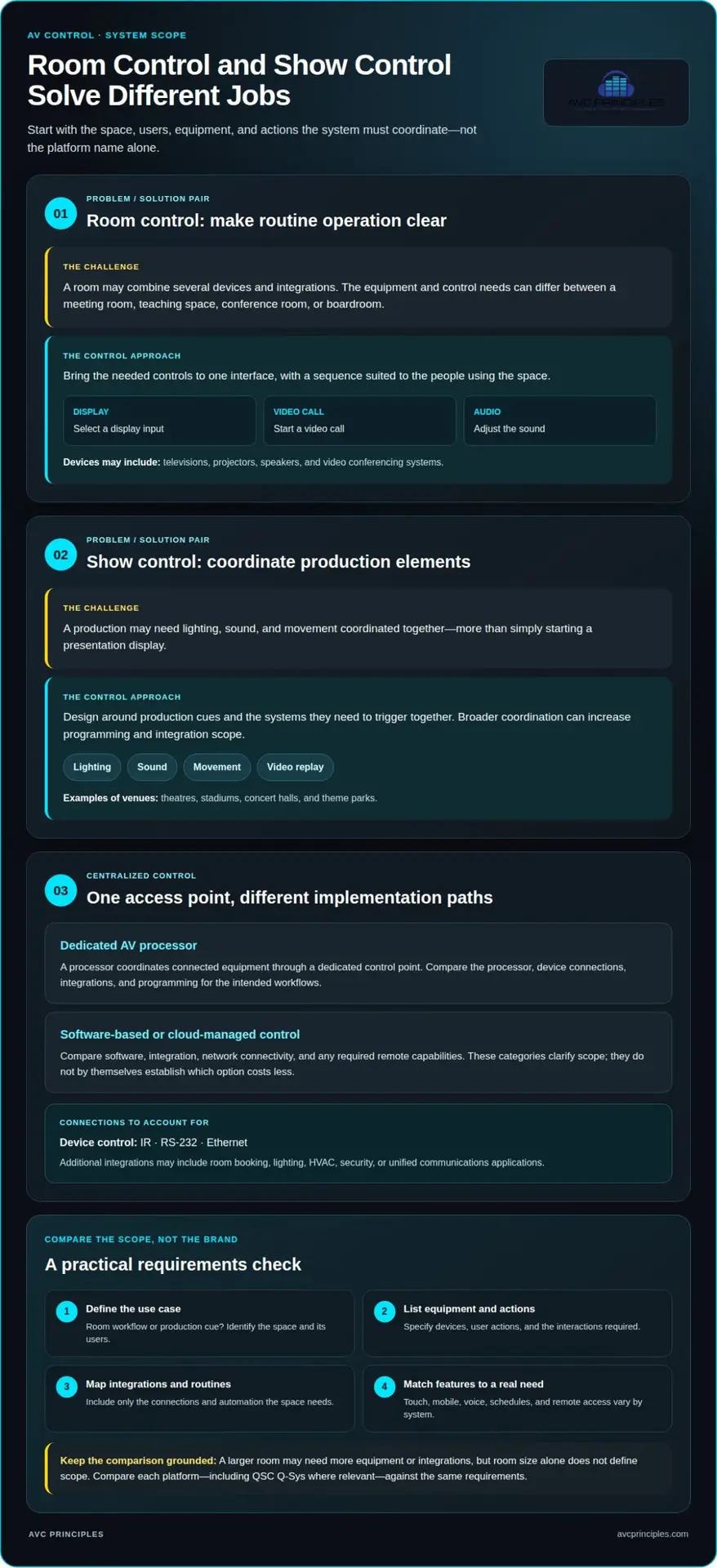
Room control supports spaces such as conference rooms, meeting rooms, teaching spaces, and boardrooms. A control interface can bring televisions, projectors, speakers, and video conferencing systems to one point. In a corporate setting, this can simplify starting a presentation and help maintain a consistent setup across collaboration spaces. Consider who will use the system: non-technical staff benefit from a clear control sequence.
For a corporate meeting room, the operating sequence might select a display input, start a video call, and adjust audio. AV control software can connect these actions through a single interface. Devices may communicate through IR, RS-232, or Ethernet. Those connection requirements affect design scope because each controlled device and interface must be accounted for. A system that also connects with room booking or lighting adds further integration considerations.
QSC Q-Sys is one option to include when comparing room-control platforms. Assess it against the same requirements as other systems: devices to control, required integrations, and operator workflow. The platform name alone does not determine project cost. Feature complexity, brand, and the scope of system coordination all matter. A consistent requirements list makes proposals easier to compare.
Room-control features may include touch-based operation, mobile-app control, voice-control integration, scheduled routines, and remote access. These functions are not available in every system, and each should address an operational need. Scheduled shutdowns, for example, may suit a room with predictable operating hours. Remote access can support troubleshooting when included in the design. Keep the monitor or control interface focused on functions users need for routine operation.
Show control serves a different operating environment. It coordinates production elements such as lighting, sound, and movement in venues including theatres, stadiums, concert halls, and theme parks. A concert sequence may trigger several systems at once, rather than simply starting a presentation display. This broader coordination can increase programming and integration scope. Compare conference-room workflows separately from production-control requirements.
To compare room and show control, define each use case first. List the equipment, user actions, integrations, and automated routines required. Then assess platforms against that scope, including QSC Q-Sys where relevant. Remove features without an operational purpose, while retaining functions needed for collaboration, production cues, or reliable room operation. This keeps the comparison tied to each system’s actual responsibilities.
Planning should account for the buyer’s specific needs and budget, with input from a qualified AV integrator. When choosing an AV control system, balance cost with features and avoid paying for features that will not be used. Systems can integrate with unified communications applications, room booking systems, lighting, HVAC, and security, so specify the connections that support the intended operation. Routines can also be automated based on time, location, or other triggers.
Centralized control of audiovisual equipment
Centralized control brings multiple audiovisual devices under one access point, reducing the need for separate operating interfaces. Compare costs based on whether the system uses dedicated processing hardware, software, or cloud-managed functions.
Centralized AV processor costs
A centralized AV processor coordinates connected equipment through a dedicated control point. Cost considerations include the processor, device connections, integrations, and programming for the intended workflows. A meeting space with displays, audio, and video conferencing has a different control scope from one managing a display alone. The equipment list and required interactions define the comparison.
Room control can let a showrunner manage audio and electronic equipment through one system and remote. AV control software can also manage multiple devices from one access point. Centralized operation consolidates commands, but each device still needs compatible connectivity and a defined control path. A display, audio system, and video source, for example, may each require integration work.
Show control provides a historical example of centralized coordination. By 1989, show control options could manage lighting, curtains, audio systems, and video replay from one control center. That illustrates how scope influences design: coordinating several systems requires more integration than controlling a single device. A modern comparison should identify which systems need unified operation, then account for their control interfaces and programmed interactions.
Software-based and cloud-managed control costs
Software-based control uses software to manage connected audiovisual devices, while cloud-managed control uses remote access or management functions. Compare their costs by accounting for software, integration, network connectivity, and required remote capabilities. These categories clarify scope but do not establish which option costs less. The key question is which functions the space needs.
Software can provide a visual interface for selecting sources or controlling meeting-room equipment. Remote access may support troubleshooting and maintenance when the system includes it. Depending on the design, cloud-managed functions can also affect how operators access controls across different environments. Compare required access points, device connections, and workflows rather than treating “software” or “cloud” as a complete cost description.
Centralized processors and software-based approaches are not automatically cheaper than one another. A processor-led design concentrates control in dedicated equipment; a software-led design focuses on software functions and connectivity. Either approach may require integration and programming. Distinguish equipment costs from implementation scope, and map each system’s control functions to actual operational needs.
For a useful comparison, group requirements into device control, interface design, integration, and remote operation. Assess which functions improve the workflow and which add complexity without serving a defined task. This keeps the decision tied to system requirements, whether the setting is a meeting room or a control center.
AV presentations in the 1970s often relied on pre-produced slides or audio and required a large team to manage the screen, lighting, and sound system. The homeowner described the existing touch panels and audio control panels as circa 2008, illustrating how control arrangements can reflect equipment already in place.
Major AV control system manufacturers
Separate platform identity from project scope when comparing manufacturers. Extron and QSC Q-Sys are options to evaluate against the required devices, integrations, and operating workflows.
Proprietary hardware and licensing requirements
Proprietary hardware and licensing can shape platform selection and ongoing operation. Requirements vary by product and design, so there is no single rule for every manufacturer. Compare the proposed processor, software access, license terms, and installer qualifications as separate items. A system coordinating displays, audio, and lighting, for example, may have different requirements from one controlling a single device.
Do not assume that Extron and QSC Q-Sys have identical hardware, licensing, or installer requirements across every deployment. Details depend on the selected platform and its configuration. Include them in the system scope before comparing proposals: purchase cost alone does not describe a platform’s full operating requirements.
Installation, programming, and commissioning costs
Installation, programming, and commissioning are distinct project activities, each affecting the implementation scope. Installation connects processors and devices; programming defines control behavior; commissioning tests the configured system in its intended environment. The effort involved depends on equipment count, integration complexity, and the number of workflows.
Controlling a display and audio system has a different scope from coordinating multiple devices, automation, and lighting. Programming may cover source selection, control sequences, and user interfaces, which commissioning then tests together. Compare these activities separately to understand what each proposed system requires.
Recurring platform costs
Recurring platform costs may include annual licenses, subscriptions, support, and maintenance. The total depends on the platform’s licensing model, subscription scope, support arrangement, and maintenance responsibilities. These items are distinct: a subscription may cover software access, while support and maintenance address other operational needs.
Compare recurring requirements for each proposed platform, including Extron and QSC Q-Sys, without assuming their terms are identical. Also account for risks such as additional integration work, incompatible connectivity, unplanned programming changes, or unclear support responsibilities. A written scope that distinguishes included functions from optional services makes these differences visible.
Upgrade and replacement costs
Upgrade and replacement costs depend on what changes: control hardware, software, device connections, or programmed workflows. Retaining compatible components may reduce replacement scope, while switching platforms can require new integration and programming. System dependencies matter as much as the replacement device.
Adding a lighting-control function, for example, may require revised programming and commissioning even if the existing processor remains. Replacing a processor can also affect connected devices and interfaces. Compare options by mapping affected components, reconfiguration, and testing. This shows the operational work behind an upgrade, rather than treating the hardware price as the full cost.
System scalability and flexibility
Room complexity, device count, integration needs, and required control functions are major cost factors. A project connecting conference rooms with lighting, HVAC, and security has a broader scope than one controlling a single display.
Scale involves more than device count. It also includes how many spaces share a platform, how operators access its interface, and which systems need to coordinate. Recording these requirements makes expansion needs visible alongside current ones.
Consider a planned setup with 3 AV rooms, each with in-wall 7.2 surround sound and a television. Add 25 IP cameras with an NVR and 10 large wall-mounted LCD screens, and the control design must account for distinct equipment groups. These examples show why device count and system relationships both matter.
For multiple locations, determine whether each space needs independent control or a common operating structure. A learning space may need a different interface from an entertainment area or conference room. If operators need consistent controls across spaces, the platform design must support that without treating every room as identical.
Crestron can be part of a manufacturer comparison, but the name alone does not establish scalability. Evaluate each proposed platform against the required devices, interfaces, and integrations. Then consider whether the design can accommodate new rooms or functions without replacing unrelated system components.
Integrating lighting control, HVAC, and security can extend an AV system beyond audiovisual equipment. Each added connection brings coordination requirements. A room-control platform that also coordinates lighting, for example, needs a defined control relationship between the systems. That integration scope can affect design and implementation effort.
When multiple AV control manufacturers are involved, an overarching platform that is device- and vendor-agnostic can help coordinate systems. It does not eliminate the need to define interfaces, connectivity, and each connected platform’s responsibilities.
Flexibility also depends on how the system handles future changes. Adding a display, changing a room’s function, or introducing a new control sequence may require programming and integration updates. Documentation of device relationships and control logic gives those changes a defined structure.
For a practical comparison, separate current requirements from anticipated expansion. Record each space, its devices, integrations, and operator interface, then assess how each platform accommodates them. This makes a cost comparison of major AV control systems more meaningful because the scope reflects current operation and planned growth.
US AV Control System Installation & Programming Costs
In the United States, installation, programming, and commissioning costs depend on project scope. A quote reflects factors such as equipment count, system complexity, integration requirements, and programming scope.
These are separate phases, not interchangeable line items. Installation establishes physical connections between control equipment and audiovisual devices. Programming defines how devices respond to user commands. Commissioning tests the configured system in its intended operating environment. A proposal that combines these phases may obscure how labor and technical effort are allocated.
Installation scope depends on the equipment and connections involved. A room with a display and audio system requires different work from a control design linking several devices and external systems. Existing infrastructure also matters: the design must account for available connectivity and how each device communicates with the control system. These requirements shape labor and coordination.
Programming effort depends on the intended operating logic. A simple source-selection interface differs in scope from coordinated sequences involving conferencing, lighting, or multiple spaces. Define and test each command and system interaction. Changes to the requested workflow can also affect programming effort, particularly when they alter integrations or operator controls.
Commissioning verifies that the installed and programmed system performs its specified functions. Testing may cover device response, control interfaces, and interactions with connected systems. In a meeting room, for example, a sequence can be tested from source selection through display and audio operation. Broader systems need testing across their defined workflows, not just checks of individual devices.
To interpret a project estimate, separate the scope into these categories:
- Installation: control equipment, device connections, and integration work.
- Programming: interface behavior, control sequences, and system logic.
- Commissioning: functional tests and resolution of identified configuration issues.
Then compare proposals against the same equipment list and operating requirements. A project involving conference rooms, video conferencing, and lighting should identify those elements consistently in each scope. This shows whether an apparent cost difference reflects different work or different pricing for equivalent work.
Distinguish initial delivery from recurring platform requirements. Licensing, subscriptions, support, and maintenance can affect ongoing ownership, but they are separate from installation and commissioning. The selected platform and its required services determine which recurring items apply. Keeping these categories separate clarifies both project and lifecycle obligations.
For a complex facility, AV Systems Design can define device scope, control behavior, and integration requirements before implementation. This provides a structured basis for comparing installation, programming, and commissioning proposals without relying on room size alone.
AVC Principles: AV Systems Design
AVC Principles provides AV Systems Design for projects requiring a coordinated control strategy. It is a practical next step when room requirements, equipment, integrations, and future expansion need to be considered together before implementation.
For command environments, Command and Control Center Design addresses the broader operational setting. ICT Infrastructure Design supports planning when audiovisual systems depend on coordinated communications infrastructure. Staged Environment Engineering applies to performance and event spaces with integrated technical requirements.
Bring your intended uses, spaces, equipment, and integration priorities. AVC Principles can use these requirements to shape an AV systems design aligned with the project scope. Contact AVC Principles to discuss your AV system design requirements.
Set the Next Project Decision in Motion
Use a cost comparison of major AV control systems as a planning reference, then define the operational outcomes your spaces must support. A clear project brief connects control requirements with the facility’s broader technical design and keeps decisions coordinated as the project develops.
AVC Principles offers AV Systems Design, ICT Infrastructure Design, and Staged Environment Engineering. These services are relevant when audiovisual control forms part of broader infrastructure or a performance environment. The next step is to translate your requirements into a project scope that supports how people will use the system.
Discuss your project with AVC Principles and identify the design priorities that should guide the next phase. A well-defined direction gives your team a sound basis for moving forward.
Frequently Asked Questions
What are the upfront hardware and software costs of major AV control systems such as Crestron, Extron, AMX, Q-SYS, and Control4?
Upfront costs depend on system configuration and project scope, not the manufacturer name alone. For a useful comparison, include the control processor, required software or licenses, interfaces, device connections, programming, and installation. A single conference room has different requirements from several coordinated spaces. Compare proposals based on the same equipment list and operational needs to identify meaningful differences between platforms.
What is the total cost of ownership of major AV control systems over five years?
Five-year total cost of ownership includes the initial system and implementation cost, plus applicable recurring licenses, subscriptions, support, maintenance, upgrades, and replacements during that period. Estimate each category separately, then add projected costs across the five-year timeframe. A system with recurring software charges, for example, should account for them alongside initial programming and later changes. The total depends on the selected platform and operating requirements.