
A project can meet its schedule and still exceed its budget. A cost overrun is the amount by which actual costs exceed an approved budget or original estimate. AV project cost overrun prevention starts with making that gap visible early.
In AV projects, labor, procurement, design decisions, and scope changes can all affect costs. Tracking spending against the budget is essential, but it works best when teams also compare estimates with actual costs, coordinate decisions across project functions, and monitor margin as work progresses.
This article explains how budget tracking supports cost control, how to interpret estimated and actual costs, and how regular coordination can reveal problems before they grow. It also covers margin monitoring, helping project teams identify cost pressure, investigate its causes, and make informed adjustments while work is underway.
Key Takeaways
- Track committed and actual spending against the project budget to surface variances while there is still time to respond.
- Compare estimated and actual costs by category, then use completed-project results to strengthen future estimates.
- Coordinate finance, procurement, operations, and project teams so purchasing and scope decisions are reflected in current forecasts.
- Monitor labor, supplier costs, and project margin throughout delivery; investigate where costs are diverging before they erode profitability.
- Use clear scope definition and change control to assess the cost and schedule impact of proposed work before it proceeds.
1. What is the definition of cost overrun?
A cost overrun is the amount by which actual project costs exceed an approved budget or original estimate. The approved estimate is the baseline for measuring that difference. Compare actual costs with the same approved scope and budget period. A job scoped at 120 labor hours but consuming 165 hours shows how actual work can exceed its estimate. In AV projects, labor, equipment, materials, and procurement all contribute to project costs.
A change order differs from a cost overrun. It documents an approved change to the original scope, price, or schedule. The change itself does not automatically mean the project is over budget. If the revised budget accounts for its costs, project management can track performance against the updated baseline. If additional work proceeds without approval or a budget adjustment, its labor and materials can push actual costs above the original estimate.
Scope creep occurs when project work expands without a clear, approved adjustment to scope, budget, or schedule. For example, adding displays, revising signal routing, or expanding commissioning requirements can create extra design and installation work. Each request may seem limited, but unrecorded changes accumulate. They can also cause delays when teams must revise drawings, coordinate new equipment, or repeat completed work. A defined change-control process makes each request visible before it affects delivery.
Material price changes and supply-chain disruptions can also widen the gap between estimated and actual costs. A quoted component may become more expensive, arrive later, or require a substitute. Substitution can affect compatibility, design coordination, and installation effort. Record the item affected, revised price, lead-time effect, and resulting labor or schedule impact. This creates a traceable basis for updating forecasts and deciding whether formal approval is needed.
Change-order documentation should identify the requested work, reason, affected deliverables, price adjustment, schedule impact, and approving parties. It should also record the decision and date. Without these details, teams may disagree about whether work was included in the original scope or authorized later. Costs can extend beyond equipment: additional programming, installation hours, testing, and schedule changes can all affect the project budget.
What AV project contract terms help prevent change-order disputes? Define the baseline scope, written approval process, pricing method, schedule adjustments, and who can authorize changes. Record approved revisions and their cost and schedule effects so teams can compare delivery with the current agreement.
For effective AV project cost overrun prevention, separate approved scope changes from unplanned cost variances in reporting. When a variance appears, trace it to its source: added work, labor consumption, supplier pricing, or delayed delivery. Then update the forecast and route proposed scope changes through the documented approval process. This keeps the project’s budget, scope, and actual costs aligned as delivery progresses.
2. What Is AV Project Budget Tracking in an AV Workflow?
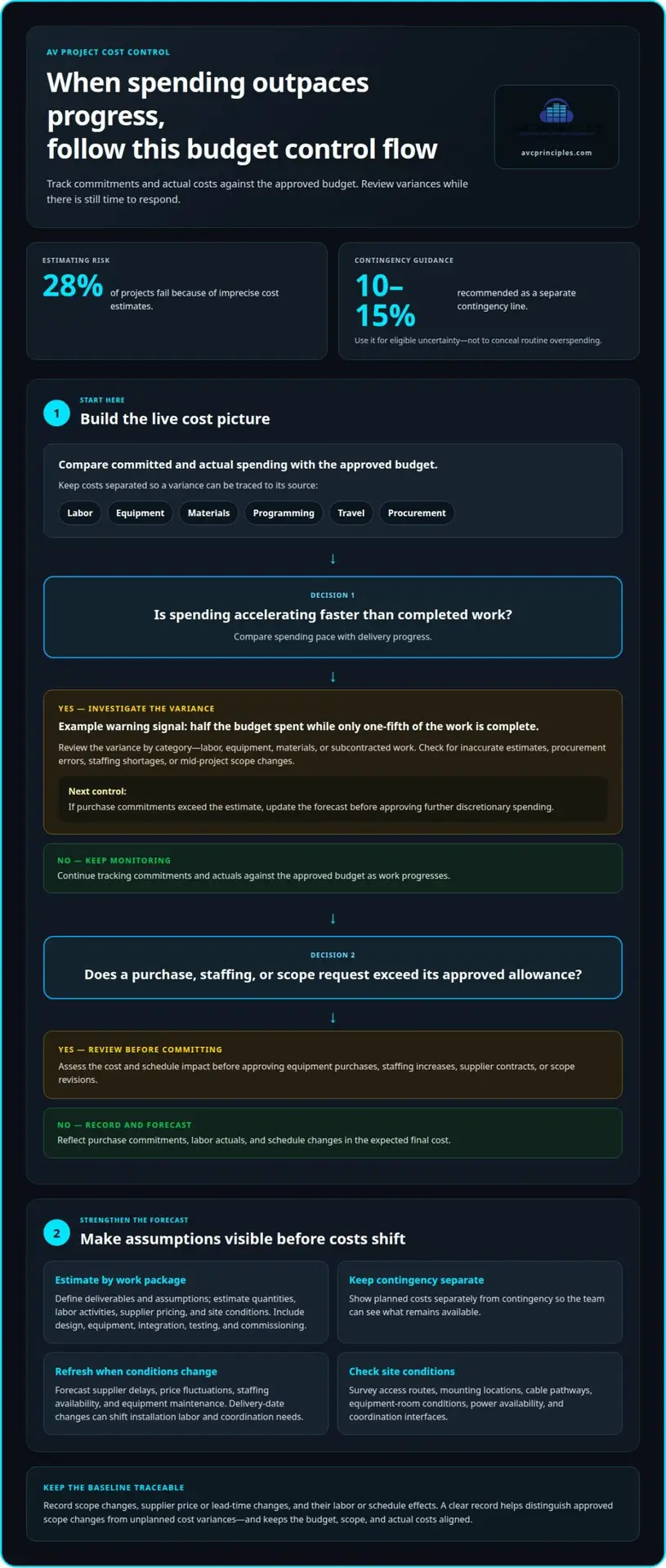
Budget tracking compares committed and actual spending with the approved project budget. In an AV workflow, the record should separate labor, equipment, materials, programming, travel, and procurement. A detailed cost structure makes estimates easier to test against actual commitments. About 28% of projects fail because of imprecise cost estimates. That risk makes estimating quality a core control, not an administrative detail.
Start with scope, system architecture, deliverables, and installation conditions. Then estimate resources for each work package, including design, equipment, integration, testing, and commissioning. How do you create an accurate AV project budget and scope? Define each deliverable, document assumptions, and build estimates from quantities, labor activities, supplier pricing, and site conditions. Keep allowances and contingency separate from planned costs so teams can see what remains available.
Forecasting updates the expected final cost as purchase commitments, labor actuals, and schedule changes emerge. The research recommends a separate contingency line of 10-15% in an AV project budget. Its purpose is to absorb eligible uncertainty, not conceal routine overspending. Forecasts should account for supplier delays, price fluctuations, staffing availability, and equipment maintenance. A changed delivery date can shift installation labor and coordination needs, even when equipment pricing stays stable.
Early warning signs include spending that accelerates faster than completed work. Spending half the budget while completing one-fifth of the work signals a potential overrun. Review the variance by cost category: labor, equipment, materials, or subcontracted work. Common causes include inaccurate estimates, procurement errors, staffing shortages, and mid-project scope changes. If actual purchase commitments exceed the estimate, update the forecast before approving further discretionary spending.
Site surveys identify physical constraints that estimates may miss. How can site surveys identify risks that increase AV installation costs? Document access routes, mounting locations, cable pathways, equipment-room conditions, power availability, and coordination interfaces. For example, an obstructed cable route can require redesign, extra labor, or schedule changes. Recording these conditions before finalizing scope helps align the design, installation method, and budget assumptions.
Budget thresholds turn approval controls into practical steps. Set review points for equipment purchases, staffing increases, supplier contracts, and scope revisions. A request that exceeds its approved allowance should trigger a cost and schedule impact review before commitment. Project management should also reconcile purchase orders, invoices, labor records, and progress against one current forecast. How do project management practices keep AV projects on budget and schedule? Assign decision owners, review variances regularly, and record actions, approvals, and revised forecasts in a shared status process.
Budget tracking works as a continuous control loop: estimate, commit, measure, forecast, and respond. An updated forecast shows whether a variance is isolated or affecting final delivery. Teams can then investigate its cause, adjust resources, or seek approval for a scope change. This keeps estimates connected to actual project conditions throughout the AV workflow.
3. How Do Estimated vs Actual Costs Work in AV Projects?
An estimate sets the expected cost for defined work; actuals record what the project spends. Comparing them shows where forecasts match delivery and where they diverge. PMI’s Pulse of the Profession reports that 43% of projects exceed their original budget. For projects that exceed it, PMI reports an average overrun of 27%. These figures reinforce the need for consistent cost visibility, not a final review alone.
Use the same scope and cost categories for both sides of the comparison. The basic variance is actual cost minus estimated cost. Divide that gap by the estimate and multiply by 100 to express the variance percentage. The calculation identifies the size of the difference, not its cause.
Cost visibility depends on recording commitments and expenses consistently. Track labor, equipment, materials, procurement, and other project costs separately. Match invoices and purchase orders to the relevant estimate category. Record labor against the work performed rather than grouping hours under a broad project label. These practices help teams see whether an overrun stems from additional work, inaccurate estimates, or higher resource consumption.
Current pricing matters. Construction cost estimates should use current pricing and cost databases rather than outdated spreadsheets or rough figures. Recording the variance against the equipment estimate makes the effect visible. Project teams can then update forecasts and distinguish supplier price changes from errors in the original quantity or specification.
Historical project data improves future estimates when teams compare similar work. After completion, review planned and actual labor hours, equipment quantities, supplier costs, and schedule assumptions. Separate approved scope changes from variances against the original work. For example, a project with added programming should not be treated as a simple estimating failure if the additional work was approved. Accurate records preserve that distinction.
Post-project reviews turn actual costs into useful estimating practices. Identify which categories differed, why they differed, and whether the cause is likely to recur. Supplier planning may need adjustment after repeated delivery issues. Labor assumptions may need revision when commissioning or integration work consistently takes longer than planned. Keep findings tied to comparable project types, system requirements, and delivery conditions.
For the next estimate, use verified project actuals as a reference, then adjust for changed scope, current supplier pricing, and site conditions. Document assumptions alongside the estimate so later comparisons remain meaningful. This creates a disciplined cycle: estimate, record actual costs, analyze variances, and refine the next forecast. Better tracking clarifies the source of cost differences before they disappear into a single total.
4. Coordination across finance, procurement, operations, and project teams
AV project costs span departments, so disconnected records can hide exposure. Procurement may record an equipment commitment before finance receives its invoice. Operations may see a delivery delay while the project schedule still assumes installation can proceed. A shared project status aligns these signals, giving finance, procurement, operations, and project management the same view of committed spending, actual costs, delivery status, and remaining work.
Each function contributes a different control. Procurement reports supplier quotes, purchase orders, substitutions, and delivery changes. Finance reconciles invoices, labor expenses, and approved budget revisions. Operations identifies access constraints, staffing conflicts, and dependencies affecting installation. Project managers connect these updates to scope, milestones, and decisions. For example, a delayed display shipment can shift technician assignments and commissioning dates, even before an invoice changes.
Centralized financial and operational reporting should use consistent project identifiers and cost categories. Link purchase commitments to the relevant equipment line, labor records to completed activities, and schedule updates to affected work packages. A variance report can then show whether spending exceeds progress, a supplier change affects delivery, or added work requires a decision. Without these links, teams may hold accurate records individually yet miss their combined effect.
Coordination protects profitability by revealing trade-offs before teams act on incomplete information. An unplanned equipment substitution may affect compatibility, testing requirements, and installation effort. Procurement can identify the substitute, engineering can assess its system impact, and finance can evaluate the revised forecast. Operations can then reflect any schedule implications. This sequence helps prevent a purchasing decision from creating unexpected labor, rework, or quality pressure elsewhere.
Cost overruns can also affect customer commitments and operational readiness. If a delayed component pushes testing back, the project may miss a handover milestone. If teams compress the remaining work without checking resources, quality reviews or commissioning tasks may be constrained. A coordinated review connects cost, schedule, and quality impacts before recovery actions are approved. The response can then address the cause instead of shifting pressure to another workstream.
Contract terms add another coordination requirement. Project managers should route proposed changes and supplier impacts through the agreed approval process, while finance records related cost effects. Construction contracts may include cost and timeline requirements; overlooking those terms can lead to penalties or lawsuits. Maintain clear records of decisions, approvals, delivery changes, and schedule effects. This gives the project team a traceable basis for resolving disagreements about authorized work.
Use milestone reviews to bring the four functions together around current evidence. Finance presents cost variances; procurement reports commitments and supply risks; operations identifies resource constraints; project management evaluates scope and schedule. Assign an owner and action to each unresolved issue. When an unexpected change could exceed budget or delay delivery, record its financial, operational, and quality effects before committing resources. This coordination makes project-level decisions visible to the teams responsible for delivery.
5. Margin and profitability monitoring
A project can remain within its original budget and still deliver less profit than expected. Margin monitoring compares expected revenue with forecast and actual costs as work progresses. Cost monitoring shows where spending is changing; margin monitoring shows what that change means for project profitability. Together, they help an organization detect erosion before the final account closes.
Set the baseline at project approval. Record expected revenue, estimated labor, equipment, materials, and other planned costs. Then update actual and committed costs against those categories as the project advances. A 35% project margin illustrates why small cost movements matter: a 10% cost overrun consumes close to one-fifth of its profit. The effect depends on the original margin, so review both the variance and remaining forecast.
Use a regular review cycle with current labor records, purchase orders, supplier updates, and milestone progress. The research recommends logging AV project labor hours daily rather than weekly. Daily records make it easier to spot where labor consumption departs from the estimate while work remains. Compare actual spending with completed work, not just elapsed time. Early spending that outpaces progress can signal pressure on final margin.
Cost performance index, or CPI, provides another reference for monitoring delivery efficiency. The reference point is 1.0: compare earned value with actual cost using the project’s established method. A result below that reference indicates costs are accumulating faster than earned value. It does not explain the cause by itself. Review the work packages behind the variance, then separate additional approved work from unplanned labor, procurement, or productivity issues.
Margin reviews should prompt specific actions, not just status reports. If labor use is above estimate, identify the activities responsible and assess the remaining workload. If supplier pricing changes, update the forecast and review procurement commitments. If scope has shifted, account for approved revenue and cost effects separately. This analysis helps distinguish a temporary timing difference from a forecast reduction in final profitability.
Keep margin records consistent from estimate through closeout. At each review, retain the original budget, current forecast, actual spending, approved changes, and explanations for material variances. At completion, compare final results with the forecast and record lessons for future estimates. These project actuals give the organization a stronger basis for planning labor, procurement, and risk allowances next time.
For AV project cost overrun prevention, connect budget tracking to margin monitoring rather than treating them as separate controls. Review AV project cost control planning as part of a disciplined approach to project delivery.
AVC Principles
AVC Principles helps organizations define AV system requirements and technical scope before delivery decisions create avoidable cost pressure. Through AV Systems Design, ICT Infrastructure Design, Staged Environment Engineering, and Command and Control Center Design, the work establishes a coordinated design basis for project planning, procurement, and implementation.
Consider this support when an AV project involves complex system integration, multiple stakeholders, or scope that needs structured definition. Clear design documentation helps teams align requirements and identify interfaces that affect estimates, scheduling, and delivery coordination.
To discuss your project requirements, contact AVC Principles.
Set the project’s financial controls before delivery begins
Make cost oversight part of project planning, not a closeout exercise. Define who owns estimates, approvals, purchasing decisions, and forecast updates. Establish how scope revisions enter the project record and how their financial effects are assessed. Clear ownership gives each decision a route into the project’s financial picture.
AV project cost overrun prevention depends on designs and delivery assumptions that translate into practical project controls. AVC Principles offers AV Systems Design, ICT Infrastructure Design, and Staged Environment Engineering. These disciplines support coordinated planning across system requirements, infrastructure interfaces, and staged environments, giving project teams a stronger basis for defining scope and evaluating delivery decisions.
Bring the project’s requirements and cost-control priorities into the next planning discussion. Contact AVC Principles to discuss how its design expertise can support your AV project. A clear starting point helps teams make informed decisions as the work moves forward.
Frequently Asked Questions
What is the definition of cost overrun?
A cost overrun occurs when the final or forecast project cost rises above its approved budget. The key distinction is whether the budget changed through an authorized scope revision. A documented change may increase the approved baseline; costs beyond that adjusted baseline indicate a variance that needs investigation. Keeping the original estimate and approved revisions visible helps explain how the final cost developed.
How Can AV Teams Control Labor Costs More Effectively?
Control labor costs by assigning hours to defined work activities, such as installation, programming, testing, and commissioning. Compare recorded time with the effort forecast for each activity, not just the project-wide labor total. If hours rise, identify whether the cause is rework, access constraints, coordination, or added requirements. This helps teams choose a response that addresses the source rather than indiscriminately limiting labor.
How Can You Track Procurement and Material Spend?
Maintain a procurement record that connects each specified item to its requisition, purchase order, delivery status, invoice, and project cost category. Reconcile committed amounts with invoices and received materials so outstanding obligations remain visible before payment. Record substitutions separately, including who approved them and whether they change installation or integration work. This gives project teams a clearer view of material commitments than invoices alone.
How Do Change Orders Affect AV Project Budgets?
A change order can add or remove work, revise the budget baseline, and alter the delivery schedule. Its financial effect may include design effort, equipment, installation, programming, testing, or rework caused by changed interfaces. Record each approved change against the affected scope and forecast. If work proceeds without agreed cost treatment, the project team may absorb expenses that were never reflected in its approved financial plan.
How Do Estimated vs Actual Costs Work in AV Projects?
Estimated costs represent planned resources and spending for defined work. Actual costs record expenses incurred, while committed costs capture obligations such as issued purchase orders. Compare all three by cost category and work package. For example, an equipment line can show its estimate, ordered amount, and invoiced amount separately. Reviewing these records together distinguishes forecast exposure from costs already recorded in accounts.
How Do You Spot a Budget Overrun Before It Lands?
Look for costs accumulating faster than completed deliverables, rising labor consumption, and purchase commitments that leave too little budget for remaining work. Forecast final cost by combining actual spending, open commitments, and a reasoned estimate of unfinished tasks. Compare that forecast with the current approved budget at each project review. A worsening forecast is an early signal, even if invoices have not arrived.
How Should You Respond to Unavoidable Overruns?
First identify the root cause and estimate its effect on remaining work, schedule, and forecast. Pause discretionary spending where appropriate, then review pending change orders before approving further commitments. Separate required work from optional scope and document decisions, owners, and revised assumptions. Communicate the financial position to those responsible for project decisions so corrective actions address the cause rather than obscure it.
What Are the Practices for Preventing Budget Overspend?
Establish a detailed baseline, assign approval owners, and connect project records across finance, procurement, and delivery teams. Reconcile labor, purchase commitments, invoices, and progress regularly. Route scope changes through documented review before work proceeds, and update forecasts when assumptions shift. At closeout, compare final results with the estimate and preserve the reasons for major variances. These practices make lessons useful for future project planning.