
A corporate AV system’s value is measured by the financial benefit it generates, not by revenue alone. Calculating ROI on corporate AV investment means subtracting the total investment cost from the financial return, then expressing the net gain as a percentage of that cost.
The formula is straightforward, but choosing the right costs and benefits takes care. A sound assessment distinguishes revenue from profit and accounts for costs over the evaluation period. This is essential to calculating ROI on corporate AV investment accurately.
This guide explains how to build the calculation, assess annualized returns, and evaluate AV system value over time. You’ll learn how to include relevant project costs and connect measurable financial benefits to the investment. A consistent method for calculating ROI on corporate AV investment helps decision-makers compare projected returns with actual performance and make informed infrastructure decisions.
Key Takeaways
- Use net profit, not gross revenue, to calculate a meaningful percentage return against the full investment cost.
- Separate projected results from actual performance by using estimates before implementation and final financial figures afterward.
- Account for the investment period when comparing returns, since the same total ROI can represent different annual performance.
- Use ROI to assess a defined AV project, while recognizing that the percentage alone does not show timing or the full business impact.
- Build AV system value from measurable financial benefits and lifecycle costs, including equipment, installation, and maintenance.
What Is Return on Investment?
Return on investment (ROI) expresses an investment’s net financial gain as a percentage of its cost. For example, $200 in net income from a $1,000 investment produces a 20% ROI.
Follow these steps to define the return, calculate it consistently, and consider the timeframe alongside the percentage.
-
Select an ROI Formula
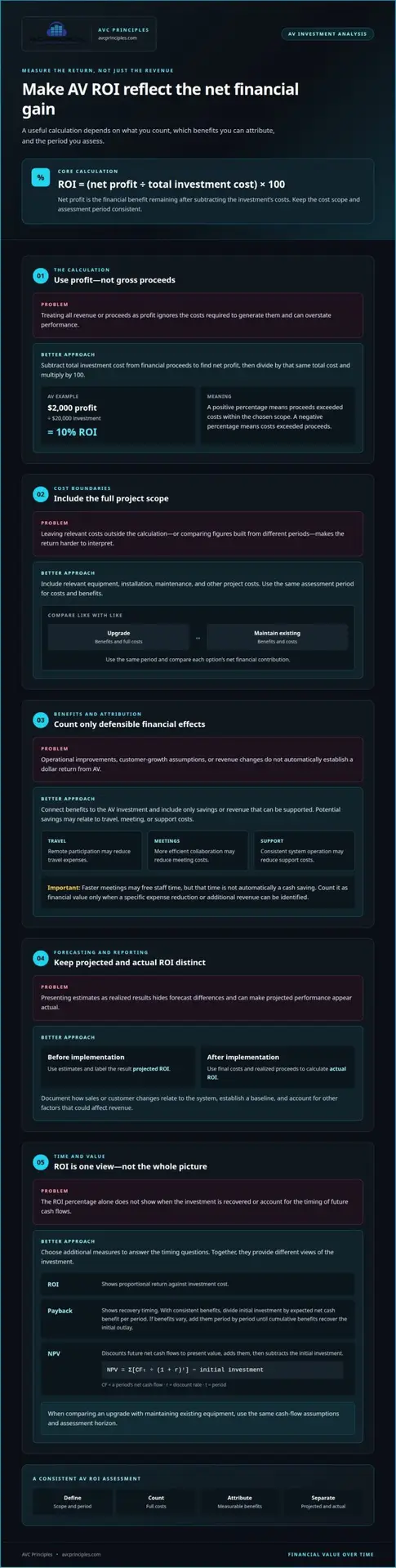
Choose the formula that matches the figures being assessed: ROI = (net profit ÷ total investment cost) × 100. Net profit is the financial benefit after subtracting the investment’s costs, while total investment cost includes the relevant outlay. Keep the same scope and assessment period for both figures.
For a $20,000 investment that produces $2,000 in profit, the calculation is ($2,000 ÷ $20,000) × 100, or 10%. Don’t divide gross proceeds by cost and label the result profit-based ROI. For AV decisions, compare modern system benefits with the full cost of upgrading, then compare those figures with the benefits and costs of maintaining existing equipment. Include operational effects that can be measured, such as changes in meeting capacity or avoidable support expenses. The better option depends on its net financial contribution over the same period.
-
Calculate Net Profit and ROI Percentage
Subtract the total investment cost from the financial proceeds to find net profit. Then divide that profit by the same total cost and multiply by 100. For instance, if an investment costs $1,000 and generates $1,200 in proceeds, net profit is $200 and ROI is 20%. This calculation makes clear why revenue alone can overstate performance.
Use a consistent boundary for costs and proceeds. If installation or maintenance is part of the investment being assessed, include it in the cost calculation. Label estimates as projected ROI; after implementation, use final costs and realized proceeds to calculate actual ROI. These distinctions make the calculation useful for learning from forecast differences, not just reporting a percentage. A positive percentage means proceeds exceeded costs within the chosen scope. A negative percentage means costs exceeded proceeds.
-
Calculate Payback Period and Net Present Value
Estimate the payback period by dividing the initial investment by the expected net cash benefit per period, if that benefit is consistent. If benefits vary, add them period by period until cumulative benefits recover the initial outlay. This provides a timeframe that the percentage alone cannot show.
For net present value (NPV), discount each future net cash flow to its present value, add those discounted amounts, and subtract the initial investment. In formula form, NPV = Σ[CFt ÷ (1 + r)t] − initial investment, where CF is a period’s net cash flow, r is the discount rate, and t identifies the period. Use the same cash-flow assumptions and assessment horizon when comparing an upgrade with maintaining existing equipment. ROI shows proportional return; payback shows recovery timing; NPV incorporates timing and the selected discount rate.
Revenue versus profit in ROI calculations
Distinguish revenue from profit before calculating return on investment. Revenue records incoming funds; profit accounts for the expenses needed to generate them.
Corporate AV costs vary with room size, system scope, integration needs, and installation complexity. Equipment lifespan and replacement costs depend on usage, maintenance, compatibility, and the components being replaced.
AV can reduce travel expenses by enabling remote participation, meeting costs through more efficient collaboration, and support costs through consistent system operation. Include only savings that can be linked to the investment.
- Estimate the project’s full expenses and attributable revenue. Include relevant equipment, installation, maintenance, and other project costs. Forecast revenue only when it has a clear connection to the AV investment, such as additional business enabled by improved presentations. For example, a hypothetical customer-growth estimate needs to be tied to customer numbers and revenue per customer before it can support a revenue projection. Use the same forecast period for costs and benefits.
Separate direct financial effects from operational improvements. Faster meetings may free staff time, but that time does not automatically represent cash savings. Count it as financial value only when the organization can identify a specific expense reduction or additional revenue. This prevents projected benefits from overstating ROI.
- Calculate net profit by subtracting project expenses from attributable revenue, then divide net profit by total project cost and multiply by 100. A coffee-machine example illustrates the distinction: $28,000 in additional revenue minus a $9,000 investment leaves $19,000 in net profit. Dividing $19,000 by $9,000 and multiplying by 100 gives an ROI of about 211%.
The $28,000 figure is revenue, not profit. Treating it as profit would ignore the investment cost and overstate the result. Apply the same discipline to AV projections: distinguish gross sales or savings from the net benefit remaining after related expenses. Record whether each input is estimated or realized, so projected returns don’t appear as actual performance.
- Document how customer growth or sales changes relate to the AV system. Establish a baseline, identify the change being attributed, and account for other factors that could affect revenue, such as pricing, sales activity, or market demand. A customer-growth assumption alone does not establish a dollar return: it needs a customer count and a defensible revenue value per customer.
Use consistent categories when comparing an AV upgrade with maintaining existing equipment. Include attributable travel, meeting, and support savings as reductions in expenses, not as revenue. An AV systems design assessment can help define project scope and identify which costs and operational benefits belong in the evaluation.
Annualized ROI
Annualized ROI expresses a return as an annual rate, making investments with different timeframes easier to compare. Consider the investment period alongside the percentage, since simple ROI alone does not show how quickly the return accumulated.
-
Account for the Investment Timeframe
Record the start and end points of the assessment period before comparing returns. A 25% ROI over five years and a 25% ROI over five days have the same simple ROI, but very different annual performance. The timeframe changes the interpretation, not the total return.
Use matching periods for costs and benefits in each comparison. For example, don’t compare one system’s annual savings with another system’s total return over several years. If an AV investment generates benefits over multiple years, state the full period and separate the initial investment from later cash flows. This makes comparisons more accurate and supports better decisions.
A simple annual estimate can divide a period’s ROI by the number of years, but it does not account for compounding. Treat it as a straight-line comparison, not an annualized compound rate. Label the method clearly so readers can distinguish a basic annual allocation from an annualized calculation.
-
Calculate Annualized ROI
Use the compound annualized formula when comparing returns across different holding periods: [(1 + ROI)1/n − 1] × 100. Enter ROI as a decimal and n as the number of years. This produces an annual rate that reflects the full period rather than treating every year as a separate, identical return.
For example, a stock bought for $12.50 on January 1, 2017, and sold for $15.20 on August 24, 2017, has a simple ROI of 21.6%. Annualizing that return gives 35.5%. The two percentages describe different measures: one is the holding-period return, and the other expresses it at an annual rate.
Use the annualized figure only when the dates, initial value, and ending value are defined consistently. The calculation may use 365 days to determine the years between investment dates. For a period reported in quarters, a 5% quarterly ROI corresponds to a simple annualized ROI of 20%. That simple figure is not the same as a compounded annual rate.
Finally, report the period and method beside every percentage. A 50% ROI reached in three years differs from the same return reached in five years. For corporate AV, the annual rate can support comparisons, while the underlying period shows how long the system takes to generate its assessed value.
Advantages and limitations of ROI
Use ROI to compare defined projects, then consider what the percentage leaves out. For corporate AV decisions, distinguish expected benefits from actual results and examine costs that could reduce returns.
-
Assess the Advantages of ROI
Use ROI to evaluate a specific AV project against another investment or the current operating approach. A consistently calculated percentage can show whether expected financial benefits justify the costs within the chosen scope. It also creates a measurable baseline for reviewing performance after implementation.
For example, compare an upgrade’s projected savings and revenue with its total expenses, then revisit those inputs once the system is in use. A standalone project calculation keeps the decision focused on that project rather than the entire business’s operating performance. Record assumptions alongside the result so decision-makers can see which benefits drive the percentage.
-
Identify Limitations and Hidden Costs
List potential costs that could reduce returns before finalizing the estimate. AV expenses may include integration, installation, maintenance, training, support, system downtime, and later adjustments for changing requirements. Omitting a relevant expense can overstate the investment’s financial contribution.
ROI also leaves out how long it takes to earn a return. The same percentage reached over a longer period may compare differently with one achieved sooner. The calculation cannot capture every operational benefit, such as improved collaboration, unless that benefit can be tied to a defensible financial outcome. Don’t treat a nonfinancial improvement as revenue without a clear valuation method.
Consider risk in the inputs. If expected customer growth depends on better presentations, changes in pricing or sales activity may also affect results. Record those assumptions separately instead of attributing every increase to AV. This makes actual results easier to interpret and helps avoid overstating the return.
- Review expected and actual figures using the same project boundaries. Compare forecast revenue, savings, and costs with realized figures, then identify the main source of any variance. For example, if maintenance or training costs exceeded the estimate, update the project’s net benefit rather than carrying forward the original projection.
Use ROI alongside the investment timeframe and operational context. A single percentage is useful for screening and comparison, but cannot show cash-flow timing, implementation disruption, or strategic value on its own. Consider those factors before approving an AV investment, and document the conditions that could change the result. This record supports later decisions about continued use, adjustments, or replacement.
Calculating AV system value and ROI
Assess AV value through financial outcomes the system can deliver and operational changes that can be linked to them. A defensible calculation connects each benefit to a defined project scope and assessment period.
- Define the investment boundary before assigning value. Include equipment, installation, and maintenance, then specify the period for assessing benefits. These inputs provide a starting point for evaluating the project, not a general price estimate.
The same hypothetical system produces $1,690 in net value per year during the five years after its initial costs are removed. Keep that ongoing value distinct from the initial investment. State which costs are included and how the annual value was estimated, so the calculation doesn’t count the same expense or benefit twice.
- Quantify productivity gains through observable changes in work. Compare meeting duration, time spent resolving technical issues, room availability, and staff time spent coordinating sessions before and after implementation. Translate time saved into financial value only when the organization can link it to reduced expenses or productive work that generates measurable revenue.
For example, track whether a conferencing upgrade reduces repeat meetings caused by failed connections. Record changes in meeting time and their operational impact, then assign financial value only where there is a defensible basis. Improved collaboration may be valuable, but it should not automatically be recorded as profit or investment return.
- Track operational and financial metrics against a baseline. Useful measures include system uptime, support requests, meeting-room utilization, travel avoided, meeting time, and attributable revenue or expense reductions. When calculating ROI on corporate AV investment, review these measures over the same assessment period, then calculate the return using the financial benefits and project costs within that boundary.
Separate performance indicators from ROI inputs. Uptime shows whether a system is available, while support requests can indicate changes in operating demand. These metrics become financial inputs only when they correspond to a measurable cost or benefit. This distinction helps evaluate system performance without overstating the financial result.
- Use the analysis to guide AV planning and investment decisions. An AV Systems Design process can align system scope with room requirements, integration needs, and intended outcomes. This connection helps identify relevant operational indicators before implementation, rather than selecting favorable measures afterward.
For a project-specific assessment, discuss AV system design in relation to the intended performance outcomes. A defined scope, clear cost categories, and measurable benefits support a disciplined approach to calculating ROI on corporate AV investment and capital allocation.
AVC Principles
AVC Principles helps organizations translate corporate AV requirements into a defined system scope and design. This is a useful next step when an ROI estimate depends on room requirements, system integration, or measurable performance outcomes.
Through AV Systems Design and ICT Infrastructure Design, project requirements can be aligned with the technical environment and intended use. This structure helps decision-makers assess project inputs and connect system performance measures to business objectives. It also provides a clearer basis for evaluating investment assumptions before implementation.
For complex environments, AVC Principles can help establish the design direction and coordinate the technical requirements that shape AV system value. Contact AVC Principles to discuss your corporate AV investment and its design requirements.
Make ROI Part of the Next AV Decision
Use the ROI model as an ongoing decision tool, not a calculation that ends when a system is commissioned. Assign responsibility for tracking the business outcomes behind the investment, and revisit assumptions when room requirements, workflows, or infrastructure priorities change. This keeps future planning connected to operating needs rather than an outdated projection.
AVC Principles can translate those requirements into coordinated design through AV Systems Design, ICT Infrastructure Design, and Staged Environment Engineering. This work gives decision-makers a clearer technical basis for shaping future AV investments and evaluating how system scope supports organizational objectives.
Bring your project requirements and intended outcomes into the next planning conversation. Contact AVC Principles about your AV ROI to discuss how design can support your investment decisions. With a defined direction, your next AV project can move forward with greater clarity.
Frequently Asked Questions
What is the formula for calculating ROI?
Calculate ROI by dividing net profit by total investment cost, then multiplying by 100. In formula form: ROI = (net profit ÷ total investment cost) × 100. For a corporate AV project, define which financial benefits and expenses belong to the project before entering figures. That boundary keeps the result interpretable and helps prevent unrelated business revenue from being attributed to the system.
How Do I Use My ROI Number To Make Better Decisions?
Use ROI as one input to an investment decision, not as the decision itself. Compare projects using the same assessment period and cost boundaries, then examine when returns arrive and which assumptions drive them. A project with a lower percentage may still meet a more important operational need. Record the trade-offs so stakeholders can assess financial return alongside system requirements and business priorities.
Is there an Excel formula for ROI?
Yes. If cell A1 contains the initial investment and B1 contains the final value, enter =(B1-A1)/A1 and format the result as a percentage. For a profit-based calculation, place net profit in one cell and total investment cost in another, then divide profit by cost. Keep cost inputs and financial benefits in separate, clearly labeled cells to make assumptions easier to review.
What Are Some Common ROI Mistakes?
Common errors include treating gross revenue as profit, excluding relevant project expenses, and comparing returns across different time periods. Another is crediting an AV system with every sales increase or cost reduction that follows implementation. Separate forecasts from actual results, document how each benefit is attributed, and avoid counting the same saving in multiple categories. These practices make the calculation more useful for review.
What Is ROI, And Why Should You Track It?
ROI measures financial return relative to the cost of an investment. Tracking it helps organizations evaluate a defined project, assess whether expected outcomes occurred, and inform future capital decisions. For AV projects, recording assumptions and actual outcomes can reveal which benefits were measurable and which estimates need refinement. Use ROI alongside operational measures, since one percentage cannot represent every project outcome.
What Should You Ask Before Trusting Your ROI Numbers?
Ask whether the calculation uses net profit or gross revenue, includes all relevant costs, and attributes benefits to the project. Confirm that projected and actual figures are clearly distinguished and that the assessment period is stated. Examine whether the result depends on uncertain assumptions, such as customer growth or avoided travel. These questions help reveal how robust the calculation is before it informs an investment decision.
What does ROI stand for?
ROI stands for return on investment. It describes the financial return generated in relation to an investment’s cost. In a corporate AV assessment, it refers to a defined project or system, not automatically to the performance of the whole organization. Specify the project scope, financial benefits, and expenses being evaluated so readers understand what the reported ROI represents.
What is a Good ROI?
A good ROI depends on the project’s objectives, risk, timeframe, and alternatives. No single percentage defines a strong return for every corporate AV investment. Compare the result with the organization’s approval criteria and other uses for the capital. Consider operational requirements too, since a system may address essential meeting or communication needs that a percentage alone cannot capture.