
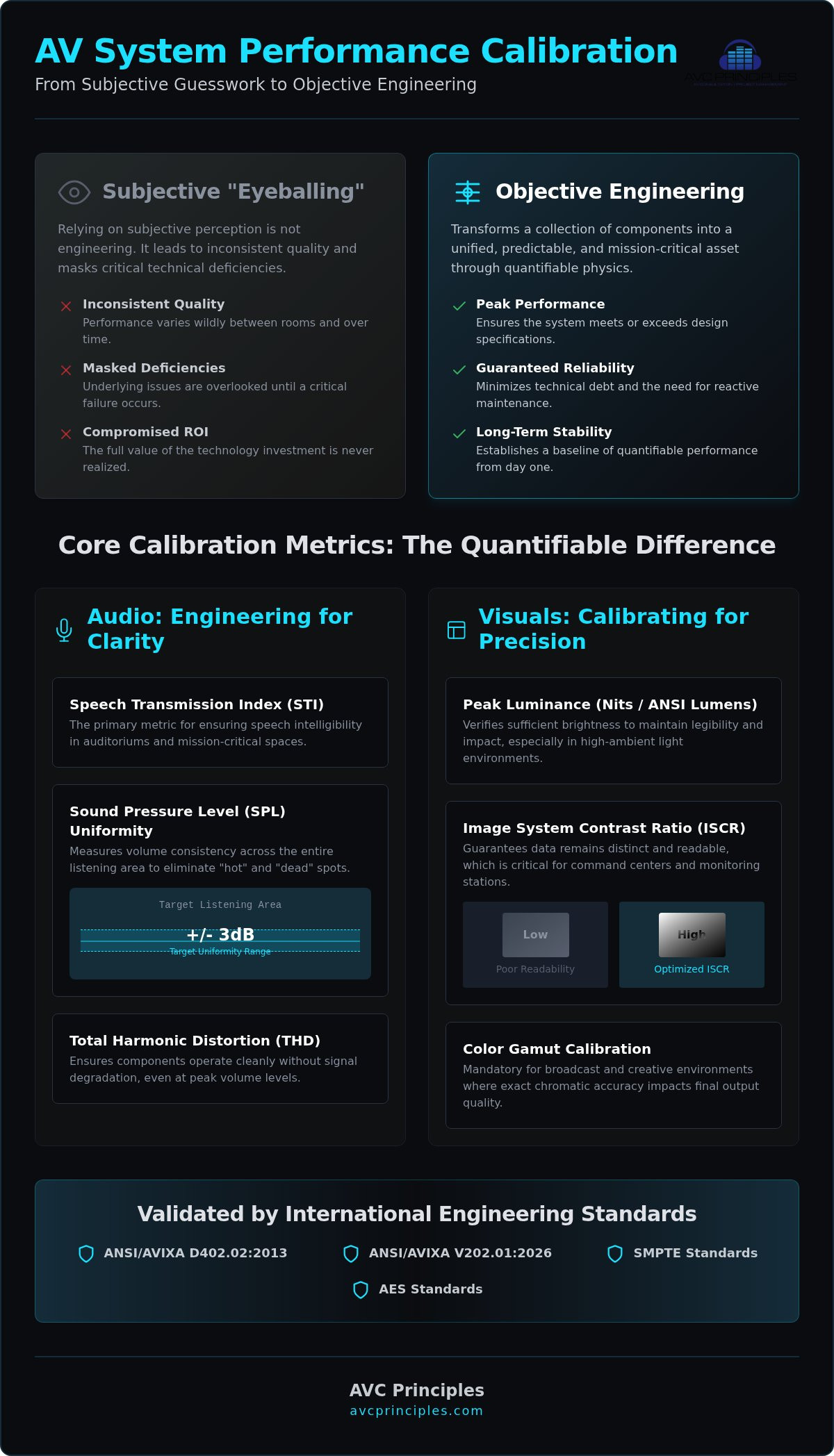
Subjective “eyeballing” of a display or “earballing” of an acoustic space is not engineering; it’s a failure of professional oversight. For mission-critical infrastructure, the distance between “functional” and “optimized” is measured in decibels, nits, and millisecond latency. Professional AV system performance calibration exists to bridge this gap through quantifiable physics. Most stakeholders accept inconsistent quality as an inevitable byproduct of complex integration. They shouldn’t. Ambiguity during system handovers often masks technical deficiencies that compromise long-term ROI.
Precision. Standardization. Verification. This article serves as a comprehensive technical reference for the engineering protocols required to achieve peak performance. You’ll gain a clear understanding of current industry benchmarks, including the ANSI/AVIXA D402.02:2013 (R2024) standard for performance verification and the new ANSI/AVIXA V202.01:2026 for display image size. We provide a structured framework for evaluating infrastructure objectively. This guide ensures your high-stakes systems meet rigorous mission-critical requirements.
Key Takeaways
- Differentiate between rudimentary equipment setup and professional engineering commissioning to verify that technical design intent is fully realized.
- Identify specific quantifiable metrics for audio and visual systems, focusing on speech intelligibility (STI) and peak luminance benchmarks.
- Apply established AVIXA and SMPTE frameworks to ensure AV system performance calibration meets international engineering standards.
- Implement a phased engineering workflow that prioritizes physical infrastructure integrity prior to component-level firmware alignment.
- Leverage independent, vendor-neutral commissioning to mitigate technical risk and verify performance in mission-critical environments.
Defining AV System Performance Calibration in Professional Environments
Professional AV infrastructure demands more than mere connectivity. It requires a rigorous verification process. Calibration, in a metrological context, is the comparison of a device’s performance against a known standard of accuracy. In large-scale systems, this process ensures that the hardware delivers the exact output specified in the initial architectural design. AV system performance calibration is the final, essential step in the engineering lifecycle. It transforms a collection of installed components into a unified, predictable environment. Without this step, the system remains a collection of parts rather than a mission-critical asset.
Calibration vs. Commissioning: A Technical Distinction
System commissioning represents a comprehensive oversight phase. It encompasses the entire transition from physical installation to operational readiness. While calibration focuses on specific signal accuracy and output alignment, commissioning validates the entire system’s adherence to the design intent. Technical documentation provides the necessary benchmarks for this verification. Design drawings. Signal flow diagrams. Performance specifications. These documents aren’t suggestions; they’re the law of the project. Independent oversight is critical here. It prevents internal biases from overlooking minor technical deviations that could lead to systemic failures during high-stakes events. A vendor-neutral approach ensures that the client’s interests remain the priority throughout the final testing phases.
The Objective of Performance Calibration
Reliability is the primary metric of success. In command centers or broadcast hubs, failure is not an option. Rigorous testing aligns hardware output with international engineering standards, such as those established by AVIXA and SMPTE. This alignment minimizes technical debt. Systems that aren’t properly calibrated often require constant reactive maintenance. By establishing a baseline of quantifiable performance from day one, organizations ensure long-term stability. Environment-specific factors significantly impact results. Ambient light levels. Acoustic reverberation. Viewing angles. These variables change from room to room. AV system performance calibration accounts for these differences, adjusting the system to the unique physical characteristics of the venue. The result is a predictable, high-performance infrastructure that meets the specific needs of the end-user.
Core Calibration Metrics for Audio and Visual Systems
Engineering-grade performance relies on the transition from subjective observation to objective measurement. Professional AV system performance calibration utilizes specific metrics to validate that an environment meets its intended functional requirements. Speech Transmission Index (STI) is the primary metric for auditorium intelligibility. Without these benchmarks, system performance remains theoretical. Data-driven verification provides the only path to ensuring that high-stakes infrastructure fulfills its mission-critical purpose.
Audio Performance Metrics and Measurement
Audio systems must provide consistent coverage and clarity across the entire listening area. Sound Pressure Level (SPL) mapping identifies variances in volume, aiming for uniformity within a +/- 3dB range in professional venues. Total Harmonic Distortion (THD) and system headroom analysis ensure that components operate within their linear range, preventing signal degradation at peak loads. We rely on Audio Engineering Society (AES) standards to govern digital signal integrity and spectral balance. For staged environments and concert halls, acoustical analysis measures reverberation times to ensure the physical space doesn’t counteract the electronic reinforcement. These measurements provide a baseline for acoustic reliability.
Visual Display and Projection Benchmarks
Visual verification requires precise light and color measurement. In high-ambient light environments, ANSI Lumen verification confirms that projection systems maintain sufficient brightness to remain legible. Command centers and critical monitoring stations utilize Image System Contrast Ratio (ISCR) standards to ensure that data remains distinct and readable under varying conditions. Color gamut calibration is mandatory for broadcast-grade environments where chromatic accuracy directly impacts the quality of the final output. These metrics provide the data necessary to prove system ROI and operational readiness. Precise alignment of luminance and color ensures that the display technology supports the user’s decision-making process.
Network and Infrastructure Reliability
The shift toward AV-over-IP infrastructure introduces new variables. Network reliability metrics, including packet loss, jitter, and end-to-end latency, are now fundamental to the calibration process. High-stakes environments can’t tolerate the signal dropouts or synchronization errors associated with unoptimized networks. Rigorous testing of the ICT backbone ensures that the AV hardware performs at its theoretical maximum. Professional technical commissioning provides the independent oversight needed to verify these complex network interactions. This systematic approach guarantees that the underlying infrastructure supports the demands of the modern AV ecosystem.
Industry Standards and Regulatory Compliance Frameworks
Professional engineering isn’t a matter of opinion. It’s a matter of code. High-stakes infrastructure relies on established frameworks to ensure that system output remains consistent, reliable, and legally compliant. AV system performance calibration serves as the mechanism for verifying that an installation meets these rigorous international standards. Moving beyond consumer-grade certifications, enterprise-level engineering utilizes quantifiable benchmarks from organizations like AVIXA, SMPTE, and the ITU. These standards provide the structural integrity required for mission-critical environments.
AVIXA Performance Standards
AVIXA standards define the baseline for commercial system verification. ANSI/AVIXA D402.02:2013 (R2024) remains the reaffirmed standard for verifying system performance against client expectations. It provides a structured framework for the commissioning process. For acoustic environments, ANSI/AVIXA A102.01:2022 dictates requirements for audio coverage uniformity. This ensures every listener in an enclosed area experiences the same signal quality. Visual Information Clarity (VIC) is equally critical, particularly in Network Operation Centers (NOCs). The new ANSI/AVIXA V202.01:2026 standard for display image size and viewing positions provides the metrics needed to ensure data legibility for 2D content. Adhering to these engineering codes eliminates the ambiguity often found in sub-professional handovers.
Broadcast and Entertainment Engineering Codes
Broadcast infrastructure demands a different tier of precision. SMPTE ST 2110 governs professional media over managed IP networks, ensuring essence-based streams remain synchronized and uncompressed. This level of signal integrity is mandatory for sports and entertainment broadcast design. Digital audio transport often relies on AES standards to maintain synchronization across complex signal chains. Regulatory compliance also extends to emergency operations center (EOC) communications. These environments require 100% uptime and immediate signal availability. Engineering to these codes ensures that the infrastructure supports rapid decision-making during critical events. Failure to meet these standards isn’t just a technical oversight; it’s a risk to operational continuity.
Regulatory Compliance and Accessibility
Legal requirements now dictate specific AV performance metrics. The April 24, 2026 Title II Digital Accessibility Rule codifies WCAG 2.1 Level AA as the enforceable standard for digital accessibility. This rule impacts commercial AV systems in public-facing and government-operated spaces for entities serving 50,000 or more people. AV system performance calibration must now account for inclusive design. Systems must meet these accessibility benchmarks to remain compliant with federal law. Healthcare environments also face strict requirements for video signal integrity in surgical and diagnostic spaces. Engineering oversight ensures that every component meets these mandatory regulatory frameworks from the initial design phase through final testing.
The Engineering Workflow for System Commissioning and Testing
Execution requires a phased, architectural approach. A disciplined engineering workflow ensures that no technical deficiency is overlooked during the transition from installation to operation. This lifecycle moves methodically from physical verification to granular signal alignment. AV system performance calibration serves as the critical final phase, but its success depends on the integrity of the preceding steps. Secure your infrastructure with professional technical commissioning services to guarantee long-term performance integrity.
Phased Commissioning Methodology
- Phase 1: Physical Infrastructure Verification. Assessment of cable terminations, rack airflow, and structural mounting. Adherence to F502.02:2020 (R2023) standards for rack design is verified at this stage.
- Phase 2: Component-level Testing. Firmware alignment across all endpoints. Verification of EDID tables and HDCP compliance to ensure seamless signal switching and interoperability.
- Phase 3: Integration and Signal Flow Validation. End-to-end testing of control logic and signal paths. Validation that the user interface correctly manipulates the hardware according to design intent.
- Phase 4: Final Performance Measurement. Comparison of actual system output against the original design benchmarks. This involves precise adjustments to audio and visual parameters to meet quantifiable targets.
Technical Documentation and Reporting
Reporting provides the objective proof of system readiness. Comprehensive commissioning reports document every test result, providing stakeholders with a clear record of compliance. ‘As-Built’ documentation is an essential deliverable. It maps the final state of the infrastructure, serving as the foundational reference for future maintenance and lifecycle upgrades. For multi-site enterprise rollouts, standardizing these results ensures consistent quality across different geographical locations. This level of detail eliminates the ambiguity common in general AV handovers.
Verification Tools and Methodologies
Precision measurement requires specialized, calibrated equipment. Measurement microphones and signal generators provide the data needed for acoustic alignment and spectral balance. Network protocol analyzers verify the stability of AV-over-IP infrastructure, identifying packet loss or jitter before they impact the user experience. The use of vendor-neutral testing tools is necessary to ensure unbiased results. These methodologies provide the clinical data required to verify that the system meets its mission-critical requirements. AV system performance calibration relies on these objective inputs to transform a collection of hardware into a high-performance asset.
Independent Commissioning: Ensuring Long-Term System Integrity
Technical integrity is maintained through independent verification. While an installation team focuses on physical deployment, the commissioning engineer focuses on performance validation. AV system performance calibration conducted by a third party ensures that the final output aligns with the initial engineering intent without the bias of an installation contractor. This independent oversight acts as a safeguard. It guarantees that high-stakes infrastructure meets the rigorous demands of its intended application from the first day of operation. Organizations that bypass this phase risk inheriting systems with latent defects that compromise reliability.
Risk Mitigation in High-Stakes Environments
Vendor-neutral performance verification identifies latent failure points before they manifest in a live environment. In complex ICT infrastructures, interoperability between multi-vendor components is a common source of instability. For instance, subtle mismatches in EDID handshaking or network multicast configurations can lead to intermittent signal loss. Independent testing validates that hardware from different manufacturers communicates according to established protocols. This process protects the architectural integrity of the technical design. It ensures that the system is not just functional, but resilient. Identifying these issues before system handover prevents costly downtime and reactive repairs during mission-critical events.
The Role of Technical Consulting
Technical consulting provides the authoritative verification required by government and corporate clients. It bridges the gap between conceptual design and operational reality. This persona is the trusted strategist, managing the multi-disciplinary challenges of large-scale integration. AVC Principles provides professional engineering oversight for mission-critical AV infrastructure. This oversight ensures that every aspect of the project meets complex engineering specifications. By removing the conflict of interest inherent in self-certification, clients receive a verified system that performs to its theoretical maximum. Our methodical approach provides the precision needed to navigate complex technical environments with confidence.
Lifecycle Benefits of Precision Calibration
The benefits of a properly calibrated system extend far beyond the initial handover. AV system performance calibration establishes a baseline for long-term health. Systems that operate within their design parameters experience less thermal stress and component wear. This leads to a measurable reduction in technical debt. A disciplined approach to commissioning ensures that the initial capital investment delivers sustained value over the entire lifecycle of the system. It replaces ambiguity with clinical precision.
- Consistency. Users experience identical audio-visual quality across multiple venues or rooms.
- Predictability. Maintenance teams can rely on standardized performance benchmarks for troubleshooting.
- Longevity. Optimized signal levels and power management extend the operational hardware lifecycle.
- ROI Documentation. Objective data proves that the system meets the performance requirements specified in the contract.
Securing System Performance Through Engineering Rigor
Engineering excellence is not a byproduct of installation; it’s the result of disciplined verification. Transitioning from subjective observation to quantifiable metrics ensures that high-stakes infrastructure fulfills its intended design. By adhering to established AVIXA and SMPTE standards, organizations replace technical ambiguity with operational certainty. AV system performance calibration provides the objective data necessary to prove system ROI and verify that mission-critical requirements are met across the entire lifecycle.
Independent engineering oversight is the primary safeguard against latent system failures. It protects the architectural integrity of the technical design while ensuring compliance with complex regulatory frameworks, such as the 2026 Digital Accessibility Rule. Expert-led technical commissioning transforms a collection of hardware into a resilient, high-performance asset. This methodical approach ensures that every decibel and nit aligns with professional benchmarks.
Consult with AVC Principles for Professional Commissioning to secure your infrastructure with specialists in mission-critical environments. Our independent engineering oversight and vendor-neutral approach guarantee that your technical design intent is fully realized. Achieve the precision and reliability your infrastructure demands.
Frequently Asked Questions
What is the difference between AV calibration and system commissioning?
System commissioning is the comprehensive engineering phase that validates the entire project against the design intent. Calibration is a subset of this process, focusing specifically on the technical alignment of audio and visual outputs. While calibration ensures signal accuracy, commissioning verifies physical infrastructure, control logic, and user interfaces. Professional AV system performance calibration serves as the quantifiable proof that the hardware meets the specific engineering benchmarks established during the design phase.
How often should a professional AV system be re-calibrated?
Professional systems require re-calibration annually or whenever significant changes occur within the environment or hardware stack. Firmware updates, equipment replacements, or structural modifications to the room’s acoustics can alter performance benchmarks. In mission-critical environments like command centers, quarterly verification is often recommended to ensure 100% operational readiness. Regular testing identifies technical drift before it compromises the integrity of high-stakes communications or broadcast signals.
What are the primary metrics used to measure audio intelligibility in large venues?
Speech Transmission Index (STI) is the industry standard metric for measuring intelligibility in auditoriums and large-scale venues. It quantifies how well speech is preserved from the source to the listener. Other critical metrics include Sound Pressure Level (SPL) uniformity, which targets a variance of +/- 3dB across the listening area, and frequency response consistency. These data points provide the objective evidence needed to verify that the acoustic environment supports professional communication requirements.
Why is independent engineering oversight necessary for AV projects?
Independent oversight removes the conflict of interest inherent when an installation contractor self-certifies their own work. An engineering consultant provides a vendor-neutral assessment, ensuring that the final system strictly adheres to the original design specifications. This oversight protects the client’s capital investment by identifying technical deficiencies before the final handover. It guarantees that the infrastructure meets the rigorous performance standards required for mission-critical applications without bias or compromise.
Does professional calibration improve the lifespan of AV equipment?
Professional calibration significantly extends equipment lifespan by ensuring components operate within their intended linear range. Properly aligned systems avoid thermal stress caused by overdriving amplifiers or running displays at excessive luminance levels. By optimizing gain structures and signal processing, calibration prevents clipping and premature hardware failure. This disciplined approach to system management reduces long-term technical debt and maximizes the return on investment for complex AV and ICT infrastructure.
What industry standards govern visual performance in command centers?
Visual performance in command centers is governed by ANSI/AVIXA V202.01:2026 for display image size and viewing positions. This standard ensures that 2D content remains legible for all operators within the space. Additionally, Image System Contrast Ratio (ISCR) standards define the required difference between peak white and black levels under specific ambient light conditions. These engineering codes ensure that critical data remains distinct and readable, supporting rapid decision-making in high-pressure environments.
Can automated calibration tools replace a professional engineering consultant?
Automated tools are essential for data collection but cannot replace the expertise of a professional engineering consultant. While a measurement microphone or software can identify a frequency peak, an engineer interprets that data within the context of the room’s architectural physics. Human oversight is required to balance competing technical requirements and resolve complex integration challenges. A consultant provides the strategic analysis necessary to transform raw metrics into a high-performance, reliable system.
How does AV system calibration impact network reliability?
Calibration identifies and resolves network bottlenecks that compromise AV-over-IP stability. By verifying multicast configurations and bandwidth allocation, AV system performance calibration ensures that high-resolution media streams don’t overwhelm the ICT infrastructure. It involves testing for packet loss, jitter, and end-to-end latency to guarantee signal synchronization. This rigorous verification process prevents the dropouts and synchronization errors that often plague unoptimized networked AV systems in professional environments.