
Connectivity design is an architectural discipline. It is not a procurement exercise. Many organizations prioritize hardware acquisition over structural integrity, only to encounter scalability bottlenecks and restrictive vendor lock-in. A robust data center connectivity design requires a focus on foundational engineering principles before a single switch is ordered. It’s the difference between a reactive patch and a resilient, high-performance network.
You likely recognize that legacy topologies can’t sustain the low-latency requirements of modern mission-critical applications. Inconsistent technical documentation often compounds these issues, leading to fragmented infrastructure that fails under load. This article provides a technical analysis of the engineering parameters necessary to build scalable, high-reliability environments. We’ll examine vendor-neutral infrastructure specifications, architectural standards, and the rigorous methodology required to ensure redundancy. The following sections move from high-level topology theory to granular execution details. This guide establishes the framework for a network that prioritizes long-term structural integrity over temporary hardware solutions.
Key Takeaways
- Define core performance parameters. Latency, throughput, and redundancy serve as the architectural foundation for high-stakes environments.
- Analyze Leaf-Spine (Clos) architectures. Non-blocking fabric designs provide the predictable performance required by modern topologies.
- Evaluate physical layer media. Select fiber optic and high-speed copper based on rigorous bandwidth and reach requirements.
- Implement technical commissioning. Establishing baseline metrics during the design phase ensures long-term reliability and connectivity integrity.
- Secure independent engineering oversight. A disciplined approach to data center connectivity design avoids proprietary constraints and ensures vendor neutrality.
Defining Connectivity Design Parameters for Modern Data Centers
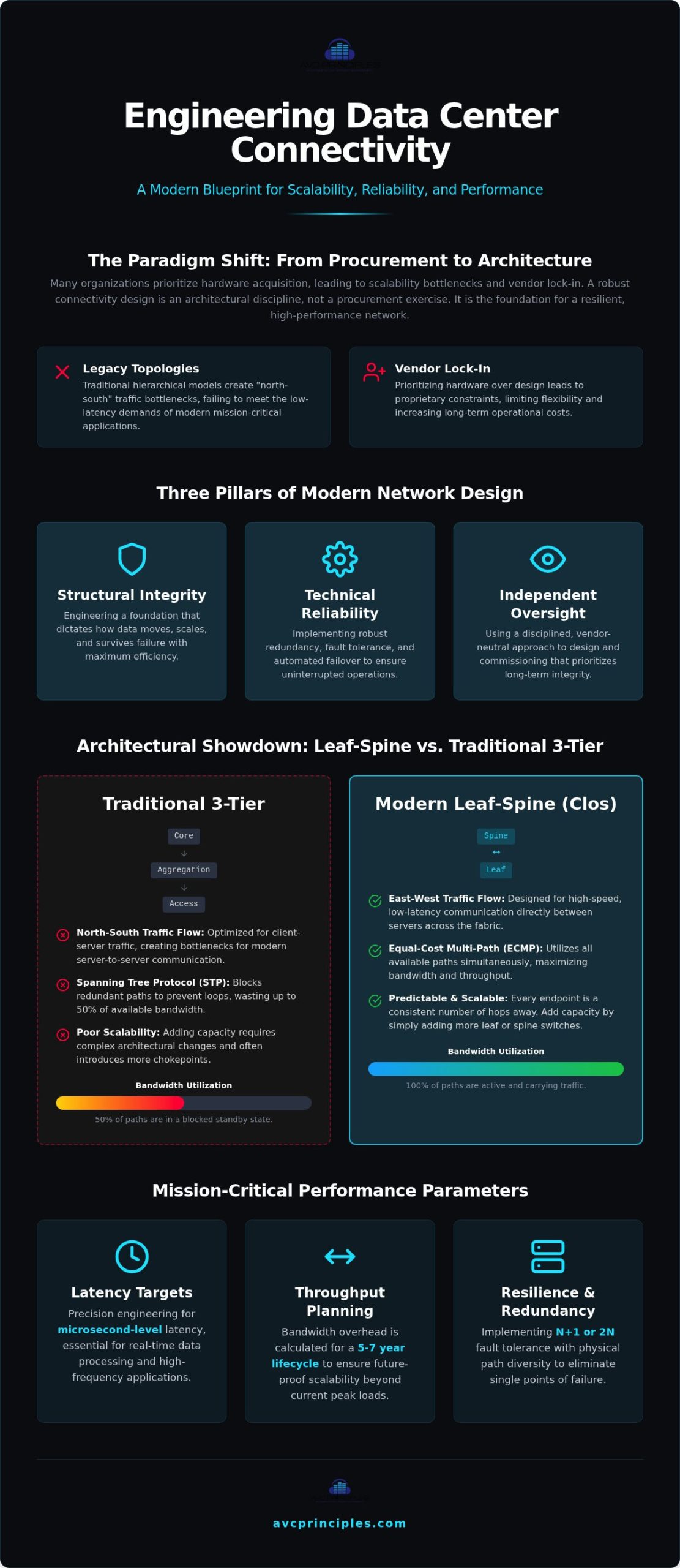
Connectivity design serves as the skeletal framework for all facility operations. It dictates how data moves, scales, and survives failure. In high-performance environments, the data center connectivity design must move beyond simple port density. It’s a disciplined engineering exercise in managing signal integrity across high-density fabrics. Legacy hierarchical models often create north-south traffic bottlenecks. Modern fabric architectures, such as Leaf-Spine, prioritize east-west traffic flow. This transition is essential for mission-critical reliability in broadcast environments, command centers, and enterprise ICT infrastructure. Structural integrity. Technical reliability. Comprehensive oversight. These pillars define the modern approach to data center networking.
Foundational Latency and Throughput Requirements
Precision engineering requires microsecond-level latency targets for real-time data processing. High-frequency applications don’t tolerate delays. We calculate bandwidth overhead to ensure future-proof scalability. This involves analyzing current peak loads and projecting growth over the five-to-seven-year lifecycle of the infrastructure. Packet loss is another critical metric. In high-speed data transmission, even minimal loss rates trigger retransmissions that spike latency. We mitigate this through rigorous media selection and interface calibration. Technical documentation must define these thresholds before the first cable is pulled to ensure the system meets performance baselines.
Redundancy and Fault Tolerance Standards
Network resilience isn’t optional. We define redundancy through specific configurations like N+1 or 2N. An N+1 setup provides a single backup component for each group of active systems. A 2N configuration offers a fully mirrored environment for maximum fault tolerance. Physical path diversity is a core requirement. It mitigates the risk of single points of failure by routing redundant links through separate conduit paths. Automated failover mechanisms must respond within milliseconds to maintain uptime. We verify these systems during the commissioning phase to ensure the technical documentation matches the operational reality. Success depends on independent oversight and a commitment to established engineering standards.
Architectural Frameworks: Leaf-Spine vs. Traditional Topologies
Modern data center connectivity design has evolved beyond the limitations of legacy hierarchical models. The traditional three-tier architecture, comprising core, aggregation, and access layers, was optimized for north-south traffic. This model fails under the demands of modern distributed workloads. Contemporary environments require a transition to two-tier fabric designs. These architectures prioritize east-west traffic flow, ensuring that server-to-server communication remains efficient and predictable. Structural integrity. Technical reliability. These are the requirements for high-performance fabrics.
The Leaf-Spine (Clos) architecture provides a non-blocking environment. Every leaf switch connects directly to every spine switch. This creates a predictable performance profile where any two endpoints are separated by a consistent number of hops. Latency remains constant across the fabric. This predictability is essential for mission-critical applications that cannot tolerate jitter or variable delay. The design moves away from oversubscribed aggregation points toward a distributed, high-bandwidth fabric.
The Leaf-Spine Advantage for Scalability
Spanning Tree Protocol (STP) is no longer a viable management solution for high-density environments. It forces redundant paths into a standby state to prevent loops, effectively wasting half of the available bandwidth. Leaf-Spine utilizes Layer 3 routing with Equal-Cost Multi-Path (ECMP) protocols. All available paths carry traffic simultaneously. This optimizes bandwidth utilization and increases total system throughput. Horizontal scaling becomes a modular process. You add spine switches for increased throughput or leaf switches for higher port density without architectural overhauls. This methodology ensures long-term infrastructure ROI.
Integrating Multi-Disciplinary ICT Infrastructure
Infrastructure must support more than standard data packets. AV-over-IP and high-bitrate broadcast streams are now integral components of the enterprise network. These signals require specialized network calibration to prevent packet loss. Command and control center visualization depends on zero-latency transmission across the fabric. Converged low-voltage systems must be documented during the initial design phase to ensure compatibility with the core network. A disciplined approach to ICT infrastructure design bridges the gap between traditional networking and specialized broadcast requirements. It ensures that high-stakes visualization environments remain stable under peak load through rigorous performance standards and independent oversight.
Physical Layer Engineering and Media Selection
Signal integrity begins at the physical layer. A rigorous data center connectivity design treats media selection as a primary engineering constraint. It’s not a secondary procurement task. Selection depends on distance, bandwidth requirements, and lifecycle expectations. Improper media choices lead to signal degradation and premature infrastructure obsolescence. Structural integrity. Technical precision. Operational longevity.
High-speed copper solutions like Direct Attach Copper (DAC) and Active Optical Cables (AOC) are essential for short-reach connectivity. DAC cables provide the lowest latency and power consumption for top-of-rack server connections. For reaches beyond five to seven meters, AOCs offer a lighter, more flexible alternative without the electromagnetic interference risks of copper. Compliance with TIA-942 and ISO/IEC 11801 standards is mandatory. These benchmarks ensure that the cabling system supports multi-vendor environments and high-density configurations. Managing cable density is also a thermal requirement. Excessive cabling in rack channels restricts airflow, leading to thermal hotspots that compromise hardware reliability.
Fiber Optic Standards and Performance Metrics
Fiber selection dictates the fabric’s total capacity. Multi-mode fiber, specifically OM4 and OM5, supports 100G+ environments over short distances. OM5 utilizes Shortwave Wavelength Division Multiplexing (SWDM) to increase capacity without adding fiber strands. For backbone connectivity and long-reach requirements, OS2 single-mode fiber remains the industry standard. It offers virtually unlimited bandwidth potential. Connector technology is equally critical. MPO/MTP connectors enable high-density patching by consolidating 12 or 24 fibers into a single interface. LC connectors remain the standard for discrete equipment ports. The choice between them depends on the required patching density and the specific architectural framework.
Cabling Infrastructure and Lifecycle Management
Technical documentation is the blueprint for day-two operations. It ensures that the network remains manageable long after initial commissioning. Effective lifecycle management requires standardized color-coding and labeling. This reduces human error during maintenance and troubleshooting. We design for the eventual transition to 400G and 800G paths by installing high-count fiber trunks today. Future-proofing isn’t a vague concept. It’s a calculated engineering decision. Clear cable paths and modular patching systems allow for horizontal scaling without disrupting existing services. Every design choice must prioritize accessibility and logical organization to maintain the system’s structural integrity over time.
Network Reliability and Performance Calibration
Network reliability is not a theoretical promise. It’s a verified state achieved through rigorous calibration. A disciplined data center connectivity design establishes baseline performance metrics during the initial architectural phase. These benchmarks serve as the success criteria for the entire project lifecycle. Technical commissioning provides the necessary audit to ensure that the physical installation aligns with the design intent. Without this verification, structural integrity remains unproven. Baseline validation. Performance verification. System commissioning.
Timing and synchronization are critical for converged ICT environments. Precision Time Protocol (PTP) is the required standard for sub-microsecond accuracy in broadcast and AV-over-IP applications. Network Time Protocol (NTP) lacks the granularity needed for high-stakes synchronization. We also prioritize the mitigation of electromagnetic interference (EMI). High-density spaces generate significant electrical noise that can compromise signal integrity. We address this through specific shielding requirements and the physical separation of high-voltage and low-voltage pathways. Our firm provides the independent oversight required for technical commissioning and testing to ensure your network meets these rigorous standards.
Measuring and Maintaining Low Latency
Real-time applications require end-to-end latency testing protocols. We utilize specialized network analyzers to measure delay across the entire fabric, identifying bottlenecks before they impact operations. Jitter analysis is equally vital. Inconsistent packet delivery creates synchronization errors that degrade media streams and data clusters. Latency jitter, defined as the variation in packet delay over time, must remain below 10 microseconds to satisfy the synchronization requirements of uncompressed 8K video streams under 2026 engineering standards. Maintaining these tight tolerances ensures that mission-critical visualization remains stable under peak load.
Testing and Commissioning Protocols
Fiber infrastructure requires a two-tier testing approach. Tier 1 testing measures total link attenuation and cable length to ensure compliance with loss budgets. Tier 2 testing utilizes Optical Time Domain Reflectometer (OTDR) analysis to characterize individual splices and connectors. This level of detail identifies macro-bends or faulty terminations that Tier 1 testing might overlook. Redundancy verification involves simulated failure testing. We intentionally disable primary paths to observe failover behavior and measure recovery times. These results are documented in final commissioning reports, providing a permanent record of the system’s operational capacity and technical reliability.
The Necessity of Independent Engineering Oversight
Engineering oversight is a technical safeguard. It is not an administrative layer. A rigorous data center connectivity design requires an objective perspective that prioritizes system performance over hardware sales. Independent oversight ensures compliance with established engineering standards throughout the project lifecycle. This role is critical when bridging the technical requirements of AV, ICT, and broadcast engineering. These disciplines often have competing priorities for bandwidth and latency. A consultant serves as the strategic lead who harmonizes these requirements into a single, cohesive architecture. Structural integrity. Technical reliability. Professional gravity.
The transition from initial concept development to final technical commissioning requires a steady hand. Without independent verification, design intent often degrades during the installation phase. We manage this risk through comprehensive oversight of the implementation process. This involves verifying that the physical layer installation matches the high-level documentation. Commissioning is the final audit of the system’s operational capacity. It proves that the network meets the performance baselines established during the design phase. Success depends on a disciplined methodology that values the “how” of engineering as much as the “what.”
Independent Design vs. Vendor-Led Proposals
Vendor-led proposals naturally prioritize proprietary ecosystems. This approach often leads to vendor lock-in, which restricts future architectural flexibility and increases long-term costs. An independent consultant provides an objective evaluation of hardware performance compared to marketing claims. We ensure that the chosen components meet the specific needs of the mission-critical environment rather than the sales targets of a manufacturer. Architectural integrity depends on a multi-vendor strategy that utilizes open standards. This methodology ensures that the fabric remains modular and scalable. It allows for competitive procurement and prevents the bottlenecks associated with proprietary topologies. Independent design protects the owner’s interests by ensuring that the infrastructure remains an asset, not a liability.
The Value of Comprehensive Technical Documentation
Technical documentation is the single source of truth for any infrastructure project. It serves as a primary risk mitigation strategy by defining every connection, path, and performance parameter before a single cable is pulled. Detailed system architecture prevents ambiguity during the construction phase. It ensures that electrical contractors and network engineers are perfectly aligned with the design intent. This documentation also provides the roadmap for day-two operations and future expansion. It’s the blueprint that allows for seamless horizontal scaling as data demands grow. High-quality documentation reduces the time required for troubleshooting and maintenance, directly impacting the system’s total cost of ownership. Consult with AVC Principles for vendor-neutral ICT infrastructure design. Standardized documentation. Rigorous methodology. Foundational success.
Securing Structural Integrity in Network Design
High-performance network architecture requires a move from reactive procurement to disciplined engineering. We’ve analyzed the transition to Leaf-Spine fabrics and the rigorous standards of physical layer media selection. These parameters ensure that the infrastructure remains scalable and resilient under peak load. A successful data center connectivity design prioritizes technical documentation as the blueprint for project success. It’s the only way to avoid proprietary lock-in and ensure long-term ROI. Structural integrity. Technical precision. Operational longevity.
Achieving these standards requires specialized expertise and independent oversight. We bridge the gap between AV, ICT, and broadcast engineering through expert technical commissioning. This process verifies that the system meets established performance baselines before operations begin. Our firm provides the steady hand needed to manage high-stakes infrastructure from initial concept to final execution. Engage AVC Principles for Expert ICT Infrastructure Design to secure your facility’s structural integrity. Let’s build a network that’s prepared for the demands of tomorrow.
Frequently Asked Questions
What is the primary difference between Leaf-Spine and Three-Tier architecture?
Leaf-Spine architecture creates a non-blocking fabric where every leaf switch connects to every spine switch, ensuring a consistent two-hop distance between any two endpoints. This contrasts with traditional Three-Tier models that utilize core, aggregation, and access layers. While Three-Tier designs were optimized for North-South client-server traffic, Leaf-Spine is built for modern East-West traffic. This transition eliminates Spanning Tree Protocol bottlenecks and provides predictable latency for distributed workloads.
How does connectivity design impact data center latency?
Effective data center connectivity design minimizes latency by reducing the physical and logical distance between data processing nodes. Architectural choices, such as implementing a flat fabric instead of a deep hierarchy, directly lower the total hop count. Additionally, the selection of high-speed media and low-latency switching protocols ensures that packet processing delays remain within microsecond thresholds. This precision is vital for real-time applications in command centers and broadcast environments where signal delay causes operational failure.
What are the current TIA-942 standards for data center cabling?
The TIA-942 standard defines the architectural requirements for data center infrastructure, including cabling systems, redundancy levels, and environmental considerations. It establishes specific tiers for reliability, ranging from basic infrastructure to fault-tolerant systems with 2N redundancy. Compliance ensures that the physical layer supports high-density configurations while maintaining proper airflow and thermal management. These standards provide the blueprint for building resilient environments that meet the rigorous demands of mission-critical enterprise and government facilities.
Why is Single-Mode fiber preferred over Multi-Mode in modern data centers?
OS2 Single-Mode fiber is preferred for its superior bandwidth capacity and significantly longer reach compared to Multi-Mode alternatives. While Multi-Mode fiber like OM4 or OM5 is suitable for short distances, it faces modal dispersion limits at higher speeds. Single-Mode fiber eliminates these constraints, supporting the transition to 400G and 800G paths over much greater distances. This makes OS2 the primary choice for backbone connectivity and high-performance fabrics that require long-term architectural longevity.
What role does technical commissioning play in connectivity design?
Technical commissioning serves as the final audit to verify that the physical installation matches the engineering design intent. It involves rigorous testing of every link to establish performance baselines for throughput, latency, and redundancy. This process identifies macro-bends, faulty terminations, or configuration errors that could compromise network reliability. Independent commissioning provides the objective proof needed to ensure the system meets all technical specifications before the facility transitions to active operations.
How can data center connectivity be optimized for AV-over-IP?
Optimization requires specialized network calibration to handle high-bitrate, uncompressed media streams. Implementing Precision Time Protocol (PTP) ensures sub-microsecond synchronization across the fabric, which is essential for professional broadcast and visualization environments. Additionally, configuring IGMP snooping and multicast management prevents network congestion. These engineering choices ensure that AV-over-IP data receives the necessary priority and bandwidth to maintain signal integrity without interfering with standard ICT data packets.
What is the importance of vendor-neutrality in ICT infrastructure consulting?
Vendor-neutrality ensures that infrastructure decisions are based on objective performance metrics rather than proprietary sales targets. This approach prevents vendor lock-in, which often restricts future scalability and increases the total cost of ownership. By utilizing open standards, consultants can integrate the most effective hardware from multiple manufacturers into a unified architecture. This methodology protects the client’s investment and ensures that the data center connectivity design remains modular and adaptable to future technological shifts.
How do you design for 400G and 800G scalability?
Designing for 400G and 800G requires a focus on high-count fiber trunks and advanced connector technology like MPO/MTP. Engineers must calculate link loss budgets with extreme precision to accommodate the tighter tolerances of these high-speed optics. Utilizing OM5 or OS2 fiber ensures the physical layer can support the increased bandwidth demands of next-generation fabrics. This proactive approach involves installing modular patching systems that allow for seamless horizontal scaling without requiring a complete overhaul of the existing cabling infrastructure.