
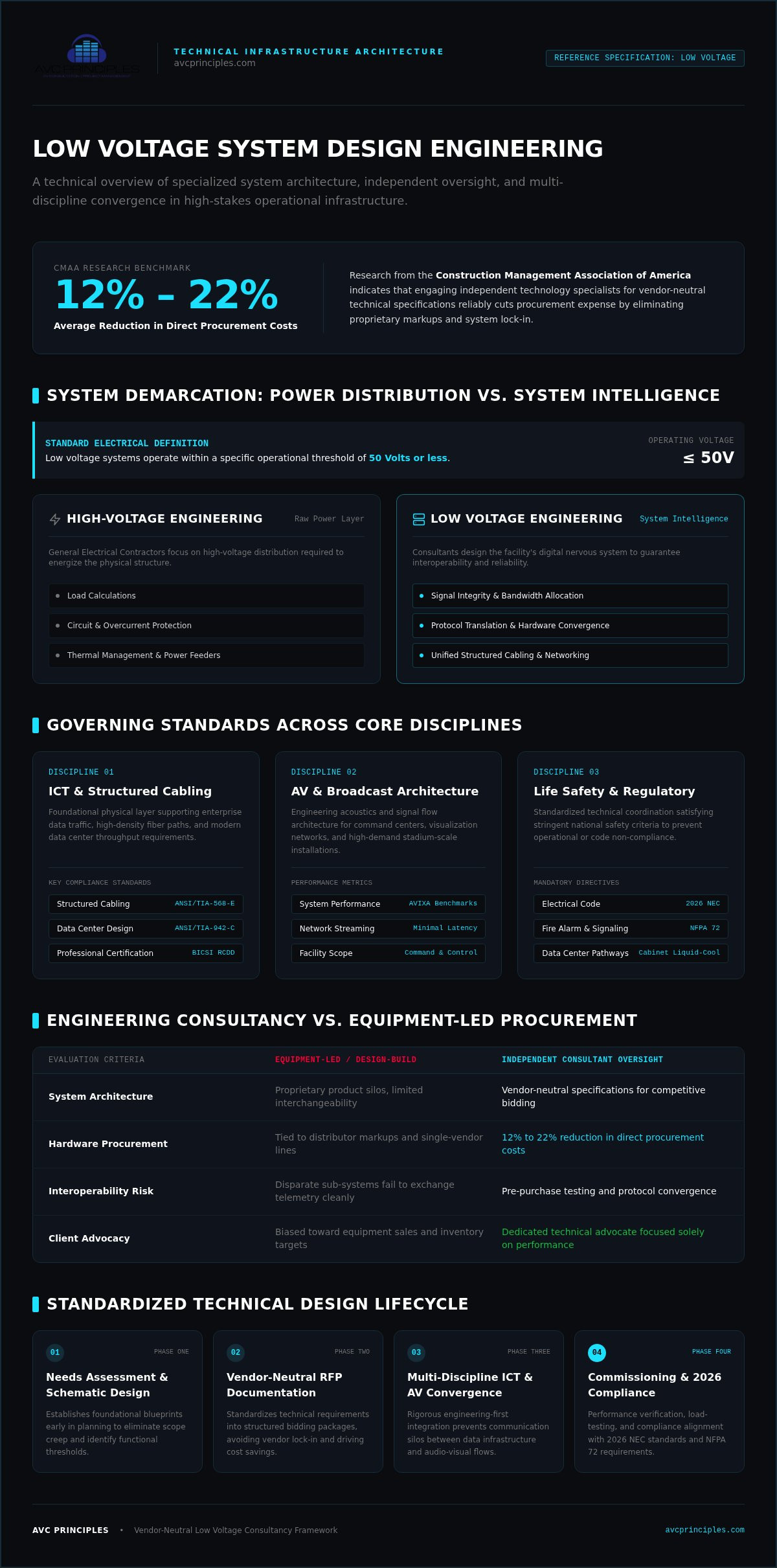
Research from the Construction Management Association of America indicates that utilizing independent technology specialists for vendor-neutral specifications results in an average 12% to 22% reduction in direct procurement costs. These savings aren’t a matter of luck. They’re the product of disciplined engineering. You understand that in high-stakes infrastructure, hardware is only as effective as the neurological blueprint governing it. However, many large-scale ICT projects still collapse under scope creep or interoperability failures. These risks typically emerge when low voltage system design consultants are excluded from the early planning stages, leaving projects without vendor-neutral technical documentation.
Professional engineering consultancy provides the structural integrity required to manage these complexities. This reference offers a comprehensive technical overview of the role, disciplines, and lifecycle of the consultant. We’ll establish a clear framework for system design that prioritizes interoperability and technical reliability. You’ll gain insight into standardized documentation for RFPs and the rigorous requirements of 2026 NEC and NFPA 72 compliance. This guide moves methodically from initial schematic design to final system commissioning. It defines the path to reliable, integrated infrastructure.
Key Takeaways
- Define the technical distinction between general electrical contractors and professional low voltage system design consultants who provide specialized system architecture.
- Evaluate the fiscal and operational advantages of independent engineering oversight compared to equipment-led design-build procurement models.
- Navigate the standardized design lifecycle from initial needs assessment through to final commissioning and 2026 regulatory compliance.
- Coordinate the convergence of ICT infrastructure and AV systems using a disciplined, engineering-first approach to prevent interoperability failures.
- Implement rigorous technical documentation and performance testing standards tailored for high-stakes environments like command centers and stadiums.
Defining the Scope of Low Voltage System Design Consultants
Low voltage systems operate within a specific electrical threshold, generally defined as 50V or less. This category encompasses the digital nervous system of a facility, including data networks, security protocols, and communication arrays. While electrical contractors focus on the high-voltage distribution required for raw power, low voltage system design consultants focus on the intelligence and connectivity of the infrastructure. They provide the specialized technical architecture necessary for high-stakes environments. This role involves the creation of vendor-neutral specifications that facilitate competitive bidding. Without this oversight, projects often suffer from fragmented technology silos that fail to communicate effectively.
The Distinction Between Power and Systems Engineering
Power distribution. System intelligence. Structural integrity. These are distinct engineering disciplines. High-voltage engineering prioritizes load calculations, circuit protection, and thermal management. Conversely, low voltage engineering prioritizes signal integrity, bandwidth allocation, and protocol translation. A building might have power, but without a rigorously designed structured cabling infrastructure, it lacks the capacity for modern operations. Specialized system design requires a deep understanding of how disparate hardware components interact within a unified network. Clinical system planning at this stage mitigates the risk of catastrophic failure during high-demand usage. It ensures that the underlying physical layer can support the evolving needs of the facility’s technology stack.
The Value of Independent Technical Oversight
Independent oversight ensures that technical specifications remain vendor-neutral. This approach prevents proprietary lock-in and facilitates a transparent bidding process. When engineering is separated from equipment retail, the focus remains solely on performance and reliability. Consultants ensure strict compliance with national standards, including ANSI/TIA-568-E for cabling and AVIXA benchmarks for audiovisual performance. This methodical approach identifies potential interoperability failures before hardware is purchased or installed. It protects the project budget from the hidden costs of proprietary systems and undisclosed markups. The low voltage system design consultant serves as the owner’s primary technical advocate, ensuring that engineering requirements are met without the bias of equipment sales. This advocacy is essential for maintaining the long-term viability of the technical infrastructure. It provides a steady hand during complex integrations, ensuring that the final result meets the established performance criteria.
Core Disciplines within Low Voltage Engineering
Low voltage engineering requires the rigorous coordination of several distinct disciplines to ensure a unified technical environment. These systems manage data transmission, environmental control, and life safety protocols. Professional low voltage system design consultants manage the integration of these silos, preventing the fragmentation that occurs when disparate systems fail to interoperate. Data integrity. Network resilience. Physical security. These are the pillars of modern facility infrastructure.
ICT and Structured Cabling Systems
Information and Communications Technology (ICT) serves as the foundational physical layer for all building technologies. This discipline involves the design of backbone and horizontal cabling that supports enterprise-level data traffic. Under the ANSI/TIA-942-C standard, modern data centers require specific cabinet widths and high-density fiber paths to manage liquid cooling and increased throughput. A consultant holding a Registered Communications Distribution Designer (RCDD) credential ensures that these designs meet global benchmarks for reliability and administrative documentation. Standardizing cable plant documentation is essential for scalability. It allows for future expansions without the need for destructive infrastructure overhauls.
Integrated Audio-Visual and Broadcast Systems
Audiovisual design moves beyond simple hardware placement. It involves engineering acoustics and signal flow architecture for complex environments. In command and control centers, visualization networks must support real-time data streaming with minimal latency. Stadium-scale broadcast systems require rigorous sound reinforcement and RF coordination to manage thousands of concurrent signals. These designs now account for the convergence of AV-over-IP, where traditional video signals transition to the standard network infrastructure. For projects requiring this level of technical precision, professional ICT infrastructure design provides the necessary oversight to ensure all systems remain compliant and efficient.
Modern security engineering integrates access control and IP video surveillance into the broader IT network. The 2025 edition of NFPA 72 mandates cybersecurity risk mitigation for any IP-connected life safety system. This requires documented network segmentation and encrypted transmission protocols to protect against unauthorized access. Simultaneously, building automation systems (BAS) are converging with IT via Class 4 Fault-Managed Power Systems (FMPS). Governed by the 2026 National Electrical Code, FMPS allows for high-power delivery over small-gauge lines. This technology transforms how smart building controls and LED architectural lighting are deployed across large campuses. These converged systems require a steady hand to manage the complex intersection of power, data, and security.
The selection of a project delivery model determines the long-term viability and fiscal efficiency of technical infrastructure. Two primary models exist: independent engineering and design-build. Independent low voltage system design consultants provide technical architecture as a professional service. They don’t sell hardware. This separation ensures that the resulting specifications are driven by performance requirements rather than equipment inventory or sales quotas. Conversely, design-build firms combine engineering and installation into a single contract. While this might appear efficient, it often masks a fundamental conflict of interest.
The Conflict of Interest in Design-Build
Hardware margins frequently influence the system architecture in a design-build scenario. When the designer also profits from the equipment sale, the incentive to specify proprietary systems increases. This creates a vendor lock-in that restricts future maintenance and expansion to a single provider. Independent engineering mitigates this risk by authoring vendor-neutral CSI Division 27 and 28 documentation. These documents allow owners to bid the installation phase across multiple qualified contractors. Research from the Construction Management Association of America indicates that this competitive bidding process results in an average 12% to 22% reduction in direct procurement costs. It replaces hidden markups with transparent, market-driven pricing.
When to Hire an Independent Consultant
High-stakes environments require a level of precision that general contractors cannot provide. Sports arenas, hospitals, and government centers operate with zero tolerance for system failure. These projects demand rigorous adherence to the Unified Facilities Criteria for ICT infrastructure and other institutional benchmarks. Independent low voltage system design consultants serve as the owner’s technical advocate throughout the project lifecycle. They perform essential checks and balances during the installation phase, ensuring the contractor adheres to the engineered design.
Complex integrations involving multiple technology silos also necessitate independent oversight. A consultant manages these intersections without the bias of hardware sales, focusing on the following critical factors:
- Total Cost of Ownership: Evaluating energy efficiency and long-term maintenance requirements.
- System Scalability: Ensuring the architecture supports future technology refreshes without destructive overhauls.
- Technical Commissioning: Verifying every signal path and software integration against the original design intent.
This disciplined approach ensures the facility functions as intended from day one. It’s a mandatory process in mission-critical facilities where every component must meet established performance criteria. By prioritizing engineering over retail, owners secure a more resilient and cost-effective infrastructure.
The engineering lifecycle for low voltage systems follows a rigorous, multi-phased progression. This methodology ensures that high-level conceptualization translates into granular, functional detail. Professional low voltage system design consultants manage this sequence to prevent technical drift and maintain project alignment. Each phase produces specific deliverables that govern the next stage of development.
- Phase 1: Needs Assessment. Defining operational requirements and conceptual architecture.
- Phase 2: Schematic Design. Developing system signal flow and high-level device placement.
- Phase 3: Construction Documentation. Authoring CSI MasterFormat specifications (Division 25, 27, and 28) and detailed drawings.
- Phase 4: Bidding Support. Evaluating contractor responses and ensuring technical compliance.
- Phase 5: Technical Commissioning. Verifying performance against the original engineering intent.
Standardizing Technical Documentation
Precise documentation is the foundation of successful execution. Consultants utilize CAD and Building Information Modeling (BIM/Revit) to coordinate technology infrastructure with architectural and MEP systems. This coordination identifies physical conflicts before construction begins. Deliverables include detailed rack elevations, conduit pathway requirements, and comprehensive signal flow diagrams. Standardized technical documentation eliminates ambiguity, which directly reduces installation errors and prevents costly field changes. By establishing a uniform language for device placement and connectivity, consultants ensure that contractors have a clear roadmap for deployment. For organizations requiring this level of precision, professional AV systems design ensures that every technical detail is accounted for within the master plan.
Commissioning and Final Performance Testing
Commissioning is the final validation of the engineered system. It moves beyond simple connectivity checks to focus on rigorous performance verification. In mission-critical command centers, this involves verifying calibration metrics for visualization networks and sub-millisecond latency requirements. Acoustic validation ensures speech intelligibility in large venues, while broadcast control testing confirms signal integrity across the entire facility.
The process concludes with a detailed punch-list and project close-out documentation. This final stage requires testing every input, output, and control interface to confirm they meet the 2026 industry standards for reliability. Project close-out includes the delivery of as-built documentation and system training for the facility’s operational staff. This disciplined verification ensures that the owner receives a fully optimized environment that meets every technical standard. It provides the final assurance that the investment in high-stakes infrastructure is fully realized.
Strategic Low Voltage Engineering with AVC Principles
Professional gravity. Clinical precision. Authoritative oversight. These are the hallmarks of a disciplined engineering firm. High-stakes environments demand a senior partner who understands the nuances of multi-disciplinary challenges. AVC Principles operates as a trusted strategist for organizations managing complex, large-scale systems. As low voltage system design consultants, the firm prioritizes structural integrity and technical reliability. This engineering-first approach ensures that ICT and AV convergence is managed with clinical precision. Every project phase moves methodically from initial theory to final execution.
Mission-Critical Command and Control Design
Command centers and stadiums operate under unique constraints. These environments demand 24/7 reliability and peak performance during high-stress scenarios. Engineering for situational awareness requires more than hardware placement. It involves the ergonomic and technical integration of visualization systems within network operations centers. Strategic design ensures that emergency response teams have immediate access to critical data without latency or system fragmentation. This level of oversight provides the steady hand needed for high-stakes infrastructure. It transforms disparate technology silos into a unified, resilient environment.
The AVC Principles Methodology
The firm’s methodology is defined by competence and discipline. It emphasizes the “how” of engineering through vendor-neutral technical documentation. This neutrality protects project budgets and ensures that system architecture remains robust. Rigorous commissioning standards provide the final verification of engineering compliance. It’s a process focused on results and long-term viability. Standardized documentation and performance testing aren’t optional; they’re the foundation of structural integrity. Organizations seeking to avoid the pitfalls of proprietary lock-in and scope creep can engage with AVC Principles for specialized engineering consultancy. This partnership secures a resilient technical foundation for the facility’s entire lifecycle. It ensures that every component meets the highest standards of professional engineering.
Securing the Technical Foundation of High-Stakes Infrastructure
High-stakes infrastructure requires more than hardware deployment. It demands a neurological blueprint defined by structural integrity and clinical precision. Independent low voltage system design consultants provide the necessary oversight to manage complex ICT and AV convergence without the bias of equipment sales. By prioritizing vendor-neutral engineering and rigorous technical commissioning, organizations protect their project budgets from proprietary traps and scope creep. It’s the most effective way to ensure long-term system resilience.
Structural reliability. Technical precision. Verified performance. These results are achieved through a disciplined lifecycle approach that moves methodically from initial theory to final execution. Whether managing the intricate signal flows of a command center or the high-density fiber paths of a stadium, independent engineering remains the owner’s primary technical safeguard. It ensures that the final environment meets every established performance standard. Your facility doesn’t have to suffer from interoperability failures or hidden markups.
Consult with AVC Principles for Independent Engineering Oversight to secure specialized expertise in Command and Control Center Design and vendor-neutral infrastructure engineering. Our commitment to rigorous testing and calibration standards ensures your facility operates as intended from day one. You can build with confidence when your technical architecture is managed by a seasoned strategist.
Frequently Asked Questions
What is the difference between a low voltage consultant and a low voltage contractor?
A consultant provides the technical architecture and oversight while a contractor handles the physical installation. Consultants act as the owner’s advocate to ensure the design intent is met without the bias of equipment margins. This separation of duties creates a check and balance system. It prevents proprietary lock-in and ensures that the final installation adheres to the engineered specifications. Contractors focus on labor and execution based on the consultant’s documentation.
When is the best time to bring a low voltage design consultant into a project?
The optimal time to engage low voltage system design consultants is during the initial programming or schematic design phase. Early involvement allows for the seamless coordination of technical requirements with architectural and MEP plans. It ensures that conduit pathways, telecommunications rooms, and power requirements are adequately sized before construction begins. Waiting until the construction phase often results in costly field changes and compromised system performance. Proactive engineering reduces long-term project risks.
Do low voltage consultants sell the equipment they design?
Professional engineering consultants don’t sell hardware or represent specific equipment manufacturers. Their revenue is derived strictly from professional service fees for design, documentation, and commissioning. This vendor-neutral model ensures that system specifications are driven by performance requirements rather than sales quotas or inventory levels. It allows for a transparent, competitive bidding process that typically reduces total procurement costs for the owner. The consultant’s priority remains the structural integrity of the design.
What industries require specialized low voltage system design consultants?
Mission-critical sectors including government, healthcare, and sports entertainment require specialized engineering. High-stakes environments like command centers and stadiums depend on zero-latency signal flows and 24/7 reliability. These facilities utilize complex ICT and AV integrations that exceed the capabilities of general electrical contractors. Large-scale auditoriums and corporate headquarters also benefit from this disciplined approach. Any environment where system failure presents significant operational or safety risks necessitates professional low voltage oversight.
How does low voltage design integrate with traditional MEP engineering?
Low voltage design integrates with traditional MEP engineering by coordinating physical pathways, thermal loads, and power distribution. While electrical engineers focus on high-voltage power delivery, the low voltage consultant manages the intelligence layer. This includes specifying conduit requirements for data cabling and calculating the heat output of equipment racks for HVAC coordination. This multi-disciplinary approach prevents physical conflicts in the building’s infrastructure. It ensures that the technical systems operate within a stable environment.
What technical standards do professional low voltage consultants follow?
Consultants adhere to rigorous benchmarks including ANSI/TIA-568-E for cabling and NFPA 70/72 for life safety. Specifically, the 2026 National Electrical Code governs power-limited systems and Class 4 Fault-Managed Power. BICSI standards define the requirements for telecommunications distribution, while AVIXA standards dictate audiovisual performance metrics. Adherence to these global benchmarks ensures that the infrastructure is scalable, reliable, and compliant with national safety regulations. Documentation must reflect these updated standards for legal and operational validity.
What are the deliverables included in a professional low voltage design package?
A professional design package includes CSI MasterFormat specifications, signal flow diagrams, and detailed device placement drawings. These deliverables provide a comprehensive roadmap for the installation phase. Rack elevations and conduit pathway layouts are also standard components. These documents facilitate accurate bidding and reduce the likelihood of field errors during construction. The package concludes with a technical commissioning report that verifies the system’s performance against the original engineering intent.
Can a low voltage consultant help with data center infrastructure design?
Professional low voltage system design consultants are essential for engineering data center structured cabling and fiber pathways. They design the high-density connectivity required for modern AI compute and liquid cooling topologies. This includes specifying cabinet layouts, MDA/HDA distributions, and redundant pathway architecture. Their involvement ensures compliance with ANSI/TIA-942-C standards for data center reliability. This specialized expertise prevents network bottlenecks and facilitates future scalability within the compute environment.