
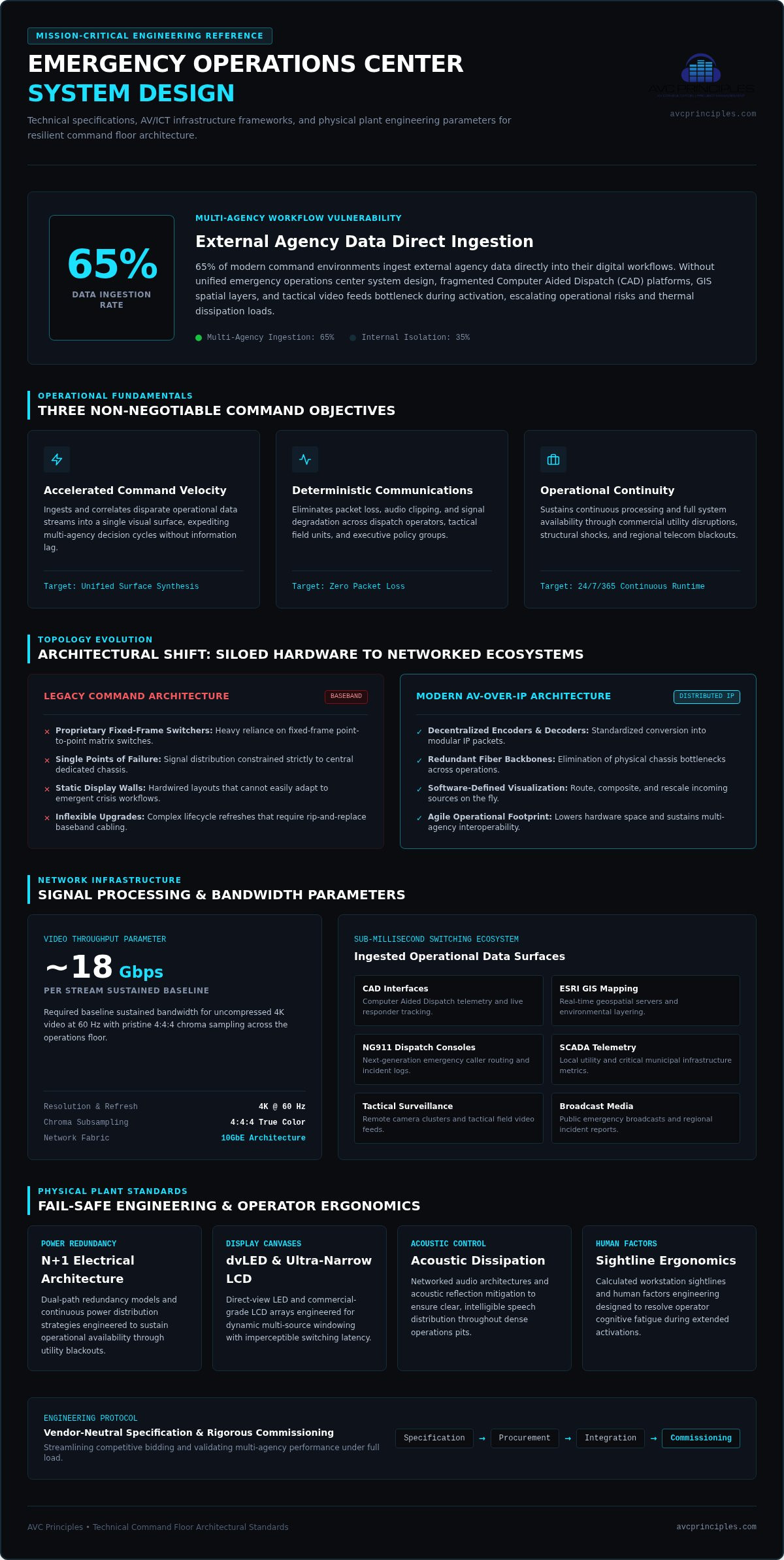
A mission-critical facility’s operational integrity isn’t proven during routine briefings; it breaks the moment fragmented CAD platforms, GIS layers, and tactical surveillance streams bottleneck during a multi-agency activation. With 65% of modern command environments now ingesting external agency data directly into their digital workflows, legacy hardware and unmitigated thermal dissipation risks quickly paralyze operational response. Eliminating these points of failure demands rigorous emergency operations center system design that systematically unifies hardened physical infrastructure, low-latency AV-over-IP signal routing, and strict standards compliance.
You already understand that operational latency and system downtime aren’t survivable options when inter-agency leadership depends on a single, continuous operating picture. This technical engineering reference outlines the AV/ICT infrastructure frameworks, physical plant standards, and vendor-neutral specifications required to commission a truly resilient command floor. We’ll examine the engineering parameters for N+1 electrical redundancy, acoustic reflection control, and ergonomic workstation sightlines that resolve operator cognitive fatigue and safeguard mission continuity.
Key Takeaways
- Core engineering frameworks for standards-compliant emergency operations center system design that unify physical plant infrastructure, low-latency AV-over-IP routing, and mission-critical network backbones.
- Architectural methods for integrating high-density video wall processing and unified signal distribution to deliver an uncompromised Common Operational Picture.
- Dual-path redundancy models and continuous power distribution strategies engineered to sustain operational availability through commercial utility disruptions.
- Human factors engineering standards for spatial layouts, acoustic dissipation, and display sightlines that mitigate operator cognitive fatigue during extended activations.
- Vendor-neutral engineering specification practices that streamline competitive bidding and verify performance through rigorous technical commissioning.
Defining Emergency Operations Center System Design: Mission-Critical Foundations
Mission-critical command spaces require unyielding technical precision. At its core, emergency operations center engineering represents the deliberate convergence of structural architecture and mission-critical electronics. An effective Emergency operations center (EOC) functions as the central nervous system for crisis management, synthesizing continuous telemetry, environmental indicators, and tactical field data into a unified Common Operational Picture (COP). Comprehensive emergency operations center system design governs this integration, aligning specialized physical facilities, AV/ICT infrastructure, and survivable communications networks. Mission parameters leave no margin for tolerance. Systems must deliver 24/7/365 operational availability, multi-gigabit throughput, and near-zero-latency distribution to sustain instantaneous coordination between municipal, state, federal, and private utility stakeholders.
Core Operational Objectives in Mission-Critical Facilities
During wide-scale activations, system performance directly dictates incident outcomes. Mission-critical environments fulfill three non-negotiable operational requirements:
- Accelerated Command Velocity: Ingesting and correlating disparate operational data streams into a single visual surface accelerates multi-agency decision cycles.
- Deterministic Communications: Eliminating packet loss, audio clipping, and signal degradation across dispatch operators, tactical response units, and executive policy groups.
- Operational Continuity: Sustaining full system availability and operational processing during commercial utility drops, structural shocks, or regional telecom blackouts.
The Architectural Shift from Siloed Hardware to Networked Ecosystems
Legacy command floor designs relied on rigid, proprietary baseband infrastructure. Fixed-frame point-to-point matrix switchers created single points of failure, constrained signal distribution to dedicated chassis, and complicated lifecycle upgrades. Modern emergency operations center system design replaces these rigid topologies with distributed, standards-based AV-over-IP architectures.
Decentralized network encoders and decoders convert video and control streams into modular IP packets over redundant fiber backbones. Instead of static, hardwired wall layouts, software-defined visualization platforms allow operations teams to route, composite, and rescale incoming sources on the fly. CAD interfaces, ESRI GIS mapping servers, NG911 dispatch consoles, and remote surveillance camera clusters route dynamically across shared workspaces. This architectural transition eliminates integration bottlenecks, lowers hardware footprints, and delivers the operational agility modern crisis environments demand.
Core Subsystems in Modern EOC Technology Architecture
Mission-critical operations depend on the seamless integration of visual processing, audio routing, unified communications, and structured physical cabling. Routing uncompressed 4K video at 60 Hz with 4:4:4 chroma sampling requires a baseline sustained bandwidth of approximately 18 Gbps per stream. High-performance processing engines orchestrate dynamic multi-source windowing across central display canvases without introducing frame drops or human-perceptible lag. Concurrently, networked audio architectures ensure clear, intelligible speech distribution throughout dense operations pits. Aligning these elements into a cohesive plant topology defines the core work of comprehensive emergency operations center system design.
Ultra-Low Latency AV-over-IP Video Wall Ecosystems
Central display surfaces serve as the focal visual anchor for incident management teams. To maintain rapid situational awareness, video wall systems must ingest and present real-time GIS mapping, live tactical field feeds, broadcast media, and local SCADA telemetry side by side. Modern infrastructure employs 10GbE network fabrics to deliver sub-millisecond video switching, ensuring latency remains imperceptible during real-time operations. Hardware-based processors support fluid window presets, while commercial-grade direct-view LED (dvLED) or ultra-narrow bezel LCD arrays provide continuous 24/7 luminance uniformity. Dedicated hardware encoders at individual operator consoles enable instant desktop sharing to the central wall or breakout conference suites.
Voice Intelligibility, Conferencing, and Audio Capture
Clear vocal exchange prevents operational errors during crisis response. Dante-enabled digital signal processors (DSPs) run multi-channel acoustic echo cancellation (AEC) algorithms to manage audio from disparate soft-codec conferences and land mobile radio (LMR) bridges. Ceiling-mounted beamtracking microphone arrays capture seated or standing operators dynamically without picking up background keystroke noise or cooling fans. Furthermore, zoned tactical loudspeaker arrays provide localized dispersion, containing sound within distinct functional workgroups to prevent ambient cross-talk from polluting adjacent command teams.
Structured Cabling and Low-Voltage Network Backbone
System survivability depends on physical transport design. Facility backbones must incorporate dual-redundant fiber optic risers routed through geographically separated pathways between master telecommunications rooms and console stations, aligning with rigorous DoD Emergency Operations Center Planning and Design criteria. Horizontal distribution utilizes Category 6A shielded twisted pair (STP) cabling to isolate high-throughput feeds from electromagnetic interference. Network engineers segment all command AV data onto physically isolated or cryptographically segregated virtual networks. For public safety agencies planning complex facility retrofits, partnering with specialists in command and control center design ensures these low-voltage and video distribution architectures meet stringent uptime standards.
Fail-Safe Infrastructure: Engineering Redundancy and Data Continuity
Resilience requires eliminating single points of failure across the entire facility footprint. In modern emergency operations center system design, software capabilities mean little if physical infrastructure drops off-line. Dual-path engineering guarantees that a severed conduit, hardware failure, or commercial utility blackout won’t disrupt ongoing command workflows. Automated environmental sensors continuously monitor rack intake temperatures, safeguarding high-density switching components against rapid thermal buildup and catastrophic hardware failure.
Primary vs. Secondary Signal Path Distribution
Mission-critical networks utilize active-active core switch fabrics configured for hitless failover in under 50 milliseconds. Data, video, and control paths must run through physically diverse conduit routes, preventing localized structural breaches from severing primary and secondary lines simultaneously. For life-safety and emergency dispatch audio, systems integrate dedicated hardwired analog bypass circuits alongside the networked audio matrix. If the packetized network infrastructure undergoes reboot or cyber containment, tactical radio and intercom traffic remains live.
Power Redundancy and Technical Grounding Architectures
Continuous operational continuity mandates dual-conversion online uninterrupted power supply (UPS) systems deployed in an N+1 topology. These units condition power continuously, buffering critical AV and ICT equipment racks during automatic transfer switch transitions between municipal utility lines and backup diesel generators. Technical clean power circuits must remain physically isolated from high-draw mechanical loads like building HVAC compressors. Furthermore, grounding systems require a dedicated, low-impedance earth electrode reference grid designed to conform with UFC 4-010-23 EOC Planning and Design baselines, shielding sensitive processors from damaging ground loops and electrical surges.
Data Isolation and Cybersecurity Protocols for External Feeds
Synthesizing multi-agency data expands external vulnerability vectors. Command architectures enforce strict physical or cryptographically verified network segmentation, preventing unauthorized transversal between public web feeds and internal CAD networks. At individual operator stations, certified secure hardware-based KVM switches allow personnel to interface with multiple security classifications from a single keyboard and mouse without bridging data pathways. Low-voltage access switches mandate IEEE 802.1X port-level authentication, immediately disabling endpoints upon unauthorized physical disconnection or device replacement.
Human Factors Engineering: Operator Ergonomics and Spatial Layout
Human-centric engineering directly reduces cognitive fatigue during prolonged multi-day crisis activations. In sustained deployments, operator performance drops when physical discomfort compounds psychological stress. Emergency operations center system design must treat the command floor as an engineered human-machine interface, calculating sightlines, decibel thresholds, and foot-candle levels with mathematical rigor. Workstation placement dictates cross-functional coordination between policy, tactical, and logistics sections, ensuring spatial layouts support rapid operational handoffs without generating floor-wide chaos.
Display Sightline Calculations and Viewing Distance Standards
Visual presentation standards rely on geometric modeling rather than arbitrary aesthetic placement. Display positioning must comply with ANSI/INFOCOMM V202.01:2016 standards for Display Image Size and Acuity, establishing defined parameters for critical visual interpretation:
- Vertical Sightline Constraints: Keep maximum vertical gaze angles below 30 degrees from the seated horizontal sightline, eliminating hyperextension of the cervical spine.
- Focal Field Alignment: Position primary analytical canvases within a 60-degree cone of vision to limit repetitive lateral head movement.
- Clear Line of Sight: Maintain an unobstructed visual path from every seated console station to the central data wall, regardless of desktop monitor height adjustments.
When mapping sightlines against structural physical limits, review technical spatial requirements with independent AV and ICT design consultants early in schematic design.
Acoustic Control and Noise Criteria Engineering
Acoustic reflections and elevated ambient decibels erode verbal comprehension, creating conditions ripe for mission error. High-throughput command centers mandate a baseline ambient background noise rating between NC-30 and NC-35. Reaching this threshold requires specialized duct silencers and isolated plenums on all mechanical air-handling distribution routes, preventing HVAC hum from masking radio communications. Additionally, wall and ceiling assemblies require acoustical materials with a minimum Sound Absorption Coefficient (SAC) of 0.75, dampening high-frequency vocal chatter across adjacent dispatch clusters.
Tactical Lighting and Console Integration
Lighting geometry directly influences ocular endurance during 12-hour operational shifts. Indirect, glare-free architectural fixtures positioned parallel to the video wall prevent specular reflections from obscuring critical GIS displays. Implementing tunable white systems that adjust correlated color temperatures (CCT) between 3000K and 5000K supports human circadian regulation during non-stop activations. Heavy-duty technical consoles must integrate dual-surface motorized height adjustment, articulated multi-axis monitor arms, and integrated cable management chains to preserve ergonomic alignment across alternating operational shifts. For facility planning teams preparing architectural bid packages, consult our team to schedule specialized command and control center design review.
The EOC Engineering Lifecycle: Specifications to Commissioning
Flawless facility delivery demands systematic lifecycle governance. Successful emergency operations center system design relies on comprehensive, vendor-neutral documentation developed well before contractor procurement begins. Retaining independent engineering oversight separates system architecture from commercial equipment distribution incentives. This boundary protects project budgets from proprietary lock-in while ensuring technical recommendations remain objective. Detailed schematic packages eliminate contractor guesswork, providing explicit engineering directives that translate operational concepts into durable physical realities.
Phased Technical Documentation and Specification Packages
Precision starts with thorough contract documentation. System architectures must be defined across exhaustive MasterFormat CSI Division 27 (Communications) and Division 28 (Electronic Safety and Security) packages. Standard deliverables include:
- Point-to-Point Schematics: Comprehensive signal-flow drawings and alphanumeric cable pull schedules governing every low-voltage pathway.
- Structural and Thermal Elevations: Scaled equipment rack profiles calculating BTU/hr heat loads, continuous power consumption, and weight distribution.
- Sequence of Operation Narratives: Explicit logic documentation detailing system automation triggers, video routing presets, and audio ducking profiles during distinct escalation phases.
Independent Commissioning and Rigorous Performance Verification
A mission-critical command space cannot be validated during an active crisis. Final operational sign-off requires staged, objective testing under simulated peak stress. Independent engineering teams conduct Factory Acceptance Testing (FAT) to inspect equipment rack assembly, cable dressing, and firmware configurations prior to job site delivery.
Following installation, extensive Site Acceptance Testing (SAT) validates core performance metrics under maximum load. Network engineers verify sub-second hitless failover across dual-core switches, measure zero packet loss on saturated AV-over-IP fabrics, and benchmark thermal stability in core telecommunications rooms. Technicians also perform digital electroacoustic calibration, validating that the Speech Transmission Index (STI) meets or exceeds 0.60 across active work zones to guarantee speech intelligibility. Facility authorities engage AVC Principles for independent technical commissioning to verify contractual compliance, benchmark mission readiness, and ensure that real-world performance matches engineered intent.
Securing Operational Continuity Through Precision Engineering
Mission-critical operations don’t leave room for infrastructural compromise. A dependable command environment unifies high-throughput AV-over-IP routing, N+1 power topologies, and ergonomic sightlines into an unyielding operational ecosystem. Achieving this standard requires disciplined emergency operations center system design that mitigates cognitive fatigue while guaranteeing hitless failover across all primary communications paths.
Translating these complex operational objectives into physical reality starts with independent technical oversight. Developing vendor-neutral engineering specifications protects capital investments, establishes clear benchmarks, and ensures transparent contractor bidding across CSI Division 27 and 28 scopes. Leveraging nationwide consulting expertise across corporate, healthcare, and government facilities, our team delivers rigorous technical commissioning covering acoustic response, signal integrity, and network survivability. Engage AVC Principles for mission-critical engineering design to ensure your command floor delivers absolute reliability when regional coordination matters most.
Frequently Asked Questions
What is the primary objective of emergency operations center system design?
The primary objective is establishing an uncompromised, zero-latency Common Operational Picture that unifies multi-agency communications, geospatial intelligence, and tactical sensor feeds. Disciplined emergency operations center system design bridges physical plant architecture and electronic infrastructure. It ensures disparate municipal, state, and private entities exchange high-throughput data continuously without bottlenecking, maintaining situational awareness under severe operational stress.
Why is AV-over-IP preferred over traditional fixed-frame matrix switchers in modern EOCs?
AV-over-IP provides virtually limitless scalability and eliminates the single chassis failure points inherent to fixed-frame matrix switchers. By packetizing video, audio, and control data across 10GbE network fabrics, modern systems route uncompressed 4K signals dynamically. Engineering teams can expand endpoints modularly without replacing core routing hardware, allowing seamless integration of dynamic software-defined windowing and remote visual feeds.
How do human factors and ergonomics impact operator effectiveness during an activation?
Ergonomic and acoustic engineering directly dictates cognitive stamina and error rates during multi-day crisis deployments. Keeping vertical display angles below 30 degrees prevents cervical spine strain, while tuned acoustic absorption dampens ambient chatter below NC-35 thresholds. Indirect lighting prevents specular reflections on video walls. These measures sustain operator visual acuity and focus when prolonged physical fatigue sets in.
What power and signal redundancy measures are required for continuous EOC readiness?
Continuous readiness mandates dual-conversion online UPS units configured in an N+1 architecture paired with physically diverse, hitless-failover signal routing. Technical power systems isolate clean equipment loads from noisy mechanical building circuits, buffering utility transitions to generator power. Concurrently, active-active network fabrics and analog audio bypass lines guarantee that physical conduit breaks don’t sever critical dispatch audio.
What role does independent technical commissioning play before facility sign-off?
Independent commissioning provides objective verification that installed AV and ICT systems perform precisely to engineered specifications under simulated peak stress. Because independent consultants don’t sell equipment, their evaluations remain free from commercial bias. Comprehensive commissioning benchmarks packet delivery, thermal dissipation, acoustic Speech Transmission Index metrics, and sub-second failover protocols before the facility handles live operations.
Can commercial off-the-shelf audio visual systems be safely deployed in mission-critical command spaces?
Standard commercial off-the-shelf equipment generally fails to meet the durability, security, and low-latency requirements of a command floor. Mission environments require 24/7 continuous-duty ratings, high MTBF metrics, deterministic switching, and strict 802.1X security compliance. Consumer and basic corporate conferencing hardware lacks thermal headroom, redundant power supplies, and predictable firmware stability, introducing unacceptable points of failure during emergency activations.