
What makes a stadium broadcast reliable is often less about the equipment list than how each system connects. Stadium broadcast system design requirements need to define the workflows and interfaces between broadcast infrastructure, venue AV, and production equipment. When those boundaries are unclear, late design changes can reveal gaps in cabling, network capacity, control, or responsibility.
It’s understandable to focus first on cameras, displays, and control rooms. But equipment alone won’t show how signals move, who owns each interface, or how production continues when a component fails. Those decisions need to align broadcasters, venue operators, integrators, and design teams before procurement and construction advance.
This guide explains how to turn broadcast use cases into coordinated technical requirements. It covers workflow planning, infrastructure, interoperability, resilience, and the project decisions to document early. You’ll also see how a clear design brief can support procurement, integration, and verification, with performance testing carried through commissioning. The result is a practical framework for shaping a stadium system around operational needs, not just a collection of equipment.
Key Takeaways
- Map each event workflow to its production, in-venue presentation, recording, and external distribution requirements.
- Trace signal paths and define how baseband or IP transport fits the venue’s workflows, interoperability needs, and support capacity.
- Apply stadium broadcast system design requirements to project-specific failure scenarios rather than relying on a generic specification.
- Build a design brief from stakeholder needs, existing-condition surveys, event scenarios, technical interfaces, and acceptance criteria.
- Plan verification, functional and interoperability testing, and operational rehearsals as distinct steps from design through commissioning.
Stadium Broadcast System Design Requirements Begin with Event Workflows
A stadium broadcast system is coordinated infrastructure for event capture, production, contribution, and distribution. Unlike general venue AV, which presents content to audiences on site, broadcast systems create and route program signals for live production and external delivery.
Start stadium broadcast system design requirements with how events are produced, not with an equipment list. A league match, concert, and community event may involve different production owners, audiences, operating positions, and service hours. Document those conditions first. They help determine which services need to be permanent, which are provided by visiting production teams, and where the systems must connect.
For events using mobile production facilities, Outside broadcasting (OB) provides useful context for how production can be staged at the venue. The design brief should clarify how venue infrastructure supports that workflow without assuming every event uses the same setup.
Which broadcast workflows must the stadium support?
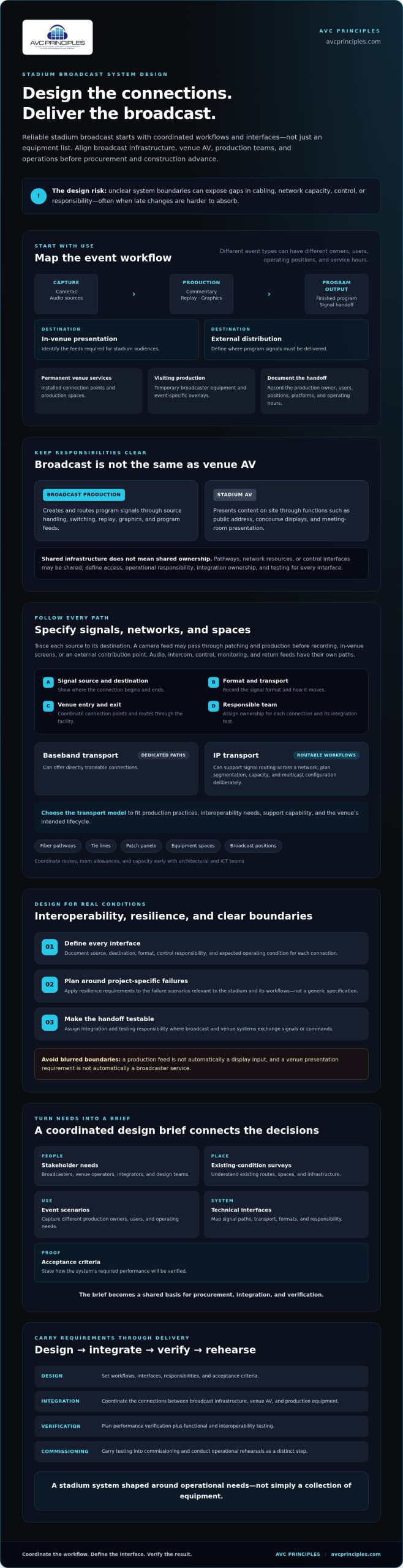
Map the path from live capture through commentary, replay, graphics, and program output to each required destination. For every event type, identify the production owner, user groups, operating positions, handoffs, audience platforms, and expected operating hours. Separate permanent venue services, such as installed connection points and production spaces, from temporary broadcaster equipment and event-specific overlays. This distinction helps teams define interfaces before procurement.
- Capture and production: Identify where cameras and audio sources connect, and who operates production positions.
- Program and delivery: Record where the finished output must go, including in-venue presentation and external distribution.
- Event overlays: Clarify which temporary systems or event-specific elements visiting teams supply and connect.
How do broadcast systems differ from stadium AV?
Broadcast production chains handle source signals, switching, replay, graphics, and program feeds. Stadium AV serves functions such as public address, concourse displays, and meeting-room presentation. Some infrastructure may be shared, including pathways, network resources, or control interfaces, but shared infrastructure does not mean shared operational responsibility. Define ownership and access for each interface.
Coordinate closely wherever broadcast and venue systems exchange signals or commands. For every connection, document the source, destination, format, control responsibility, and expected operating condition. Then assign responsibility for integration and testing. Clear boundaries reduce the risk of treating a production feed as a display input, or mistaking a venue presentation requirement for a broadcaster service. Those distinctions give design teams a coordinated basis for later technical decisions.
Core Stadium Broadcast Infrastructure: Signals, Networks, and Timing
Once event workflows are defined, trace each signal from its source to its destination. A camera feed may pass through patching and production before reaching recording, in-venue screens, or an external contribution point. Audio, intercom, control, monitoring, and return feeds follow their own paths. Document each connection, its format, where it enters and leaves the venue, and the team responsible for it.
Physical infrastructure is part of the signal design. Fiber pathways, tie lines, patch panels, equipment spaces, and broadcast positions need coordinated locations and capacity. Confirm room allowances and routes with architectural and ICT teams early. The FIFA Stadium Media & Broadcast Guidelines can inform venue planning for broadcast facilities and positions. Project teams should confirm which guidance applies to their event and facility.
How should transport and interfaces be specified?
Baseband and IP transport support different operational models. Baseband paths can offer dedicated, directly traceable connections, while IP can support routable workflows across a network. Choose between them based on production practices, interoperability, support capability, and the venue’s intended lifecycle. IP designs also require deliberate network segmentation, capacity planning, multicast configuration, and quality-of-service policies. Base these on actual signal flows and operational priorities, not generic assumptions.
SMPTE ST 2110 and AES67 are relevant examples for IP media and audio interoperability, not automatic project requirements. Dante or another audio transport approach may suit a workflow, but the design should identify required interfaces and verify applicable standards and current versions against project needs. Specify synchronization, monitoring, and fault visibility alongside transport. A signal path that works only under ideal conditions is not a complete requirement.
Signal or function
Interface and dependencies
Stakeholders to coordinate
Video
Camera connections, patching, production routing, destination format
Broadcaster, venue broadcast lead, ICT/network team
Audio and intercom
Source and return paths, audio transport, synchronization, communications
Audio team, broadcaster, venue operations
Control and monitoring
Network access, control interfaces, status visibility, operational permissions
System integrator, ICT team, production operators
Use this matrix to make ownership explicit, then expand it into a signal-flow schedule with destinations, dependencies, and acceptance checks. That documentation connects stadium broadcast system design requirements to network and room provisions that can be coordinated and tested. AVC Principles provides sports and entertainment broadcast design as part of its engineering consulting services.
Resilience, Interoperability, and the Risks a Generic Specification Misses
No single resilience specification fits every stadium. A venue hosting occasional productions with visiting broadcast teams has different operating needs from one supporting frequent events and established production operations. Stadium broadcast system design requirements should reflect event consequences, recovery procedures, available staffing, and the people responsible for maintaining each system.
Set redundancy requirements through a service-criticality analysis.
Which failure modes should design teams assess?
Review the full signal and control chain for single points of failure. Consider loss of power to production equipment, interruption of a network path, timing or synchronization faults, unavailable routing control, and failure to deliver a critical signal to its destination. A disruption to a primary program feed may have a different operational consequence from loss of a secondary monitoring view. Record those differences rather than treating every connection as equally critical.
For each scenario, agree on an operationally meaningful response with venue and broadcast stakeholders. Define what should remain available, how operators detect the fault, what recovery action they can take, and who has authority to act. Then assess resilience options against their event impact and practical demands. A duplicated path may reduce exposure to a particular fault, but it also introduces configuration, testing, and maintenance needs. Document which protections are required and which are optional, along with the risk decision behind each.
How can systems support interoperability and future change?
Interoperability depends on more than selecting compatible equipment. Specify interfaces, signal formats, naming conventions, labeling, and configuration ownership. Document how venue teams and visiting production teams access the system, where responsibility transfers, and how changes are reviewed and recorded. Without clear configuration control, an update made for one event can affect a later operation.
Assess vendor dependencies against actual workflows. Identify any interface or control function that relies on a specific manufacturer, and determine whether that dependency is acceptable for the project. Allow for planned expansion without assuming a particular future system. Maintainability also requires usable access to equipment, clear status monitoring, and current system documentation so authorized teams can diagnose faults and understand the installed configuration.
- Failure scenarios: Record the initiating fault, affected service, detection method, and recovery procedure.
- Resilience decisions: Link each protection to service criticality, operational impact, staffing, and maintenance responsibility.
- Interoperability controls: Define interfaces, configuration ownership, labeling, and change control.
Carry these decisions into integration and commissioning. Testing should verify not only that primary paths work, but also that documented recovery procedures and system interfaces perform as intended.
How to Turn Stadium Broadcast Requirements into a Design Brief
A design brief turns event needs into coordinated, reviewable project requirements. For stadium broadcast system design requirements, distinguish confirmed decisions from assumptions that broadcasters, venue operators, or project teams still need to resolve. This prevents provisional preferences from becoming fixed infrastructure before their operational purpose is clear.
What information belongs in the initial requirements brief?
Start with stakeholder discovery. Record event formats, production responsibilities, distribution destinations, access needs, and operating constraints. Then survey existing systems, planned renovations, available pathways, equipment spaces, and relevant room conditions. For each requirement, name an owner and flag unresolved assumptions for review. Independent engineering can help reconcile input from broadcast, venue AV, ICT, architecture, and operations without assigning equipment decisions to the wrong party.
Build the brief in a controlled sequence:
- Define scenarios: Describe representative events, production ownership, and required signal destinations.
- Survey conditions: Document installed infrastructure, proposed construction, pathway availability, and access constraints.
- Map interfaces: Identify where venue systems, broadcaster systems, and project disciplines exchange signals, control, or services.
- Record decisions: Assign owners, document open questions, and set review points for resolving them.
Translate these inputs into coordinated deliverables. A project-ready brief may include workflow and signal-flow diagrams, interface and equipment schedules, room and pathway requirements, performance specifications, and a risk register. Each deliverable should identify its basis, responsible discipline, and status. Clearly label items that require broadcaster confirmation, such as event-specific formats or operating arrangements, rather than presenting them as settled design criteria.
How should requirements become testable design criteria?
Give every requirement a path to verification. Link it to a drawing, specification, schedule, or interface definition, then state how the project team will confirm it during review, integration, or commissioning. For example, a required connection should identify its source, destination, responsible parties, and planned interface check. Leave numerical thresholds open until stakeholders confirm the operational need and the project team validates the criterion.
Set review and decision responsibilities across project phases. Broadcasters confirm production needs; venue operators confirm access and operational procedures; design disciplines coordinate space and infrastructure; integrators confirm implementation details. Record approvals and changes so procurement and testing use the same controlled requirements.
AVC Principles offers engineering support for developing and coordinating a stadium broadcast design brief through its broadcast design services.
From Stadium Broadcast Design to Integration, Commissioning, and Operations
Design requirements become useful only when they remain traceable through procurement, installation, integration, and commissioning. Drawings and specifications should define interfaces clearly enough for project teams to coordinate implementation and identify deviations before they affect event operations. Independent engineering helps connect documented requirements with measurable project outcomes, rather than treating design and testing as separate activities.
What should broadcast system commissioning verify?
Commissioning should use agreed acceptance criteria and include the operational representatives responsible for reviewing results. Keep four activities distinct:
- Design verification: Confirm installed work aligns with approved drawings, schedules, and specifications.
- Functional testing: Check that signal paths, control functions, timing, and monitoring perform as specified.
- Interoperability checks: Verify interfaces between broadcast, venue AV, and ICT systems using the project’s agreed workflows.
- Operational rehearsals: Have relevant operators run representative procedures, including agreed responses to faults or changes in operating state.
Test procedures should state the expected result and how it will be recorded. Log test outcomes, defects, corrective actions, retests, and stakeholder sign-off. If a requirement cannot be verified as written, resolve the criterion with the project team and operational representatives rather than relying on informal acceptance. This keeps stadium broadcast system design requirements accountable from specification through handover.
What should venue teams receive at handover?
Handover should provide a usable record of the installed system, not just a closeout package. Include current as-built drawings, equipment schedules, network records, configuration documentation, and operating procedures. Clarify system ownership, access controls, support boundaries, and escalation procedures so venue and broadcast teams know who can make changes and where to direct an issue.
Training should reflect operational roles. Operators need procedures for routine tasks and relevant fault responses; technical staff need the documentation and access required to understand system status and configuration. Where possible, schedule rehearsals before live event operations so teams can practise handoffs and confirm procedures in context.
A well-controlled handover closes the loop between intended design and operational use. It also gives future project teams a reliable baseline for changes, testing, and maintenance planning. AVC Principles provides sports and entertainment broadcast design and engineering services from concept development through commissioning. Its commissioning and testing work includes broadcast controls and network reliability. Further information is available through AVC Principles’ broadcast design services.
Build a Broadcast System Ready for the Next Event
Reliable stadium broadcasts start with defined event workflows, not an equipment list. Stadium broadcast system design requirements should connect production needs to signal paths, network and timing decisions, resilience, and clear interfaces between venue and broadcast systems.
A coordinated design brief turns those needs into documented, testable criteria. Carrying those criteria through procurement, integration, commissioning, and handover helps project teams verify system performance and prepare venue operators for their responsibilities.
AVC Principles provides sports and entertainment broadcast design, with engineering services from concept development through commissioning. Its commissioning and testing work includes broadcast controls and network reliability. To discuss coordinated requirements and measurable outcomes for your stadium project, contact AVC Principles about broadcast design.
Clear decisions made early give broadcasters, operators, and project teams a stronger basis for delivery. With a coordinated engineering framework, your venue can move forward with a shared understanding of requirements and responsibilities.
Frequently Asked Questions
What are the main requirements for a stadium broadcast system?
The main requirements are defined event workflows, complete signal paths, suitable physical and network infrastructure, interoperable interfaces, resilience matched to operational priorities, and testable acceptance criteria. Stadium broadcast system design requirements should identify who produces each event, where audio and video signals must travel, which systems are permanent or temporary, and who owns each interface. The brief should also cover operating spaces, monitoring, access, handover records, and commissioning tests.
Is there one standard for stadium broadcast system design?
No single standard defines the right design for every stadium or event. Standards and technical profiles may apply to particular workflows, signal types, or interfaces, but their suitability depends on project requirements. For example, SMPTE ST 2110 may be relevant to IP media transport, while AES67 may be relevant to audio-over-IP interoperability. Confirm the applicable standards and current versions with project stakeholders before incorporating them into specifications.
How do broadcast systems differ from stadium AV systems?
Broadcast systems capture and process sources, support production, and deliver program signals to recording, in-venue presentation, or external destinations. Stadium AV systems primarily present content to people in the venue, such as through public address, concourse displays, or meeting-room systems. The systems may share pathways or network infrastructure, but each interface needs documented signal requirements, ownership, control responsibility, and testing. Shared infrastructure should not be mistaken for shared operational responsibility.
How should a stadium broadcast network be designed for redundancy?
Start by identifying critical services and assessing how power, network paths, timing, control, or routing failures could affect them. Then agree with broadcasters and venue operators on detection, recovery actions, and acceptable service impact. Specify network redundancy only where the risk analysis supports it, and document the design, ownership, and maintenance implications. Avoid assuming a fixed level of duplication: appropriate protection depends on event needs, recovery procedures, staffing, and operational capability.
Can a stadium use IP-based video and audio systems?
Yes. A stadium can use IP-based video and audio where the workflows, network design, operational model, and support capability align. SMPTE ST 2110 and AES67 are examples that may be relevant, but neither should be assumed as a universal project requirement. The design should address synchronization, network capacity, multicast behavior, monitoring, interoperability, and configuration ownership. Confirm applicable standards, versions, and interfaces against the specific production and venue requirements.
What should be included in a stadium broadcast design brief?
A design brief should document event types, production responsibilities, signal destinations, user access, operating conditions, and existing infrastructure. Include site survey findings, room and pathway requirements, signal-flow diagrams, interface and equipment schedules, specifications, and a risk register. Assign an owner to each requirement and flag unresolved assumptions for stakeholder review. Link requirements to drawings, specifications, or verification methods, and leave numerical thresholds open until operational needs are confirmed.
How is a stadium broadcast system tested before an event?
Testing should verify the installed system against agreed project criteria. Separate design verification from functional testing of signal paths, control functions, timing, and monitoring. Check interoperability across relevant system interfaces, then rehearse operational workflows with the responsible teams. Record procedures, results, defects, corrective actions, retests, and stakeholder sign-off. Acceptance criteria should be agreed with project and operational representatives so testing reflects real event needs rather than an assumed generic specification.